
Bonuses are defined as additional financial or non-financial rewards given beyond base compensation to incentivize specific behaviors, reward performance, and strengthen loyalty among employees and customers. The case for offering them is clear: 68% of employees report that annual bonuses keep them motivated, and well-structured plans increase retention by up to 66% and productivity by 44%. For business owners and marketers, bonuses are not perks. They are precision tools for shaping behavior, closing sales, and building the kind of loyalty that compounds over time.
Why offer bonuses? The core business case
The industry term for bonus-based motivation is "incentive compensation," and it covers everything from cash performance awards to customer referral credits. The reason to offer bonuses comes down to one principle: people repeat behaviors that get rewarded. When you attach a clear, meaningful reward to a specific action, you get more of that action. Companies with strong incentive systems outperform their peers by 4.2x in financial and operational metrics. That gap is not accidental. It reflects the compounding effect of motivated teams and engaged customers working toward the same goals.
Bonuses also serve as a communication tool. When you reward a specific behavior, you signal what your business values. A referral bonus tells customers you trust word-of-mouth more than paid ads. A retention bonus tells your best employees they are worth keeping. Every bonus program sends a message, and smart business owners make sure that message is intentional.

What types of bonuses exist and how they work
Bonuses fall into two broad categories: employee incentives and customer incentives. Each type targets a different business objective.
Employee bonus types:
- Sign-on bonuses attract top talent by offsetting the risk of leaving a current role.
- Performance bonuses reward hitting measurable targets, such as revenue quotas or project milestones.
- Retention bonuses keep key staff through critical periods like mergers or product launches.
- Spot bonuses recognize exceptional one-time contributions immediately after they happen.
Customer bonus types:
- Referral bonuses reward existing customers for bringing in new ones, turning your base into a sales channel.
- Loyalty rewards give repeat buyers a reason to stay instead of switching to a lower price.
- Sales incentives push customers toward a purchase decision, often through limited-time discounts or bundled extras.
| Bonus type | Primary goal | Typical format |
|---|---|---|
| Sign-on | Talent acquisition | Cash, stock options |
| Performance | Output and results | Cash, commission |
| Retention | Reduce turnover | Deferred cash |
| Referral | Customer acquisition | Credit, cash, discount |
| Loyalty reward | Repeat purchase | Points, exclusive access |
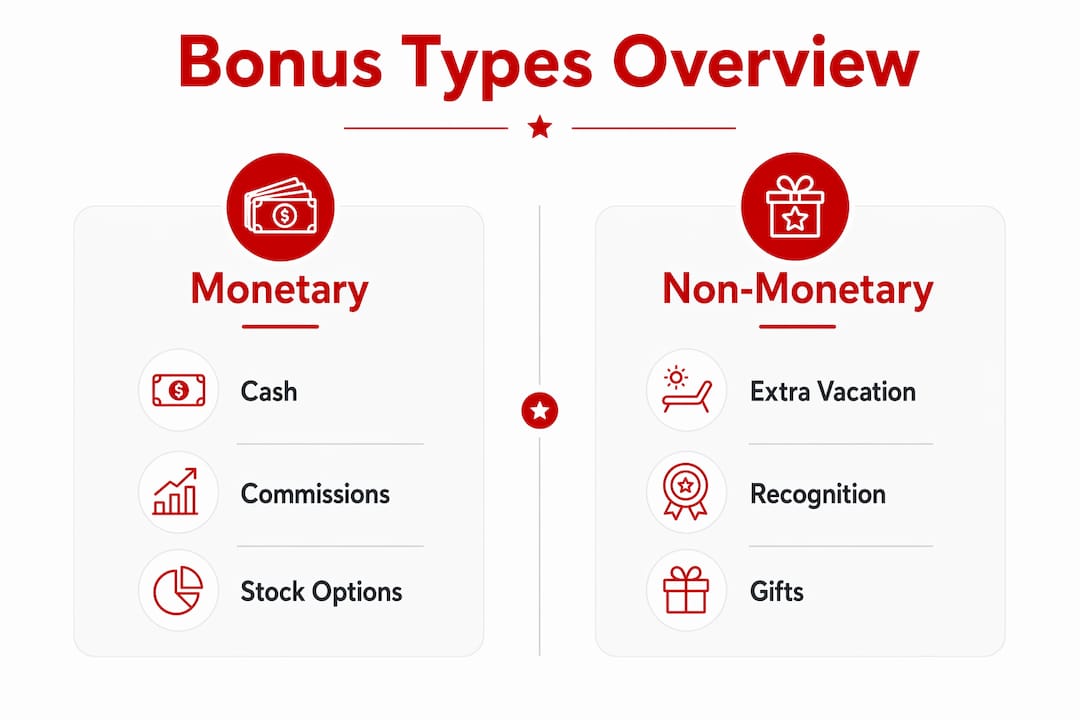
Monetary formats (cash, commissions) work well when the reward needs to feel immediate and tangible. Non-monetary formats (experiences, recognition, professional development) often carry more emotional weight and cost less per unit of motivation.
Pro Tip: Match your bonus type to your actual business goal. A retention problem calls for a retention bonus, not a performance bonus. Mismatched incentives waste money and confuse your team.
How bonuses improve motivation, retention, and performance
The psychology behind bonuses is straightforward. When people see a direct link between their effort and a reward, they repeat the effort. The key word is "direct." Vague promises of recognition do not produce the same effect as a clear, specific bonus tied to a measurable outcome.
The impact of bonuses on performance shows up most strongly when the criteria are transparent and the payout is consistent. Employees who understand exactly what they need to do to earn a bonus work with more focus. Customers who know a referral credit is waiting act on it faster. Clarity is the multiplier.
Bonuses also reduce turnover, which is one of the most expensive problems a business can face. Replacing a mid-level employee costs a significant portion of their annual salary in recruiting, onboarding, and lost productivity. A well-timed retention bonus is almost always cheaper than a replacement hire.
The risks are real, though. The biggest trap is the entitlement effect. When bonuses are paid out regardless of performance, people stop seeing them as rewards and start treating them as part of their base pay. Resetting bonus expectations annually and communicating clearly that payouts are variable prevents this drift. Unexpectedly lower bonuses cause financial stress and morale damage, so clarity in payout expectations is not optional.
Top benefits of a well-designed bonus plan:
- Increases day-to-day motivation without raising fixed payroll costs
- Reduces voluntary turnover among high performers
- Aligns individual effort with company-wide goals
- Signals organizational values through what gets rewarded
- Builds customer loyalty by rewarding repeat behavior
- Creates a measurable feedback loop between effort and outcome
Pro Tip: Transparency in bonus criteria builds trust faster than the bonus itself. Publish the rules, explain the math, and never change the goalposts mid-cycle.
Legal and organizational considerations for bonus programs
Setting up a bonus program without understanding the legal framework is a fast way to create liability. The most important distinction is between contractual and discretionary bonuses. A contractual bonus must be paid when the stated criteria are met. A discretionary bonus can be withheld at the employer's judgment. UK law under ACAS requires employers to make this distinction explicit, and employees can bring claims for unpaid contractual bonuses in tribunals or courts. American employers face similar exposure under state wage and hour laws when bonus language in offer letters or handbooks creates implied contractual obligations.
Internal equity matters just as much as legal compliance. If your team perceives the bonus criteria as unfair or inconsistent, the motivational effect reverses. People who feel the system is rigged stop trying to win it.
Financial sustainability is the third pillar. A self-funding bonus model ties payouts directly to incremental revenue or cost savings, so the program pays for itself. This prevents bonuses from becoming a fixed cost that strains cash flow during slow periods. The alternative, cutting bonuses during downturns, carries its own risk. 32% of companies cut bonuses during economic downturns, which damages morale precisely when employee support matters most.
| Bonus type | Legal status | Key implication |
|---|---|---|
| Contractual | Must be paid if criteria are met | Creates legal obligation; document carefully |
| Discretionary | Employer can withhold | Must not be applied in a discriminatory way |
| Self-funded | Tied to revenue or savings | Protects cash flow; scales with performance |
Pro Tip: Document every bonus policy in writing before you announce it. A clear written policy protects you legally and removes ambiguity that erodes trust.
Best practices for designing effective bonus plans
The most common design mistake is complexity. When employees or customers need a spreadsheet to calculate whether they earned a bonus, the motivational effect collapses. Simple, achievable bonus structures integrated with broader engagement strategies produce better results than high-pressure, high-payout schemes that create anxiety instead of focus.
Alignment is the second design principle. Every bonus should connect directly to a business goal you can measure. The SMART framework, meaning Specific, Measurable, Achievable, Relevant, and Time-bound, is the standard for setting bonus targets that motivate rather than frustrate. "Perform well" is not a target. "Close 15 qualified leads by the end of Q3" is.
Mixing individual and team-based incentives solves a common tension. Purely individual bonuses can damage collaboration. Purely team-based bonuses can mask underperformance from individuals who coast on group results. A blended structure, where part of the payout depends on personal results and part on team outcomes, rewards both accountability and cooperation. Bonus plan design sends cultural signals, and a blended model signals that both individual excellence and teamwork matter.
For marketers, bonuses integrated into a sales funnel strategy can significantly lift conversion rates at key decision points. A well-placed referral bonus at the bottom of a funnel, for example, turns a new customer into a recruiter. Understanding funnel psychology helps you place the right incentive at the right stage to maximize its effect.
Key design principles for bonus plans:
- Set one to three clear, measurable targets per bonus cycle
- Communicate criteria before the cycle begins, not after
- Use a mix of individual and team metrics to balance accountability and collaboration
- Reset expectations at the start of each new period to prevent entitlement
- Tie payout amounts to a self-funding model where possible
- Review and adjust the plan annually based on what worked and what did not
Key Takeaways
Bonuses work when they are tied to clear, measurable goals, communicated transparently, and designed to fund themselves through the performance they generate.
| Point | Details |
|---|---|
| Bonuses drive measurable results | Companies with strong incentive systems outperform peers by 4.2x in financial and operational metrics. |
| Clarity prevents entitlement | Reset expectations annually and publish criteria upfront to keep bonuses motivating rather than expected. |
| Legal distinctions matter | Contractual bonuses create legal obligations; document every policy in writing before announcing it. |
| Self-funding models protect cash flow | Tying payouts to incremental revenue or savings keeps bonus programs financially sustainable. |
| Design sends cultural signals | Blended individual and team incentives reward both personal accountability and collaboration. |
Bonuses as business strategy, not just compensation
I have watched business owners treat bonuses as an afterthought, something to hand out at the end of a good year with no structure and no clear criteria. The results are predictable. People feel grateful once, then expect it the next year, and feel punished when it does not come. That is not a bonus program. That is a liability.
The businesses I have seen get this right treat their bonus plans the way they treat their marketing. They define the goal first, then design the incentive to produce that specific behavior. They communicate the rules clearly, measure the results, and adjust the plan annually. They also understand that bonuses act like motor fuel, adding momentum to a business that already has a solid foundation. They cannot fix a broken culture or compensate for below-market base pay. When you try to use them that way, you get short-term compliance and long-term resentment.
The most underrated benefit of a well-designed bonus program is what it tells your team and your customers about how you operate. Transparency in how rewards are earned signals fairness. Consistency in paying them out signals integrity. Those two signals, repeated over time, build the kind of trust that no single bonus payment can buy on its own.
— Mike
How Moneyfunnel supports your incentive strategy
Building a bonus program that actually moves the needle requires more than good intentions. It requires a system that connects your incentives to the right audience at the right moment in their decision process.

Moneyfunnel specializes in helping business owners and marketers build sales funnel systems that integrate incentive programs directly into the customer journey. From referral bonuses that activate at the point of purchase to loyalty rewards that bring customers back through a proven funnel structure, Moneyfunnel provides the framework and mentorship to make it work. If you want to see how a single, well-built funnel can carry an entire incentive strategy, the Moneyfunnel program is the place to start.
FAQ
Why offer bonuses instead of raising base pay?
Bonuses tie compensation directly to performance, which keeps fixed payroll costs manageable while rewarding results. Base pay raises are permanent costs; bonuses scale with the outcomes they generate.
Do bonuses actually improve job satisfaction?
Yes. Research shows that 68% of employees report annual bonuses keep them motivated, with well-structured plans increasing retention by up to 66%. The key is clear criteria and consistent payout.
What is the biggest mistake in bonus program design?
Complexity is the most common failure point. When the rules are hard to follow, motivation drops. Simple, achievable targets tied to measurable goals produce better results than elaborate multi-tier structures.
Are discretionary bonuses legally risky?
Discretionary bonuses carry less legal obligation than contractual ones, but they must not be applied in a discriminatory way. Documenting your criteria and applying them consistently reduces exposure significantly.
How do bonuses fit into a marketing funnel strategy?
Bonuses placed at key funnel stages, such as referral credits at the point of purchase or loyalty rewards after a second transaction, increase conversion rates and extend customer lifetime value. Connecting incentives to affiliate income strategies amplifies this effect further.