
Most aspiring online entrepreneurs spend months chasing the wrong signals. They celebrate a viral post, obsess over follower counts, and refresh their analytics dashboard looking for validation that never translates into actual revenue. The uncomfortable truth is that likes don't pay bills, and pageviews don't scale a business. Real online business success is built on a completely different foundation: knowing your numbers, building systems that convert, and surrounding yourself with people who've already solved the problems you're still stuck on. This guide breaks down exactly what that looks like in practice.
Table of Contents
- Defining online business success: Beyond vanity metrics
- The core metrics that drive scalable online businesses
- Why simple systems and proven funnels beat complexity
- The underestimated power of mentorship and networks
- What most aspiring online entrepreneurs get wrong (and how to fix it))
- Discover proven sales funnel mentorship for faster online success
- Frequently asked questions
Key Takeaways
| Point | Details |
|---|---|
| Focus on core metrics | Tracking benchmarks like LTV:CAC and repeat purchase rate gives you a true success roadmap. |
| Start simple, iterate fast | Test basic funnels and own your email list before adding layers of complexity. |
| Mentorship accelerates growth | Having a coach or accountability network helps avoid common mistakes and speeds up results. |
| Avoid vanity metrics | Likes and followers are distractions—profit-driving KPIs lead to real growth. |
Defining online business success: Beyond vanity metrics
Now that you know success is not about popularity, let's get clear about the numbers that matter and the traps to sidestep.
When most people launch an online business, they measure progress by what's visible. How many people liked the post? How many new followers this week? How many visitors hit the homepage? These numbers feel good because they're easy to track and they go up quickly. But they tell you almost nothing about whether your business is actually healthy.
True online business success is measured by metrics that connect directly to profit, retention, and growth. According to industry benchmarks, healthy ecommerce metrics include a lifetime value to customer acquisition cost (LTV:CAC) ratio of 3:1 or higher, a repeat purchase rate above 20 to 30 percent, a contribution margin between 15 and 25 percent, an average order value (AOV) between $50 and $100, a conversion rate of 2 to 3 percent, cart abandonment under 70 percent, and a gross profit margin of 40 to 60 percent. Those are the numbers that tell you whether your business can survive and scale.
Here's a quick snapshot of what a healthy online business looks like across those benchmarks:
| Metric | Healthy benchmark | What it tells you |
|---|---|---|
| LTV:CAC ratio | 3:1 or higher | Profit per customer vs. cost to acquire |
| Repeat purchase rate | 20 to 30 percent | Customer loyalty and retention |
| Contribution margin | 15 to 25 percent | Profit after variable costs |
| Average order value | $50 to $100 | Revenue per transaction |
| Conversion rate | 2 to 3 percent | How well your funnel converts visitors |
| Cart abandonment | Under 70 percent | Checkout friction and offer strength |
| Gross profit margin | 40 to 60 percent | Overall business profitability |
One of the biggest traps new entrepreneurs fall into is building on rented land. Chasing followers on Instagram or TikTok means your audience belongs to the platform, not to you. The moment the algorithm changes or your account gets flagged, your reach disappears overnight. Owning your email list is a completely different story. Your list is an asset you control, and it consistently outperforms social media for converting subscribers into buyers.
"Avoid vanity metrics like likes and views. Focus on leading indicators that predict revenue, and test simple actions before you build complex automations." Asana research on success metrics recommends tracking 5 to 10 KPIs per team and balancing leading and lagging indicators.
Pro Tip: Before you build any automation or advanced funnel sequence, test the simplest possible version manually. Send an email by hand. Run a basic checkout page. Validate that people actually buy before you invest in complexity.
The core metrics that drive scalable online businesses
After separating meaningful metrics from noise, your next step is to measure and apply the ones that fuel real results.
Understanding which metrics matter is one thing. Knowing how to use them to make decisions is another. Here's a practical look at the six most important metrics for any online business, along with what separates a healthy number from a danger zone.
| Metric | Healthy zone | Danger zone |
|---|---|---|
| LTV:CAC ratio | 3:1 or higher | Below 2:1 |
| Repeat purchase rate | 20 to 30 percent | Under 10 percent |
| Contribution margin | 15 to 25 percent | Under 10 percent |
| AOV | $50 to $100 | Under $30 |
| Conversion rate | 2 to 3 percent | Under 1 percent |
| Cart abandonment | Under 70 percent | Over 80 percent |
| Gross profit margin | 40 to 60 percent | Under 25 percent |
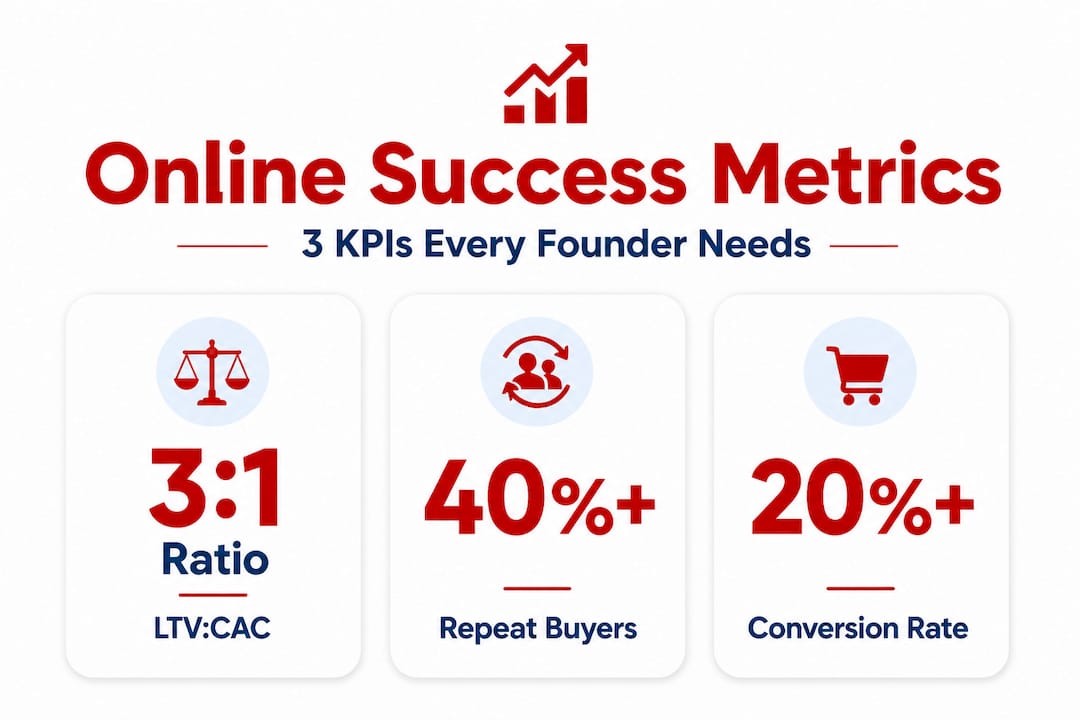
The LTV:CAC benchmark of 3:1 is the one number that separates businesses that can scale from ones that are quietly bleeding money. If you're spending $50 to acquire a customer but that customer only generates $80 in lifetime value, your margins are razor thin. You have almost no room to invest in growth, handle refunds, or weather a slow month. A 3:1 ratio means you're generating at least $150 in lifetime value for every $50 spent on acquisition. That's the cushion that allows you to reinvest confidently.
Here's a simple process to start tracking these metrics without needing advanced tools or a technical background:
- Start with your conversion rate. Use your checkout platform's built-in analytics to see how many visitors become buyers. Even a basic Shopify or ClickFunnels dashboard gives you this.
- Calculate your AOV. Divide total revenue by total number of orders for any given week. This is the fastest way to spot whether your pricing and offers are working.
- Track repeat purchase rate monthly. Look at how many customers from the previous month came back to buy again. Most email platforms make this easy to filter.
- Estimate your LTV. Multiply AOV by the average number of purchases per customer per year, then multiply by how many years a customer typically stays.
- Know your CAC. Add up all your marketing spend for a period and divide by the number of new customers acquired. Keep this under 30 percent of LTV.
- Check gross profit margin. Subtract the cost of goods and direct fulfillment from revenue, then divide by revenue. This is your real profitability signal.
Pro Tip: If you don't know your numbers on a weekly basis, you're flying blind. You cannot make reliable decisions about scaling, pricing, or offers without this data. Set aside 15 minutes every Monday to review these six metrics. That habit alone puts you ahead of 90 percent of online entrepreneurs.
Why simple systems and proven funnels beat complexity
With your metrics in place, it's time to build the systems that let you win without falling into the complexity trap.
There's a pattern that shows up constantly with new online entrepreneurs. They spend weeks researching tools, building elaborate automations, and designing multi-step sequences before they've made a single sale. They confuse activity with progress. The businesses that actually break through do the opposite. They start with the simplest possible system that can generate a sale, prove it works, and then layer in complexity only where it adds measurable value.

The most successful online businesses often start with nothing more than a two-step funnel: a landing page that captures an email address or makes a direct offer, followed by a thank-you or checkout page. That's it. No complex tech stack. No 12-email nurture sequence. Just a clear offer and a way to pay.
Here are the most common ways beginners overcomplicate their approach and stall their progress:
- Too many tools at once. Using five platforms before mastering one creates confusion and technical debt.
- Waiting for perfection. Spending months on design and copy before testing whether anyone wants the offer.
- Copying complex competitor funnels. Trying to replicate what an established brand does without understanding the economics behind it.
- Skipping the email list. Relying on social media traffic instead of building an owned asset that compounds over time.
- Ignoring the data. Making decisions based on gut feeling instead of the core metrics covered earlier.
Building your own traffic through consistent content and your own email list is the single highest-leverage activity for long-term sustainability. Platforms change. Algorithms shift. But a well-maintained email list of buyers who trust you is an asset that grows in value over time.
"Evergreen funnels need regular tweaking, not a set-and-forget approach. Healthy business economics enable scaling only when you're actively testing urgency, addressing objections, and owning your audience."
Pro Tip: Master the basic two-step funnel before adding upsells, downsells, or complex sequences. Prove the core offer converts first. Every layer you add before that is a distraction.
The underestimated power of mentorship and networks
Even the best metrics and funnels won't matter if you're building alone. Here's how mentorship redefines your path.
Solo entrepreneurship has a hidden cost that nobody talks about enough: the cost of not knowing what you don't know. You can spend six months building something that an experienced mentor could have told you in 20 minutes was unlikely to work. That's not a failure of intelligence. It's a failure of access. Most people who struggle online aren't lacking effort. They're lacking direction.
Mentorship for online business growth accelerates results in three specific ways that are hard to replicate through courses or self-study alone:
- Accountability. When you have someone checking in on your progress and holding you to commitments, you move faster. Accountability is one of the most underrated performance tools available to entrepreneurs at any level.
- Shortcuts to what's working right now. A mentor who is actively running a successful online business can tell you what's working in the current market, not what worked three years ago. That real-time insight is invaluable when you're trying to move quickly.
- Access to a network. Most breakthroughs in business come through relationships. A mentor's network becomes your network. That means faster access to tools, partnerships, traffic sources, and feedback that would take years to build independently.
Research on ecommerce success factors consistently shows that entrepreneurs who prioritize retention and profit over pure acquisition, and who leverage mentorship and community, outperform solo operators who focus only on traffic and acquisition metrics.
"The fastest path to results is not more information. It's better guidance. Successful founders consistently invest in coaching and mentorship because perspective and speed are worth more than any single tactic."
The good news is that you don't need technical expertise to benefit from mentorship. Group programs and community-based mentorship models are specifically designed for entrepreneurs who want structure, accountability, and proven systems without needing to figure everything out from scratch.
What most aspiring online entrepreneurs get wrong (and how to fix it)
After learning the fundamental strategies, it's worth questioning why so many still struggle and how you can avoid these traps.
Here's what we've observed after working with hundreds of aspiring online entrepreneurs: the biggest obstacle is almost never technical. It's psychological. Most new founders spend their early months copying what successful brands look like on the outside, focusing on polished branding, high follower counts, and complex funnels, while completely ignoring the core economics that make those brands actually profitable.
The second most common mistake is waiting. Waiting to feel ready. Waiting to automate everything before selling anything. Waiting for the perfect product, the perfect website, the perfect moment. The reality is that selling before you feel ready is exactly how you learn what works. Iteration beats preparation every single time.
Here are three things every successful online entrepreneur eventually learns, usually the hard way:
- Your numbers are your compass. You can't navigate without them, and the sooner you start tracking the core metrics, the sooner you stop making expensive guesses.
- Simple sells. Complicated funnels, confusing offers, and cluttered pages kill conversions. The cleaner and clearer your offer, the better it converts.
- Community accelerates everything. The entrepreneurs who grow fastest are almost never working alone. They're plugged into networks where how real mentorship changes outcomes becomes visible in real time through the results of people around them.
"If you're doing it right, your core numbers will tell you the truth before your bank balance does."
The entrepreneurs who break through fastest are the ones who stop trying to look successful and start measuring whether they actually are. That shift in focus, from optics to economics, is the single most important mindset change you can make.
Discover proven sales funnel mentorship for faster online success
To put these principles into practice and avoid going it alone, here's where to find mentorship that delivers results.
You now have a clear picture of what online business success actually looks like: the metrics that matter, the systems that convert, and the mentorship that accelerates everything. The next step is applying it without wasting months figuring it out alone.
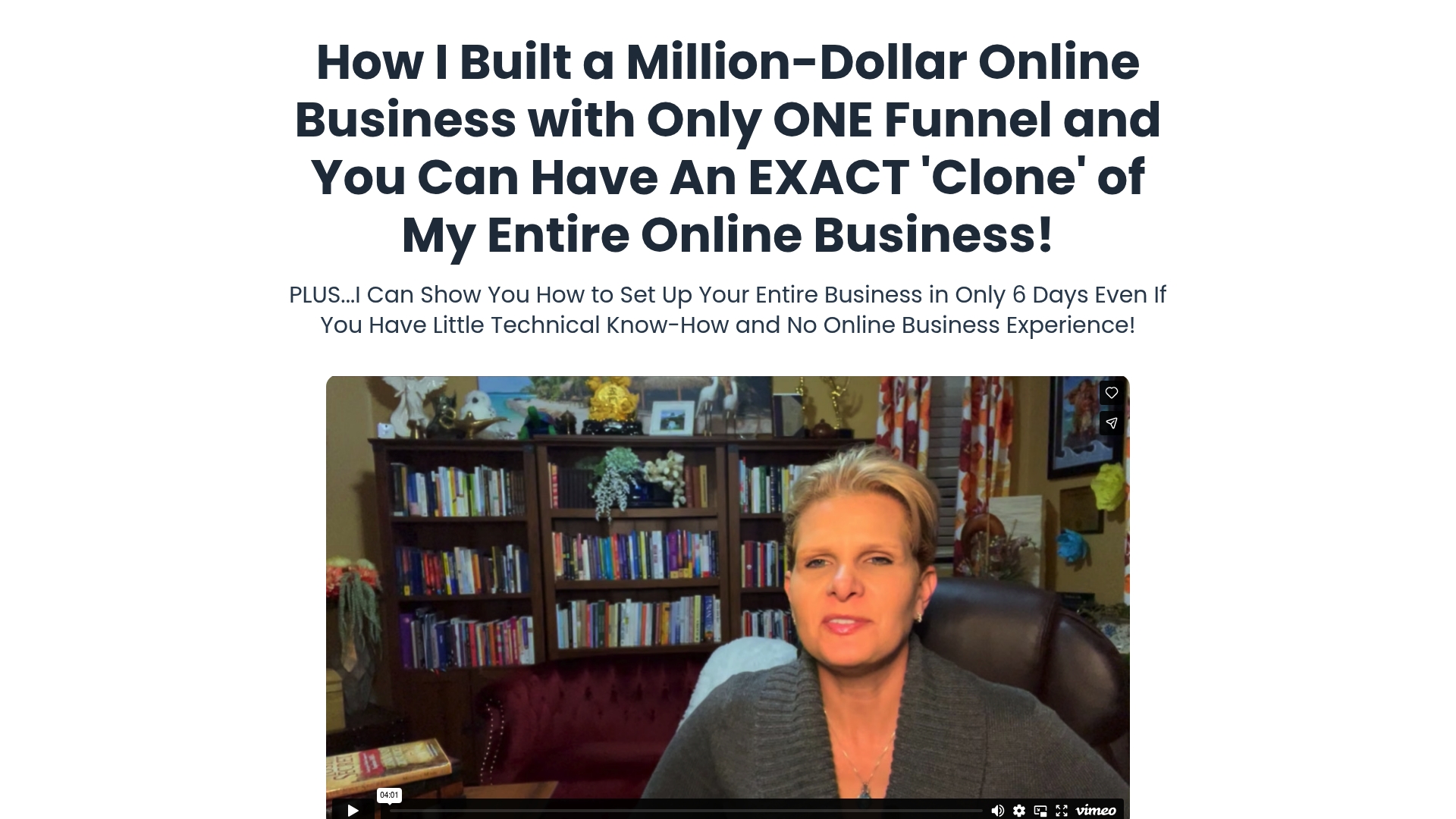
If you're ready to move from understanding these principles to actually building a business around them, step-by-step sales funnel mentorship is the fastest path forward. The program is built specifically for action-takers who want real results without tech overwhelm, offering a six-day structured mentorship experience grounded in the same funnel system used to generate $10 million in a single funnel. No guesswork. No complex tech. Just a proven system with experienced guidance and a community of entrepreneurs moving in the same direction.
Frequently asked questions
What is the most important metric for online business success?
The LTV to CAC ratio is the single most critical number to track. Aiming for a 3:1 LTV:CAC ratio or higher ensures your business is profitable enough to scale without running out of cash.
How can I avoid wasting time on vanity metrics?
Shift your focus to actionable KPIs like conversion rate, AOV, and repeat purchase rate. Avoiding vanity metrics like likes and views and concentrating on leading indicators keeps your energy on what actually drives revenue.
Is technical expertise required to build a successful online business?
No technical background is needed to get started. Avoiding overcomplication by starting with a simple funnel and leveraging mentorship allows you to make real progress quickly without advanced tech skills.
Why does mentorship matter for online business success?
Mentorship shortens the learning curve dramatically by providing accountability, real-world guidance, and access to proven systems. Mentorship over solo effort consistently produces faster results because you're learning from experience, not just trial and error.