
You spent three weeks building a website. You picked the perfect colors, agonized over fonts, and wrote product descriptions you were proud of. Then you launched and heard nothing. Zero sales. Zero visitors. That experience stops more aspiring entrepreneurs than any technical barrier ever could. The good news is that failure almost always comes from starting in the wrong order, not from a lack of talent or effort. This guide walks you through the exact steps to validate, set up, and market your online business fast, even if you have no technical background and no idea where to begin.
Table of Contents
- What you need before you start
- Validate your idea the fast way
- Set up your online business: a step-by-step manual
- Marketing your first sales: simple, smart, and sustainable
- Troubleshooting and common mistakes to avoid
- Why most online business advice sets you up to fail (and what actually works))
- Launch your online business with expert guidance
- Frequently asked questions
Key Takeaways
| Point | Details |
|---|---|
| Start with simple tools | Marketplaces and basic legal setup minimize tech headaches at launch. |
| Validate before building | Test real demand with conversations and reviews to avoid wasted effort. |
| Follow a clear execution plan | Use a step-by-step checklist for launch—from registration to first listing. |
| Focus on one channel | Build your email list and prioritize a single marketing platform at first. |
| Learn and adapt fast | Be ready to pivot and avoid perfectionism for sustainable online business growth. |
What you need before you start
Before you write a single product description or pick a business name, you need a few foundational pieces in place. Skipping this stage is one of the fastest ways to waste money and momentum early on.
The legal side is simpler than most people think. You need to choose a business structure, with most beginners opting for a sole proprietorship or a limited liability company (LLC). Registering an LLC costs $50 to $500 depending on your state, and you can get a free Employer Identification Number (EIN) directly from IRS.gov. Once you have those, open a dedicated business bank account to keep your finances clean from day one. This matters more than most beginners realize because mixing personal and business money creates tax headaches that are hard to untangle later.
Here is a quick summary of what you need and what it costs:
| Item | Estimated cost | Time needed |
|---|---|---|
| LLC registration | $50 to $500 | 1 to 3 days |
| EIN from IRS.gov | Free | 15 minutes |
| Business bank account | Free to $15/month | 1 hour |
| Domain name | $10 to $15/year | 10 minutes |
| Email marketing tool | Free to $15/month | 30 minutes |
| Logo/branding (Canva) | Free | 1 to 2 hours |
Before you even touch those steps, gather your minimum starting assets:
- A business name (check availability at your state's secretary of state website and do a quick trademark search)
- A professional email address tied to your domain or a clean Gmail
- A clear, one-sentence description of the problem your product or service solves
Pro Tip: Resist the urge to invest in a custom website before you have your first sale. The online business launch basics that actually produce revenue start with marketplaces and simple landing pages, not elaborate custom builds that take months to finish.
Validate your idea the fast way
With your basics in hand, it's time to make sure your idea actually meets a need before building anything. This step alone separates people who launch successfully from those who spend months building something nobody wants.

The core principle is straightforward: your product or service needs to solve a real problem or address a genuine emotional pain point. People do not buy features. They buy relief, transformation, or status. A digital planner that helps anxious freelancers organize their client work sells because it addresses a specific emotional frustration, not because it has 47 pages.
Checking real demand is easier than most beginners expect. Use Google Trends to see whether search interest in your topic is growing or shrinking. Browse Reddit threads, Facebook groups, and niche forums to find the exact words people use when describing their problems. Read the one-star and three-star reviews on Amazon or Etsy for products similar to yours because those reviews tell you exactly what buyers wish was different. That is your product roadmap.
Here are three minimum validation actions you should complete before building anything:
- Talk to at least five potential buyers. Not friends who will be polite, but real strangers in your target market. Ask them what they currently use to solve the problem and what frustrates them about it.
- Check your competition. If nobody is selling something similar, that is often a warning sign, not an opportunity. Healthy competition confirms demand exists.
- Test your pricing. Share your idea in a relevant online group and ask directly what someone would pay. Vague interest does not equal willingness to spend money.
"Most first-time businesses succeed by addressing simple, specific problems rather than trying to build something for everyone."
Pro Tip: Marketplaces like Etsy, Amazon Handmade, and Gumroad often outperform your own site for early traffic because they already have millions of buyers searching daily. Use their built-in audience as your product validation guide before committing to a standalone site.
Set up your online business: a step-by-step manual
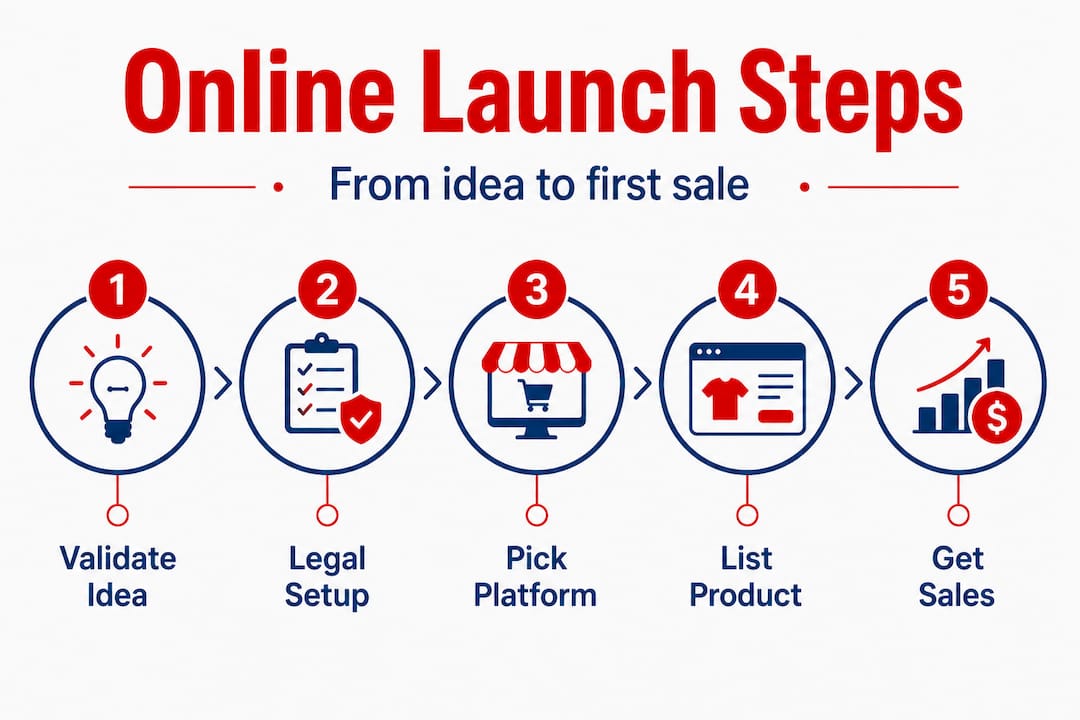
Having tested your idea, you're ready for the step-by-step execution. Follow these actions in order and resist the temptation to skip ahead.
- Finalize your business structure and register it. Even a simple sole proprietorship needs to be documented. If you want liability protection, file your LLC paperwork first.
- Get your EIN and open your business bank account. Do this before you accept a single payment. It protects you legally and makes tax time far less painful.
- Choose your platform. For most beginners, starting on a marketplace is the smartest move. Core launch steps consistently recommend platforms like Etsy, Amazon, or Shopify for beginners because they reduce the technical burden dramatically.
- Set up your email list from day one. This is non-negotiable. Use a free tool like Mailchimp or MailerLite and add a signup form to every page or listing you create. Your email list is the only audience you truly own.
- Write your first product listing. Focus on the problem it solves in the first sentence. Use clear, plain language. End with a specific call to action.
- Publish and share in one place. Do not launch on five platforms simultaneously. Pick one and go deep.
Here is a comparison to help you decide where to start:
| Factor | Marketplace (Etsy, Amazon) | Custom website (Shopify, WordPress) |
|---|---|---|
| Setup time | 1 to 2 hours | 1 to 4 weeks |
| Technical skill needed | Very low | Low to moderate |
| Built-in traffic | Yes | No |
| Monthly cost | Free to $40 | $30 to $100+ |
| Control over branding | Limited | Full |
| Best for | Beginners, physical/digital products | Established brands, scaling |
Low-technical models like marketplaces consistently outperform custom sites for beginners because you spend your energy on selling rather than on troubleshooting plugins and page builders. You can always migrate to your own site once you have consistent revenue. Check out the launching steps breakdown for a deeper look at platform selection.
Marketing your first sales: simple, smart, and sustainable
With your business live, here's how to bring in your initial customers and build early momentum without burning out or spending money on ads you do not yet understand.
The single biggest marketing mistake beginners make is trying to be everywhere at once. Pick one channel and get good at it before adding another. If your buyers hang out on Pinterest, learn Pinterest SEO. If they read email newsletters, build yours. Marketing fundamentals consistently point to SEO, email, and one social platform as the foundation for sustainable early growth.
For visuals, Canva is your best friend. It is free, beginner-friendly, and produces professional-looking graphics in minutes. Use it to create consistent product images, social posts, and email headers. Consistency in visual branding builds trust faster than any clever marketing copy.
Here are practical ways to get your first 10 sales without spending a dollar on ads:
- Email every person you know personally and tell them what you launched. Be specific about who it helps. Ask them to share it with one person who fits that description.
- Post in three to five relevant Facebook groups, Reddit communities, or Discord servers where your target buyer spends time. Lead with value, not a sales pitch.
- Optimize your marketplace listing for the platform's internal search. Use the exact words your buyers type, not industry jargon.
- Offer a limited-time introductory price to your first 10 buyers in exchange for an honest review.
- Reach out directly to five people who match your ideal customer profile and offer them a free sample or a discounted first purchase.
Pro Tip: A simple weekly email newsletter, even one that curates three useful links for your audience, builds loyalty faster than daily social posts. First sales marketing steps that stick are almost always built on email, not social media, because email audiences outperform social for long-term stability and revenue predictability.
Troubleshooting and common mistakes to avoid
Even the best guides don't guarantee a hitch-free launch. Here's what to watch out for and how to handle obstacles smartly when they show up.
The most common mistakes beginners make are not about strategy. They are about complexity and impatience. Here is what trips people up most often:
- Using overly complex tools too early. Kajabi, ClickFunnels, and advanced CRM systems are powerful but overwhelming when you have not yet made your first sale. Start with the simplest tool that gets the job done.
- Skipping validation entirely. Building a full product line before talking to a single potential buyer is the fastest path to an expensive inventory nobody wants.
- Spreading across multiple platforms at launch. Managing Etsy, your own Shopify store, Amazon, and Instagram simultaneously at launch splits your attention and produces mediocre results everywhere.
- Ignoring your email list. Social platforms change their algorithms constantly. Your email list is the only audience that cannot be taken from you overnight.
"A microbrand using free hosting tools reached a 1.9% conversion rate and a 52% profit margin by month six, proving that simple setups work when the offer and audience are right."
That result is not magic. It comes from staying focused, validating before building, and treating the email list as the business's most valuable asset. Avoiding online business mistakes early saves you months of frustration.
When something is not working, use this quick recovery checklist:
- Back up your product listings and customer data immediately so a platform change does not erase your work.
- Review your three closest competitors and identify one thing they do better than you right now.
- Survey your existing buyers or email subscribers with a single question: "What almost stopped you from buying?"
- Adjust one variable at a time, whether that is pricing, the product description, or the platform, so you can identify what actually changed your results.
Remember that 70% of startups pivot their model at least once in the first year. A pivot is not failure. It is information.
Why most online business advice sets you up to fail (and what actually works)
Here is the uncomfortable truth most business guides will not say out loud: the majority of online business advice is designed for people who already have some momentum, not for someone launching from zero. It assumes you have an audience, a budget for ads, and weeks to spend on branding before you see a dollar.
That advice actively hurts beginners. It creates the illusion that you need everything perfect before you can start. The logo, the website, the brand colors, the content calendar. By the time you finish all of that, you have invested months of effort and zero dollars of revenue, and you are emotionally exhausted before the real work begins.
What actually works is almost embarrassingly simple. Talk to real people about a real problem. Offer them something that solves it. Take their money. Then improve. That sequence, repeated consistently, is how every successful online business we have seen gets its first traction.
The businesses that survive their first year share three traits. They validated manually before spending money on tools. They built an email list from day one, which meant they owned their audience regardless of what any platform decided to do with its algorithm. And they launched something imperfect rather than waiting for perfection that never came.
Building your email list early is not just a marketing tactic. It is a business survival strategy. When you own your audience, you can pivot your product, change your platform, or shift your entire niche without starting from zero. That flexibility is what separates businesses that last from ones that disappear after one bad quarter.
The mentorship for online business that actually moves the needle is not about giving you more information. It is about helping you take the right actions in the right order, with someone accountable beside you. Launch ugly. Refine as you go. That is the only path that consistently works.
Launch your online business with expert guidance
Reading a guide is a great start, but knowing the steps and actually executing them under pressure are two very different experiences. Most beginners stall not because they lack information but because they lack structure, accountability, and someone to tell them when they are overthinking it.
The 6-Day Money Funnel Mentorship is built specifically for people who want to move from idea to first sale without getting lost in technical complexity or second-guessing every decision. The program walks you through business setup, product validation, platform selection, and your first marketing steps in a structured, day-by-day format with direct mentorship and a community of people doing the same work alongside you. If you are serious about launching and want a faster, more confident path forward, this is the resource that bridges the gap between knowing and doing.
Frequently asked questions
What is the easiest type of online business for beginners?
Marketplaces and digital products require the least technical skill and let you start selling within hours rather than weeks.
How much money do I need to legally start an online business?
LLC registration runs $50 to $500 depending on your state, but your EIN is free from IRS.gov and many hosting tools have free tiers to keep startup costs minimal.
Do I need a website or can I just use a marketplace?
Marketplaces outperform own sites for early traffic, so most beginners succeed faster starting there and adding a standalone site only after consistent revenue arrives.
What's the best way to get initial sales without ads?
Focus on one platform first, optimize your listing for its internal search, email your personal network, and post in niche communities where your ideal buyer already spends time.
How do I avoid failure if my idea doesn't sell?
Pivots are normal for 70% of startups, so treat early feedback as data, adjust one variable at a time, and always protect your email list as the one audience you fully own.