
Affiliate income growth is a measurable, repeatable outcome when you apply the right combination of organic traffic, conversion optimization, and program selection. Most affiliates focus on raw traffic numbers and miss the actual lever: commission-per-visitor. This guide covers how to grow affiliate income by targeting purchase-intent keywords, selecting high-commission programs, and using tools like Google Search Console and Conversion Rate Optimization (CRO) to extract more revenue from every page you already have. If you are new to affiliate marketing, start here.
How does organic search drive affiliate income growth?
Organic search is the foundation every serious affiliate marketer builds on. Organic search delivers 60–80% of affiliate site traffic long term. That means paid acquisition is a supplement, not a strategy.
The reason organic traffic wins on margin is simple. You pay for content once, and it compounds. A well-ranked article keeps generating clicks and commissions for years without additional spend. Paid ads stop the moment your budget does.

The keyword type matters as much as the volume. Purchase-intent keywords convert at 10 times the rate of generic informational content. A visitor searching "best project management software for freelancers" is far closer to buying than someone searching "what is project management." Target the buyer, not the browser.
Site architecture and internal linking also affect how much commission your organic traffic generates. Pages that are well-linked internally pass authority to your money pages and keep visitors moving toward conversion. Think of your site as a funnel, not a collection of isolated articles. You can see how funnel structure affects conversions in practice.
Organic vs. paid traffic: a direct comparison
| Metric | Organic Search | Paid Acquisition |
|---|---|---|
| Long-term cost | Low (content investment) | High (ongoing spend) |
| Traffic durability | Compounds over time | Stops when budget ends |
| Conversion quality | High (intent-matched) | Variable |
| Margin potential | High | Low to moderate |
| Effort to maintain | Moderate (updates) | Constant (bid management) |
The table above makes the case clearly. Organic search wins on every metric that matters for sustainable affiliate income.
Which affiliate programs actually maximize your earnings?
Program selection is where most affiliates leave money on the table. Commission rates vary widely by product category: Amazon pays roughly 4%, software companies pay 20–50% recurring, and financial products pay $50–$200 per lead. That spread is enormous. Choosing the wrong category limits your ceiling before you write a single word.
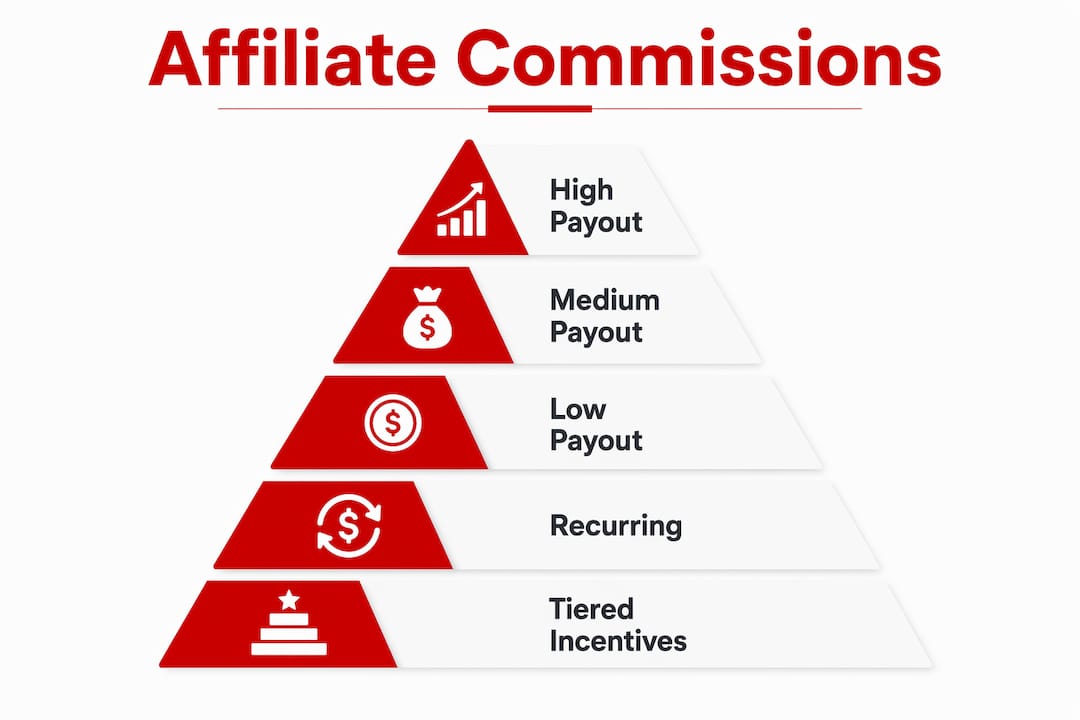
Recurring commissions are the most underrated lever in affiliate marketing. A software product paying 30% monthly means a single referral generates income for as long as that customer stays subscribed. Compare that to a one-time 4% commission on a $30 product. The math is not close.
Programs combining multiple compensation models and tiered performance incentives create stronger long-term partnerships and more predictable revenue. Look for programs that reward volume with higher rates, offer bonuses for hitting thresholds, and provide dedicated affiliate managers who actually respond.
Match your program choices to your audience's buying intent. A personal finance blog promoting a $200-per-lead mortgage refinancing offer will outperform the same blog promoting a $10 budgeting app, assuming the audience is in the right life stage. Alignment between offer and audience is the multiplier.
Affiliate commission comparison by category
| Product Type | Commission Model | Typical Payout |
|---|---|---|
| Amazon products | One-time percentage | ~4% per sale |
| SaaS / Software | Recurring percentage | 20–50% monthly |
| Financial products | Cost per lead | $50–$200 per lead |
| Online courses | One-time percentage | 30–50% per sale |
| High-ticket services | One-time flat fee | $100–$500+ per sale |
Use this table as a filter. If a program does not appear in the top two or three rows for your niche, ask whether the volume justifies the lower rate before committing content resources to it.
How can CRO tactics increase your affiliate commissions?
Conversion Rate Optimization is the fastest way to increase affiliate earnings without publishing a single new article. CRO tactics like optimized CTA placement, redesigned product boxes, and exit-intent overlays can increase commissions by 20–50% with the same traffic. One documented case showed an affiliate site grow from $4,200 to $6,150 in monthly commissions within 60 days through CRO changes alone. That is a 46% lift without touching SEO.
Here are the highest-impact CRO changes to implement first:
- Redesign product boxes. A visually distinct product summary with a clear button outperforms inline text links every time. Use a box with the product name, key benefit, rating, and a single CTA button.
- Place your first affiliate link early. Readers who reach the bottom of a 2,000-word article are rare. Your first link and CTA should appear within the first 300 words.
- Add comparison tables with embedded CTAs. Readers scanning for a decision respond to tables. Include a "Best for" column and a direct link in each row.
- Use exit-intent overlays. A well-timed overlay offering a bonus resource or discount before a visitor leaves captures conversions that would otherwise be lost.
- A/B test your headlines and CTAs. Tools like Google Optimize or VWO let you test two versions of a page element simultaneously. Even a 10% lift in CTR compounds significantly over a year.
Pro Tip: Place your first affiliate link and a clear CTA within the first 300 words of every review or comparison article. Most readers never scroll past the halfway point, so your best offer needs to appear before they leave.
Understanding funnel conversion rate mechanics gives you the framework to apply these tactics systematically rather than guessing. CRO is not a one-time fix. It is a continuous testing cycle that compounds your results over time.
How do you use google search console to keep growing?
Google Search Console (GSC) is the most underused free tool in affiliate marketing. GSC provides data to identify pages with high impressions but low click-through rates (CTR), which are your fastest wins. A page ranking in position 6 with 10,000 monthly impressions but a 1.5% CTR is leaving roughly 850 clicks per month on the table. Fix the title tag and meta description, and you can double those clicks without building a single backlink.
Here is how to work GSC into your weekly routine:
- Filter for positions 4–10. These pages already rank but are not getting clicked. They need title and meta optimization, not more content.
- Compare period over period. Track month-over-month changes in clicks and impressions to catch traffic drops before they become revenue drops.
- Check mobile usability reports. A page with poor mobile UX loses conversions at the device level before your CRO tactics even get a chance to work.
- Monitor Core Web Vitals. Slow pages rank lower and convert worse. GSC flags pages with poor loading performance directly.
Search Console data also reveals influence beyond last-click attribution, showing you which pages assist conversions even when they are not the final click. That insight changes how you prioritize content updates.
Pro Tip: Export your GSC data monthly into a spreadsheet and sort by impressions descending. The pages with the highest impressions and lowest CTR are your priority optimization list. Work through them systematically, not randomly.
What systems do you need to scale affiliate earnings long term?
Growth plateaus are almost never caused by a lack of content ideas. Operating limits in content volume and site management impose growth ceilings, and the solution is systems, not more hustle. When you hit a plateau, the bottleneck is usually your own capacity.
The affiliates who scale past $10,000 per month share one habit: they measure revenue per article, not total page views. Affiliate marketing revenue follows an 80/20 pattern, where 20% of articles generate 80% of commissions. Identifying those top performers and doubling down on them is more effective than publishing 20 new articles on untested topics.
Practical systems that support scaling include:
- Standard Operating Procedures (SOPs) for content. Document your keyword research, outline, writing, and publishing process so a contractor can replicate it.
- Revenue-per-article tracking. Connect your affiliate dashboard data to a spreadsheet and calculate monthly commission per published article. Update it quarterly.
- Email list building. Email marketing can generate 30–50% of total affiliate revenue despite representing a small share of traffic. An email list is an asset you own, unlike search rankings.
- Long-term program partnerships. Sustained relationship building with affiliate managers yields better commission rates, early access to promotions, and custom deals unavailable to casual affiliates.
Tracking commissions earned rather than clicks or views is the single most clarifying shift you can make. Vanity metrics feel productive. Commission metrics tell you what is actually working.
Key takeaways
Growing affiliate income requires combining organic SEO, high-commission program selection, CRO testing, and commission-based tracking into a single, repeatable system.
| Point | Details |
|---|---|
| Organic search is your foundation | It delivers 60–80% of long-term affiliate traffic at the highest margin of any channel. |
| Program selection sets your ceiling | Software and financial products pay 20–50x more than Amazon; choose your category deliberately. |
| CRO beats more traffic | Optimizing CTAs and page layout can lift commissions 20–50% with zero new content. |
| GSC reveals your fastest wins | Pages ranked 4–10 with low CTR are your priority; fix titles and meta to double clicks. |
| Track commissions, not clicks | Revenue-per-article analysis shows where to invest time and where to stop publishing. |
What i have learned after years of watching affiliates plateau
Most affiliates I have worked with plateau at the same point: they have decent traffic, a few programs, and no idea why income is not growing. The answer is almost always the same. They are measuring the wrong thing.
Clicks feel like progress. Commissions are progress. The moment I shifted my own tracking to revenue per article, I found that three articles were generating 70% of my income. Everything else was noise. I stopped publishing new content for 60 days and spent that time on CRO for those three pages. Income went up, not down.
The other pattern I see constantly is chasing high-traffic keywords instead of high-intent keywords. A page ranking for a 50,000-monthly-search informational term will almost always underperform a page ranking for a 2,000-monthly-search buyer keyword. The math on conversion rate makes the difference obvious once you run it.
Patience is not a soft skill in affiliate marketing. It is a competitive advantage. Most people quit before organic content compounds. The affiliates who stay consistent, track commissions honestly, and keep testing conversions are the ones who build income that actually scales. There are no shortcuts worth taking, but the process itself is not complicated. Measure what pays. Do more of that.
— Mike
Ready to build a system that grows your affiliate income?
The strategies in this article work. They also take time to implement correctly, and most people get stuck not on the concepts but on the execution. That is exactly what the 6-Day Money Funnel Mentorship at Moneyfunnel is designed to solve.

Moneyfunnel's six-day program walks you through building a proven funnel system step by step, with direct mentorship from someone who has generated $10 million with a single funnel. You get the structure, the accountability, and the specific guidance to apply what you have read here to your own affiliate business. Spots are limited. If you are serious about turning these strategies into real income, this is the next step.
FAQ
What is the fastest way to increase affiliate earnings?
Conversion Rate Optimization delivers the fastest lift. Improving CTA placement, adding comparison tables, and testing product box designs can increase commissions by 20–50% without additional traffic.
How much do affiliate programs typically pay?
Commission rates range from roughly 4% for Amazon products to 20–50% recurring for software and $50–$200 per lead for financial products. Program category is the biggest factor in your earning ceiling.
How do i use google search console for affiliate growth?
Filter for pages ranked in positions 4–10 with low CTR. Optimizing those title tags and meta descriptions can double clicks from existing impressions without new content or backlinks.
How many articles do i need to earn serious affiliate income?
Volume matters less than quality and intent. Affiliate revenue typically follows an 80/20 pattern, where 20% of articles generate 80% of commissions. Focus on fewer, better-targeted articles over mass publishing.
Does email marketing help with affiliate income?
Email marketing can generate 30–50% of total affiliate revenue despite representing a small share of site traffic. Building an owned email list reduces your dependence on search rankings alone.