
You want to know how to make money online without falling for the usual traps. The promise is everywhere: passive income, financial freedom, work from anywhere. Some of it is real. A lot of it is not. This guide cuts through the noise and gives you concrete methods that actually pay, what to watch out for before you start, and the tax rules you need to know so the IRS does not surprise you later. No hype. No vague advice. Just a clear path from zero to earning.
Table of Contents
- Key takeaways
- Before you start: avoiding scams and building the right foundation
- Proven methods to earn income online
- Managing and growing your online income
- Your tax obligations when earning online
- My honest take on what actually works
- Ready to build a real online income system?
- FAQ
Key takeaways
| Point | Details |
|---|---|
| Scams are widespread | Task scams alone caused over $220 million in losses in the first half of 2024. |
| Pick one method first | Commit 90 days to a single income method before adding others to build a real system. |
| Tax reporting starts at $400 | You must report self-employment income on Schedule C if net earnings exceed $400, even without a 1099. |
| Affiliate disclosure is required | FTC rules require disclosures placed directly next to affiliate links, not buried in footers. |
| Skills compound over time | Building digital marketing skills creates income that grows rather than income that plateaus. |
Before you start: avoiding scams and building the right foundation
Most people who fail at making money online do not fail because they picked the wrong method. They fail because they started without a plan, jumped between ideas, or got burned by a scam that looked legitimate at first glance.
The mindset piece matters more than most guides admit. Online income takes focus and patience. You will not see meaningful results in week one, and that is normal. The biggest trap is what experienced earners call "method hopping." You try freelancing for two weeks, switch to dropshipping, then pivot to surveys, and end up with nothing to show for three months of effort. Consistent focused effort over time produces far better results than scattered attempts across multiple online money-making ideas.
What you need before you begin
- A reliable internet connection and a device capable of video calls and document editing
- A PayPal or Wise account for receiving payments from international clients
- A free Google account for Docs, Sheets, and Drive to manage your work
- Basic typing speed and comfort navigating online platforms
- A separate email address dedicated to your online work
How to spot scams before they cost you money
Task scams accounted for nearly 40% of all job scam reports in the first half of 2024. These scams typically start with small, legitimate-looking payouts for simple tasks like liking videos or rating products. Then they ask you to "upgrade" your account or pay a fee to unlock your earnings. That money disappears.
The FTC is direct about this: legitimate employers never ask for money upfront or request that you return any payments. If a job offer arrives unsolicited via text or WhatsApp, it is almost certainly a scam. Research every platform on the FTC's scam database and check Reddit communities for real user experiences before signing up.
Pro Tip: Search the platform name plus "scam" or "review" on Reddit before you create an account. Real users leave detailed warnings that no review site will publish.
Proven methods to earn income online
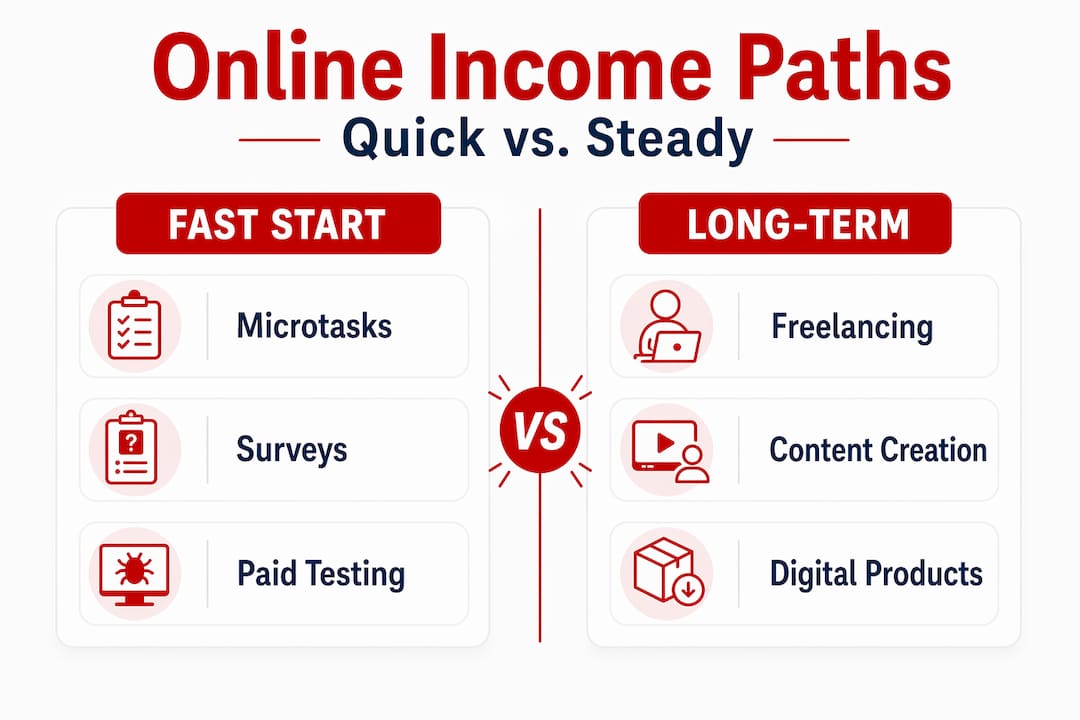
Not all online income methods are created equal. Some pay immediately but have a ceiling. Others take months to build but can scale significantly. Here is a structured look at what actually works, sorted by complexity.
Starting simple: microtasks and paid surveys
If you need money this week, microtask platforms are your fastest entry point. UserTesting pays around $10 per test, with each session running 15 to 20 minutes. Platforms like Appen and Clickworker pay for data labeling, transcription, and search evaluation tasks. Combining a few of these platforms on a weekend can realistically generate $40 to $85. It is not a full income, but it is real money with zero startup cost.
The methods ranked by earning potential
- Freelancing — Writing, graphic design, video editing, web development, and virtual assistance are the top freelance jobs right now. Platforms like Upwork and Fiverr connect you with clients globally. A beginner copywriter can earn $20 to $30 per hour within 60 days of consistent pitching.
- Affiliate marketing — You promote other companies' products and earn a commission per sale. Amazon Associates, ShareASale, and ClickBank are common starting points. Note that FTC guidelines require clear disclosures placed directly adjacent to affiliate links. Non-compliance can result in civil penalties up to $51,744 per violation.
- Selling digital products — Ebooks, Canva templates, Lightroom presets, and online courses have zero inventory cost and can generate passive income opportunities once created.
- Online tutoring and coaching — Platforms like Preply and Teachable let you monetize expertise in academic subjects, languages, fitness, or business skills.
- Remote employment — Landing a remote job with an established company is one of the most practical ways to start earning online while building digital skills that transfer to other income streams later.
The 90-day rule
Experts consistently recommend dedicating 90 days to one method before evaluating or adding another. Beginners who attempt multiple methods concurrently rarely build the systems needed to scale any of them. Pick the method that matches your current skills. Commit to it. Then expand.
Pro Tip: Set a 90-day calendar block for your chosen method and treat it like a job interview period. Track every hour worked and every dollar earned so you have real data to evaluate at the end.
| Method | Startup Cost | Time to First Payment | Scaling Potential |
|---|---|---|---|
| Microtasks/surveys | $0 | 1 to 7 days | Low |
| Freelancing | $0 to $50 | 2 to 4 weeks | Medium to High |
| Affiliate marketing | $0 to $200 | 1 to 6 months | Very High |
| Digital products | $0 to $100 | 2 to 8 weeks | High |
| Online tutoring | $0 | 1 to 2 weeks | Medium |
Managing and growing your online income
Earning your first dollar online is exciting. Turning it into a consistent income stream requires systems. Most beginners skip this part entirely, and that is why their income stays inconsistent.

Start by tracking every dollar. A simple Google Sheet with columns for date, platform, amount earned, and hours worked gives you real data. You will quickly see which activities pay the most per hour and which ones are wasting your time. This is the foundation of efficient systems for growth that separate part-time earners from full-time online business owners.
Tools that actually help
| Tool | Purpose | Cost |
|---|---|---|
| Wave Accounting | Income and expense tracking | Free |
| Toggl | Time tracking per project or client | Free |
| Notion | Project and client management | Free tier available |
| Canva | Creating digital products and social content | Free tier available |
| Google Analytics | Tracking website or blog traffic | Free |
The Pomodoro technique works well for online work. Work in focused 25-minute blocks, take a 5-minute break, and repeat. It prevents the burnout that hits most people who try to grind through 8-hour sessions without structure.
Building digital marketing skills alongside your chosen income method compounds your results over time. Understanding SEO, email marketing, and basic copywriting makes you more valuable as a freelancer and more effective as an affiliate marketer or digital product seller.
Pro Tip: Reinvest your first $100 earned online into one skill-building resource directly related to your chosen method. That investment will return more than any tool subscription.
Your tax obligations when earning online
This is the section most guides skip. Do not skip it. Getting your taxes wrong on online income is one of the fastest ways to turn a profitable side hustle into a financial headache.
Here is what you need to know:
- The $400 threshold: You must file Schedule C and report self-employment income if your net earnings exceed $400 in a year, even if no platform sends you a 1099 form.
- The $600 rule for 1099-K: Starting in 2026, platforms like PayPal, Etsy, and Venmo will issue 1099-K forms for any transactions totaling over $600. This means more online earners will receive tax forms and the IRS will have a record of their income.
- Self-employment tax: Side hustlers pay 15.3% in self-employment tax on net profits, on top of regular income tax. This catches many beginners off guard.
- Deductions reduce your bill: Common deductions include your home office (if used exclusively for work), software subscriptions, advertising costs, and mileage for business-related travel.
- Quarterly estimated payments: If you expect to owe more than $1,000 in taxes for the year, the IRS expects you to pay quarterly. Missing these payments triggers penalties.
The IRS requires you to report all self-employment income above $400 net on Schedule C, regardless of whether you receive a 1099 form. Keeping separate records and a dedicated business bank account makes this process far less painful at tax time.
Open a separate checking account the moment you start earning online. Run all income and expenses through it. Your accountant will thank you, and you will have clean records if you are ever audited.
My honest take on what actually works
I have watched a lot of people approach online income the same way someone buys a lottery ticket. They pick a method based on a YouTube thumbnail, work at it for three weeks, see no results, and conclude that "it does not work." The method was never the problem.
What I have seen work, consistently, is choosing one method that matches your existing skills and staying with it long enough to get uncomfortable. Freelancing feels slow until you land your third client and realize referrals have started coming in. Affiliate marketing feels pointless until your content starts ranking and commissions appear without you doing anything that week. The income is not instant. The systems take time to build.
The tax piece is where I see smart people make expensive mistakes. They earn a few thousand dollars, spend it, and then face a tax bill they did not budget for. Set aside 25 to 30 percent of every payment you receive. Do it automatically. Treat it as money that was never yours.
One more thing: the online business success metrics that matter are not followers or views. They are revenue per hour worked and customer retention. Track those two numbers and you will always know if you are building something real.
— Mike
Ready to build a real online income system?
If this guide gave you clarity on where to start, the next step is learning how to build a system around it. Moneyfunnel's 6-Day Money Funnel Mentorship is a structured, hands-on program that walks you through building a legitimate online income system from scratch.
The program covers the exact workflows, digital marketing fundamentals, and business setup steps that help beginners avoid the trial-and-error phase that costs most people months of wasted effort. Moneyfunnel does not guarantee earnings and does not sell a business opportunity. It provides education and mentorship grounded in real experience. If you are serious about making this work, the mentorship program is worth a look. Spots are limited and the program is designed for people ready to commit, not browse.
FAQ
How much can a beginner realistically make online?
Most beginners earn $200 to $800 per month within their first 90 days using freelancing or microtask platforms, depending on hours invested. Scaling beyond that requires building systems and client relationships over time.
What is the easiest way to make money online with no experience?
Microtask platforms like UserTesting, Clickworker, and Appen require no prior experience and pay within days. They are not a full income source, but they are a practical starting point while you build skills for higher-paying methods.
Do I have to pay taxes on money I make online?
Yes. The IRS requires you to report all self-employment net income above $400 on Schedule C, and you will owe 15.3% in self-employment tax on top of regular income tax. In 2026, platforms issuing payments over $600 are required to send you a 1099-K form.
How do I know if an online job offer is a scam?
If the offer arrived unsolicited, promises high pay for minimal work, or asks you to pay any fee to access your earnings or start working, it is almost certainly a scam. Legitimate employers never ask for money upfront.
Is affiliate marketing legal and how do I disclose it properly?
Affiliate marketing is legal, but FTC rules require you to place a clear disclosure directly next to any affiliate link or endorsement. Hiding disclosures in footers or separate pages does not comply and can result in significant penalties.