
Most people who start chasing online income quickly discover that why online income grows has nothing to do with passive income fantasies or viral posts that make money while you sleep. The reality is more interesting and more attainable. Online income growth is the result of deliberate choices: building the right income models, diversifying your revenue sources, and letting systems do the heavy lifting over time. This article breaks down the real mechanics behind digital earnings growth so you can stop guessing and start building.
Table of Contents
- Key Takeaways
- Why online income grows: the model matters most
- Diversification and systems that drive growth
- Market trends fueling digital income growth today
- Practical steps for growing your income sustainably
- My honest take on online income growth
- Ready to build your online income with a proven system
- FAQ
Key Takeaways
| Point | Details |
|---|---|
| Asset-based income compounds | Digital products and memberships generate ongoing revenue from front-loaded work, unlike hourly freelancing. |
| Diversification reduces risk | Combining multiple income streams protects you from algorithm changes and platform volatility. |
| Growth takes 12 to 18 months | Most earners see meaningful recurring revenue only after sustained, consistent effort over time. |
| Owned audiences outperform follower counts | An email list with paying subscribers is a more durable business asset than any social media following. |
| Market conditions favor creators | The creator economy is valued at $313 billion in 2026, making now a strong time to build. |
Why online income grows: the model matters most
Not all online income works the same way, and that gap explains most of the difference between people who earn sporadically and those who build something durable. The single biggest distinction is between trading time for money and building assets that generate revenue independently.
Freelancing, consulting, and coaching are the most common starting points. They pay well per hour, but they stop the moment you stop working. That is active income with a hard ceiling. Recurring revenue models like subscriptions, memberships, and digital products work differently. You do most of the work once and earn from it repeatedly, which is why they are the foundation of sustainable digital income growth.
Here is what distinguishes income models that scale from those that plateau:
- Digital products (courses, templates, ebooks) require significant upfront production but can sell indefinitely with minimal updates.
- Memberships and subscriptions generate predictable monthly income that compounds as your audience grows.
- Affiliate content like SEO articles or YouTube reviews continues driving commissions for months or years after publication.
- Service-based income pays well early but scales poorly because your hours remain finite.
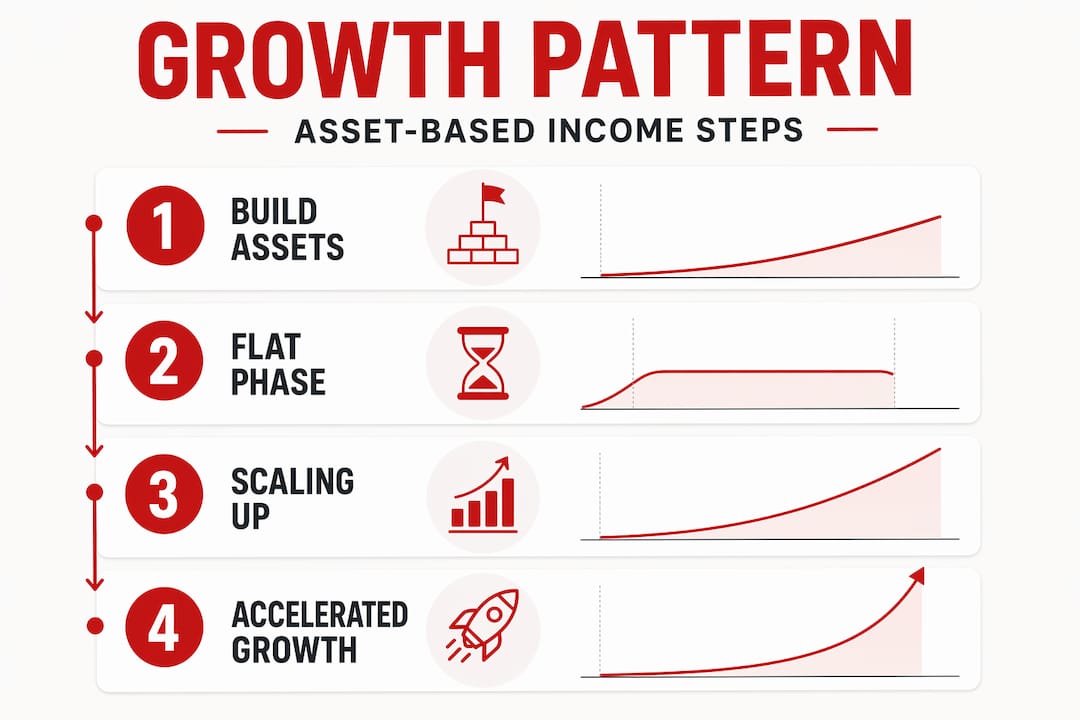
The growth pattern for asset-based income is not linear. It feels flat for months, then accelerates once the infrastructure reaches a tipping point. Most people quit before that happens.
Pro Tip: If you are starting out, do not skip service income entirely. Use it to fund your asset-building phase. Earn with your skills now, invest the time and money into products and content that will pay you later.
Diversification and systems that drive growth
Once you understand which income models scale, the next question is how to make them more resilient. The answer is diversification combined with systems that run without your constant involvement.
A single income stream, no matter how strong, carries real risk. Algorithm updates, platform policy changes, and market shifts can cut your revenue significantly overnight. Combining digital products, affiliate marketing, and memberships creates layered revenue that does not collapse from a single point of failure. This is one of the clearest reasons for online income growth among serious digital entrepreneurs.
Here is a practical sequence for building that kind of stability:
- Choose a primary channel. Start where your audience already exists, whether that is YouTube, a blog, or a newsletter, and build depth there before spreading thin.
- Add a complementary income type. If your primary channel is content, add affiliate links or a low-ticket digital product. If you consult, create a course that packages your process.
- Build your email list from day one. An email list with paying customers is a renewable business asset that no platform can take from you. It is far more valuable than 50,000 Instagram followers on a platform that changes its algorithm every quarter.
- Create systems that remove you from repetitive tasks. Use email automation, evergreen sales funnels, and scheduled content publishing so your income generation does not require daily manual effort.
- Reinvest early profits into traffic and tools. Growth accelerates when you treat early revenue as fuel, not a salary.
Pro Tip: Before adding a third income stream, make sure your second one is generating revenue consistently. Spreading across five channels too early is one of the most common mistakes new online earners make.
Learning affordable digital marketing strategies early gives you a real advantage because paid traffic and organic reach both become multipliers once your funnel is working.
Market trends fueling digital income growth today
The external environment matters. Understanding the macro trends behind the growth of digital income helps you position yourself where momentum is already building rather than swimming against the current.

The numbers are hard to ignore. The global creator economy is valued at $313 billion in 2026 with over 207 million active creators. Influencer marketing spend alone has reached $32.55 billion, and brands are generating strong returns on that investment. These are not niche numbers. They represent a structural shift in how commerce and media operate.
| Trend | What it means for you |
|---|---|
| Creator economy valued at $313B | More platforms, tools, and brand budgets are flowing toward independent creators. |
| Influencer marketing at $32.55B | Sponsorship and brand deal income is now a viable revenue stream even for mid-size audiences. |
| AI adoption at 84% among creators | Automation tools reduce production time, letting creators publish more and earn faster. |
| Shift to long-term brand deals | Ambassador relationships replace one-off sponsorships, creating more predictable revenue. |
There is one important caveat. The top 1% of creators capture 97% of platform revenue. Most creators currently earn under $5,000 annually. That disparity does not mean the opportunity is gone. It means the path to growth requires strategy, not just output volume.
"Sustainable online income grows through gradual skill acquisition and system optimization rather than quick fixes or magic systems." This framing matters because it sets realistic expectations while keeping the goal entirely achievable.
The best online business models are the ones designed around recurring revenue and owned audiences rather than platform dependency.
Practical steps for growing your income sustainably
Understanding the theory is one thing. Actually building income that grows requires a concrete approach and honest expectations about the timeline.
Most beginners realistically earn $100 to $500 in their first three months. Meaningful recurring revenue typically takes 12 to 18 months of consistent effort. That is not discouraging news. It is clarifying news. When you know the real timeline, you stop expecting results in week four and start building the compounding infrastructure that pays off in month fourteen.
Here is what separates people who break through from those who cycle through tactics:
- Invest in skill acquisition first. The online earners who grow fastest are usually those who got genuinely good at one thing: SEO writing, video editing, copywriting, or digital product creation. Skills are the multiplier on every tool and strategy.
- Pick income channels that match your strengths. If you hate being on camera, build content in formats you actually enjoy producing. Consistency requires sustainability.
- Treat your first year as a learning investment. Spend time studying your niche, testing offers, and analyzing what your audience actually pays for. This phase feels slow but sets up everything that follows.
- Avoid chasing trends and "systems" that promise shortcuts. The realistic path to online income involves applying skills systematically over time, not finding a hack that bypasses the work.
- Get mentorship or structured education. Solo trial and error is expensive in time and money. Learning from someone who has already built what you want to build compresses your timeline significantly.
Pro Tip: Track your numbers weekly from the start, even when they are tiny. Revenue, traffic, email subscribers, and conversion rates all tell you which activities are working. Most beginners fly blind for a year before looking at data seriously.
You can find a deeper breakdown of real methods that work for building sustainable income if you want to explore specific channels in detail.
My honest take on online income growth
I have spent years working alongside online entrepreneurs at every stage, from people just posting their first piece of content to those scaling past seven figures. Here is what I have actually seen, and it differs from most of what gets published on this topic.
The people who grow consistently share one trait: they build assets before they build income. They create the content library, the email list, the digital product, or the sales funnel before worrying about the revenue number. The income follows the infrastructure, not the other way around.
What I have also seen is that mindset is not just motivational fluff. The entrepreneurs who quit at month six almost always had unrealistic timelines. They expected income curves to be linear. They are not. Digital income grows exponentially once systems reach critical mass, but the early months are genuinely flat. You have to know that going in.
The hype around passive income also creates a dangerous misunderstanding. Online income requires periodic maintenance even at its most automated. Products need updating, email sequences need refreshing, and audiences need engagement. The goal is not zero work. The goal is decoupling your income from your hours so you have leverage. That distinction changes how you build and what you build toward.
Build the asset. Be patient with the timeline. Stop looking for the shortcut and start looking for the system.
— Mike
Ready to build your online income with a proven system
If this article clarified why online income grows through structure rather than luck, the next step is applying that knowledge to a real business model.
At Moneyfunnel, the focus is on exactly this: helping you build a sales funnel system that generates consistent revenue without requiring years of trial and error. The 6-day mentorship program walks you through building and activating your funnel step by step, with group mentorship so you are not figuring it out alone. The program is built for people who are serious about scaling their online business and want a structured path rather than scattered advice. Spots are limited, so if you are ready to move from learning to building, this is where that happens.
FAQ
Why does online income grow slowly at first?
Online income builds on compounding assets like content, email lists, and digital products that take months to generate traffic and trust. Most earners see significant growth only after 12 to 18 months of consistent effort.
What are the biggest factors driving online earnings growth?
Diversifying income streams, building owned audiences like email lists, and creating systems that generate revenue without constant manual work are the primary drivers of sustainable online income growth.
Is the creator economy still a good opportunity in 2026?
Yes. The creator economy is valued at $313 billion in 2026 with over 207 million active creators. The opportunity is real, but reaching meaningful income requires strategy and consistency rather than simply publishing content.
How does AI affect online income potential?
AI adoption among creators has reached 84%, primarily by reducing content production time and improving workflow efficiency. This lets creators publish more and test more offers without proportionally increasing their hours.
What is the most common reason people fail to grow their online income?
Most people fail because they chase tactics instead of building systems, expect results too quickly, and diversify before any single income stream is working consistently.