
Most online entrepreneurs hit a wall. Revenue grows for a while, then stalls, and adding more effort doesn't move the needle. If you've been grinding harder without seeing proportional results, you're dealing with a growth problem, not a scaling problem. Knowing how to scale online business means something very specific: increasing revenue faster than your costs grow. Scaling businesses can reach $200K per month with only $80K in costs, while a business that's merely growing spends nearly as much as it earns. This guide walks you through exactly how to get there.
Table of Contents
- Key takeaways
- How to scale online business: readiness first
- Building the operational engine for scale
- Marketing strategies that actually scale
- Retention, lifecycle management, and new revenue streams
- Measuring what matters and optimizing relentlessly
- My honest take on why businesses stall before they scale
- Ready to put this into action?
- FAQ
Key takeaways
| Point | Details |
|---|---|
| Scaling is not growth | Scaling multiplies revenue without proportionally increasing costs, unlike basic growth. |
| Readiness comes first | Check your LTV:CAC ratio, cash reserves, and repeatable systems before you invest in scaling. |
| Systematize before you hire | Documented workflows let new team members execute without depending on you for every decision. |
| Multi-channel marketing compounds | Combining SEO, paid ads, content, and automation creates more predictable and durable growth. |
| Retention drives compounding revenue | Repeat customers generate outsized revenue relative to their numbers, making retention a core scaling lever. |
How to scale online business: readiness first
Before you spend a dollar on ads or hire a single person, you need an honest look at whether your business is actually ready to scale. Skipping this step is one of the most expensive mistakes aspiring entrepreneurs make.
The clearest readiness signals are:
- Consistent, repeatable demand. Are customers finding you through a channel you can replicate, or was your last batch of sales a lucky streak?
- Positive unit economics. Your lifetime customer value (LTV) must meaningfully exceed your customer acquisition cost (CAC). A healthy LTV:CAC ratio indicates that scaling accelerates gains, not losses.
- CAC payback period under 12 months. If it takes you longer than a year to recoup what you spent acquiring a customer, injecting more acquisition spend will strain your cash flow.
- Operational capacity. Can your current fulfillment, support, and delivery hold up if volume doubles this month?
- Cash reserves. Scaling costs money before it pays back. You need runway.
Scaling prematurely before product-market fit and strong retention signals wastes cash and frequently leads to failure. Cohort behavior, meaning whether users return habitually, is a far better readiness indicator than total revenue or social media follower counts.
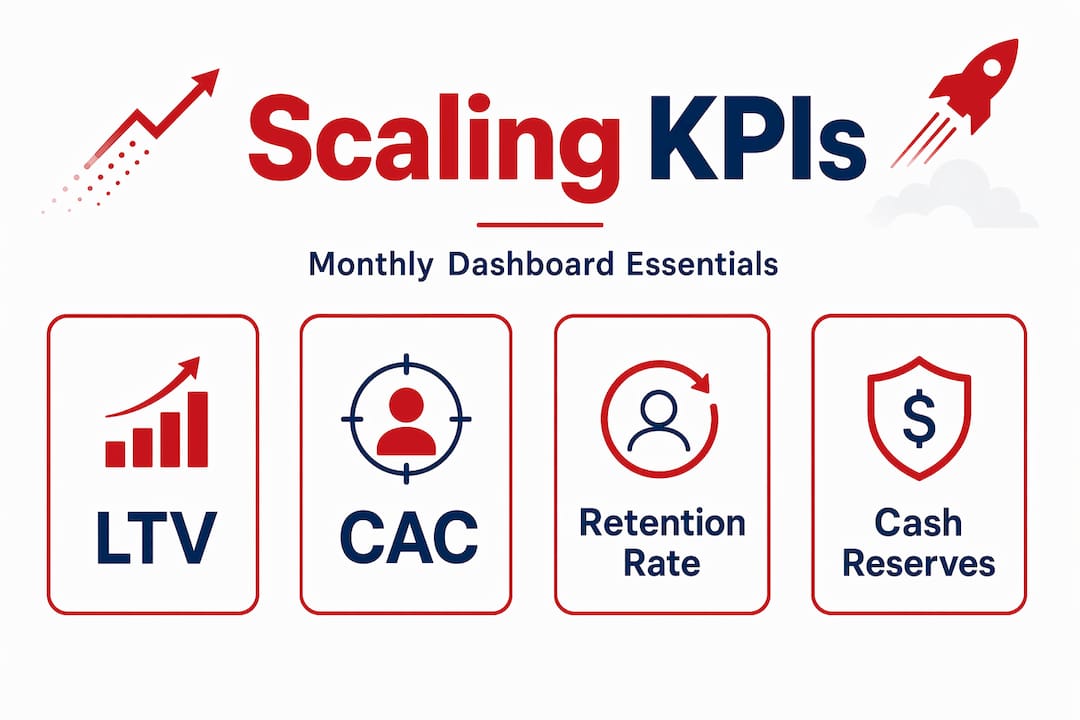
Pro Tip: Build a simple one-page dashboard that tracks LTV, CAC, gross retention rate, and cash reserves monthly before you make any scaling decision. If any of those four numbers looks shaky, fix it first.
The flip side is also real: waiting too long to scale means competitors capture the market while you hesitate. The goal is a clear-eyed assessment, not paralysis.
Building the operational engine for scale
Here's where most online businesses leave money on the table. They try to grow revenue before their internal operations can support it. The result is founder burnout, inconsistent customer experiences, and a team that can't function without constant supervision.

Most scaling failures stem from hiring before documenting workflows. Without standard operating procedures (SOPs), every new hire becomes dependent on the founder to answer basic questions. You end up busier than before you hired anyone.
The right sequence looks like this:
- Audit your highest-volume tasks using the 80/20 rule. Identify the roughly 20% of processes that drive 80% of your operational load. These are your first automation and documentation targets.
- Document before you delegate. Write out every repeatable task as a step-by-step SOP. Screen recordings work exceptionally well for software-based tasks. Tools like Loom make this fast.
- Automate what the machine can own. Order confirmations, invoice generation, email sequences, and basic reporting should not require human attention.
- Build your technology stack. At minimum, you need a CRM to manage customer data, a project management tool to track team tasks, and accounting software to monitor cash flow in real time.
- Hire after your systems are proven. Bring in people to run documented processes, not to figure out how things work alongside you.
This approach is particularly powerful for building efficient growth systems because it turns your business into something that operates independently of your daily involvement.
| Approach | Result |
|---|---|
| Hire first, document later | Founder bottleneck, inconsistent output, slow onboarding |
| Document first, then hire | Fast ramp-up, consistent execution, founder freed to lead |
| Automate before systematizing | Automation breaks frequently, hard to troubleshoot |
| Systematize first, then automate | Stable automations built on proven, repeatable steps |
Pro Tip: Treat your SOP library as a business asset. Update it quarterly and store it in a centralized tool every team member can access without asking you.
Marketing strategies that actually scale
Single-channel dependence is a scaling trap. If more than 40% of your revenue comes from one acquisition source, you have a fragile business. Diversifying across acquisition channels reduces risk and creates compounding momentum that single-channel reliance simply cannot match.
The goal is not to run every channel simultaneously. It's to build a connected system where each channel reinforces the others. Marketing must function as an integrated system of SEO, paid media, content, and automation rather than a collection of isolated tactics.
Here's how that plays out practically:
- SEO builds the foundation. Content you publish today continues acquiring customers months and years later at zero marginal cost. When you increase online sales through SEO, the economics improve over time, not worse.
- Paid channels accelerate. Once you know your CAC and LTV per channel, paid ads become a calculable investment. Spend $1, get $3 back. Scale that.
- Email automation converts and retains. A well-built sequence moves prospects to buyers and buyers to repeat customers with zero manual effort per send. Learning how to develop a marketing strategy that integrates organic and automated touchpoints is one of the highest-ROI investments you can make.
- Partnerships and subscriptions multiply reach. Affiliate programs, co-marketing with complementary brands, and subscription models create recurring, scalable acquisition streams.
With 51% of U.S. business transactions occurring online, the market opportunity for digital businesses is enormous. The constraint is rarely demand. It's the ability to reach and convert that demand profitably and repeatedly.
Pro Tip: Calculate CAC and LTV separately for each channel. This tells you exactly where to double your budget and where to cut. Most entrepreneurs treat their marketing spend as a single pool, which hides both the winners and the money pits.
You can also speed up your acquisition infrastructure by working through a funnel creation guide that maps each channel into a structured conversion path.
Retention, lifecycle management, and new revenue streams
Here's a number worth knowing: repeat customers represent about 21% of a customer base but generate roughly 44% of total revenue. That gap is the retention opportunity most entrepreneurs ignore while obsessing over new customer acquisition.
When you focus on customer lifecycle management, you shift from a leaky bucket model to a compounding one. Every dollar you spend on retention multiplies the return on your original acquisition investment.
Practical retention and expansion strategies include:
- Post-purchase email sequences that educate customers on getting maximum value from their purchase and introduce complementary offers at the right moment.
- Loyalty programs that reward repeat purchases with discounts, early access, or exclusive content. Even simple tiers drive measurable increases in purchase frequency.
- Subscription or membership models that convert one-time buyers into predictable monthly revenue. This is one of the most direct paths to online business scalability.
- Customer feedback loops that surface product gaps and feature requests before you guess your way into a new product line.
| Revenue strategy | Impact on scaling |
|---|---|
| Post-purchase sequences | Increases average order value and repeat purchase rate |
| Loyalty and referral programs | Reduces effective CAC by generating organic referrals |
| Subscription or membership tiers | Creates predictable monthly recurring revenue |
| Product line expansion (data-driven) | Increases LTV without proportionally increasing acquisition costs |
One financial discipline that compounds all of these: separate your operating cash from your scaling investment fund. Mixing them means you're always spending scaling capital on operational costs, which kills growth momentum before it starts.
Measuring what matters and optimizing relentlessly
You cannot scale what you do not measure. This sounds obvious, but most entrepreneurs either track too many vanity metrics or track nothing at all until something breaks.
The metrics that actually predict your ability to grow your online business profitably are:
- Monthly recurring revenue (MRR) and revenue growth rate. Are you moving in the right direction at the right pace?
- CAC and LTV by channel. Which acquisition paths are profitable at scale?
- Churn rate. Are you retaining customers long enough to recoup acquisition costs?
- Gross margin. Revenue growth that destroys margins is not scaling. It's regression.
- Operational metrics. Fulfillment time, support ticket volume, and error rates signal when your operations are about to break under increased load.
Revenue operations functions improve growth by 36% when teams align data infrastructure with process and strategy. You don't need a full RevOps team to capture this benefit. A weekly revenue review meeting and a monthly deep-dive into CAC, LTV, and churn will do the work for most early-stage businesses.
Pro Tip: Build your dashboard before you need it. The worst time to set up reporting is when you're in crisis mode and don't know why revenue dropped. Set it up during a calm week and you'll have early warning when something starts trending the wrong way.
A strong foundation for online business metrics and mindset makes the difference between entrepreneurs who react to problems and those who prevent them.
My honest take on why businesses stall before they scale
I've watched a lot of aspiring entrepreneurs make the same mistake. The moment revenue starts ticking up, they hire. They bring on a virtual assistant, a marketing contractor, a fulfillment person. And they do it before a single process is written down. Within three months, they're more exhausted than when they worked alone, because now they're managing people who constantly need guidance on tasks the founder never documented.
The shift that changes everything is treating your business as something you're architecting, not just operating. Viewing scaling as a foundational design decision from day one is what separates businesses that break through from those that plateau.
In my experience, the discipline to wait until your unit economics are solid, your processes are documented, and your retention signals are strong is genuinely hard to maintain when you're excited about growth. But businesses that rush past that readiness checkpoint almost always pay for it later in wasted ad spend, high churn, and team chaos.
The entrepreneurs I've seen scale most effectively share one trait: they are relentlessly focused on measuring a small number of metrics and adapting based on what the data says, rather than chasing whichever growth tactic is trending that week. Consistency and clear-eyed measurement beat novelty every time.
— Mike
Ready to put this into action?
Understanding the strategies for online business growth is step one. Implementing them in the right sequence, with expert guidance, is what actually moves the needle.

Moneyfunnel's 6-Day Mentorship Program is built for exactly this moment. You get a structured, hands-on program focused on systematizing your marketing, building your acquisition funnels, and creating the operational foundation that supports real scaling. The program is built around the same proven systems that generated $10 million with a single funnel. It covers automation, marketing operations, and revenue scaling in a practical, step-by-step format, with group mentorship from someone who has done it. Spots are limited by design to keep the mentorship quality high. If you're serious about learning how to scale with a proven system, this is the most direct path to get there.
FAQ
What is online business scaling, exactly?
Scaling means increasing your revenue faster than your costs grow. A scaled business at $200K monthly revenue might carry only $80K in costs, while a business that's simply growing tends to spend nearly as much as it earns.
When is the right time to scale your online business?
Scale when you have consistent demand, a positive LTV:CAC ratio, strong customer retention signals, and documented operational processes. Scaling before those foundations are in place typically wastes cash and increases founder burnout.
How many marketing channels should you use to scale?
Avoid depending on any single channel for more than 40% of revenue. A connected system of SEO, paid media, email automation, and partnerships creates more durable, compounding growth than any single channel can.
Why do repeat customers matter so much for scaling?
Repeat customers make up roughly 21% of a typical customer base but drive about 44% of total revenue. Increasing retention rate directly improves LTV, which means your acquisition spend becomes more profitable at every level of scale.
What metrics should you track when scaling an online business?
Focus on monthly recurring revenue, CAC and LTV by channel, churn rate, gross margin, and core operational metrics like fulfillment time and support volume. These indicators tell you whether your scaling efforts are working before problems become crises.