
Affiliate marketing is defined as a revenue-sharing performance model where you earn commissions by promoting another company's products or services through tracked links. When a customer clicks your link and completes a qualifying action, such as a purchase, signup, or app download, you get paid. Programs like Amazon Associates and Shopify's affiliate program have made this model accessible to anyone with an audience, a website, or even a social media following. The four parties that make the system run are the affiliate, the merchant, the customer, and often an affiliate network that handles the infrastructure.
What is affiliate marketing and who does it involve?
Affiliate marketing explained at its core is a four-party system, and understanding each role tells you exactly how money moves through it.
- The affiliate (also called the publisher) is you. You create content, run ads, or build an audience, then promote a merchant's product using a unique tracking link.
- The merchant (also called the advertiser) is the company selling the product. Shopify, Amazon, and software companies like ConvertKit all run merchant-side affiliate programs.
- The customer is the person who clicks your link and takes the qualifying action. They usually pay nothing extra because of your link.
- The affiliate network is an optional but common middleman. Networks like ShareASale, CJ Affiliate, and Impact handle tracking, reporting, and payment processing between affiliates and merchants.
These four roles work together as a performance-based system. The merchant only pays when a result is delivered, which is what separates affiliate marketing from traditional advertising where you pay upfront for exposure. This makes it lower-risk for merchants and genuinely scalable for affiliates who build real audiences.
Pro Tip: When evaluating what is affiliate program worth joining, check whether the merchant uses a reputable network like Impact or CJ Affiliate. Established networks offer transparent dashboards, reliable tracking, and on-time payments.

How does affiliate marketing work step by step?
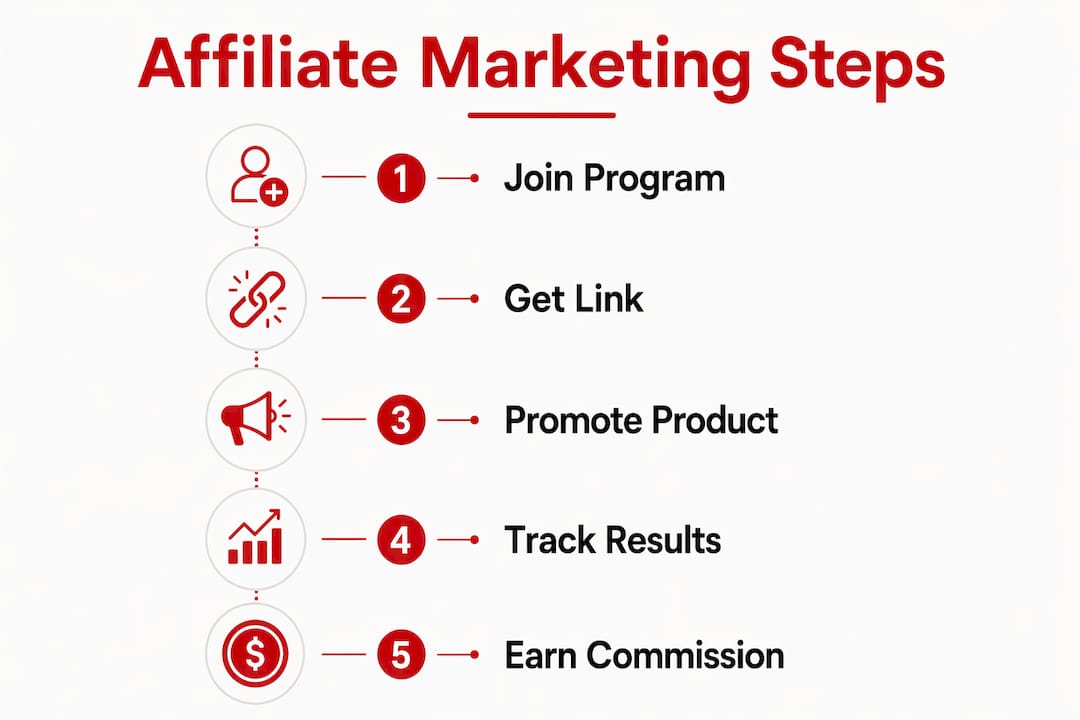
The mechanics of affiliate marketing follow a clear sequence. Understanding each step removes the mystery and shows you exactly where your effort translates into income.
- The merchant creates an affiliate program. The merchant sets commission rates, defines qualifying actions (sale, lead, download), and establishes cookie duration. Shopify's own affiliate program, for example, pays commissions on referred merchant signups.
- You join the program and receive a unique tracking link. This link contains a parameter that identifies you as the source of any traffic you send. No two affiliates share the same link.
- You publish content containing your affiliate link. This could be a product review on a blog, a YouTube tutorial, an email newsletter, or a social media post. The link is embedded naturally within that content.
- A customer clicks your link. At this moment, a tracking cookie is stored in the customer's browser. That cookie records your affiliate ID and the timestamp of the click.
- The customer completes the qualifying action. If they purchase within the cookie window, the sale is attributed to you. Cookie durations range from 24 hours (Amazon Associates) to 90 days or more on other programs.
- The merchant or network verifies the transaction and pays your commission. Payment schedules vary. Some programs pay monthly, others pay at a threshold like $50 or $100.
The cookie window is the detail most beginners overlook. A 24-hour cookie means if a customer clicks your link on Monday but buys on Wednesday, you earn nothing. A 90-day cookie gives you a much wider attribution window. Cookie duration varies widely across programs, and choosing programs with longer windows directly affects your earning potential.
Affiliate marketing is not mere link sharing. It is a performance-driven tracking system where every click, conversion, and commission is recorded with precision. That precision is what makes it a legitimate business model rather than a passive income myth.
What are the common affiliate commission structures?
Not every affiliate program pays the same way. The commission structure determines how and when you earn, and choosing the right model for your content type matters more than most beginners realize.
| Commission type | How it works | Best for |
|---|---|---|
| Pay-per-sale (PPS) | You earn a percentage or flat fee when a customer buys | Product reviewers, comparison sites |
| Pay-per-lead (PPL) | You earn when a customer submits a form or signs up | Finance, insurance, B2B software |
| Pay-per-click (PPC) | You earn per click on your affiliate link, regardless of purchase | High-traffic publishers |
| Recurring commissions | You earn monthly as long as the referred customer stays subscribed | SaaS tools, membership platforms |
Recurring commission structures require affiliates to focus on quality referrals rather than volume. If you refer someone to a software subscription and they cancel after one month, your recurring income stops. This model rewards affiliates who genuinely match products to the right customers.
Pay-per-sale is the most common structure you will encounter. Commission rates typically range from 1% for physical goods to 30% or more for digital products and software. Effective affiliate programs balance commission rates to motivate affiliates without cutting too deeply into margins. A 50% commission sounds attractive, but if the product has a high refund rate, your net earnings shrink fast.
Pro Tip: For beginners, pay-per-lead programs often convert better than pay-per-sale because the barrier for the customer is lower. A free trial signup is easier to generate than a credit card purchase.
Why are affiliate disclosures important and how to comply?
The Federal Trade Commission's Endorsement Guides require you to disclose any financial relationship with a merchant whenever you promote their products. This is not optional. FTC disclosure requirements apply to blogs, YouTube videos, social media posts, email newsletters, and any other medium where you publish affiliate links.
Clear disclosure means placing the notice where readers see it before they encounter the affiliate link. Burying a disclosure at the bottom of a 2,000-word article does not meet the "clear and conspicuous" standard the FTC expects. Best practices include:
- Place a short disclosure at the top of any page or post containing affiliate links.
- Use plain language: "This post contains affiliate links. If you buy through them, I may earn a commission at no extra cost to you."
- In video content, state the disclosure verbally and include it in the description.
- On social media, use hashtags like #ad or #sponsored in a visible position, not buried in a string of other hashtags.
Amazon Associates has its own required disclosure language that affiliates must use verbatim. Failing to comply can result in account termination, not just FTC scrutiny.
Transparent disclosures build trust beyond legal compliance. Readers who know you earn a commission are not automatically skeptical. They become skeptical when they feel deceived. Honest promotion with clear disclosures consistently outperforms hidden affiliate relationships in long-term audience retention. Compliance gaps are especially common in short-form video captions and AI-assisted content, where clear disclosure language near affiliate links is still legally required.
What beginners should know about attribution, tracking, and realistic expectations
Attribution is where affiliate marketing gets complicated, and where many beginners lose commissions they thought they had earned.
Most programs use a last-click attribution model. This means if a customer clicks your link on Monday, then clicks a competitor affiliate's link on Thursday, and buys on Friday, the competitor gets the commission. You drove the initial discovery but received nothing. Affiliate disputes over attribution are common precisely because of this mechanic. Before scaling your efforts in any program, review the attribution rules in the program dashboard. Some programs offer first-click or multi-touch attribution, which distributes credit more fairly.
"Affiliate marketing offers a lower-overhead way to monetize audiences, but it requires time and consistent effort to build traffic and meaningful income." — Coursera
This is the expectation most beginners resist. Affiliate income is not immediate. Building a blog, YouTube channel, or email list that generates consistent traffic takes months. The affiliates who earn reliably treat it as a business, not a side experiment. They review attribution rules before committing to a program, track their click-to-conversion rates, and continuously improve their content. Comparing affiliate marketing to other online business models helps you understand where it fits in a broader income strategy.
Key takeaways
Affiliate marketing succeeds when you combine precise tracking knowledge, the right commission structure, and transparent disclosure practices that build lasting audience trust.
| Point | Details |
|---|---|
| Core definition | Affiliate marketing is a performance-based model where commissions are earned through tracked qualifying actions. |
| Cookie duration matters | Programs range from 24-hour to 90-day windows; longer durations directly increase your earning potential. |
| Commission structures vary | Pay-per-sale, pay-per-lead, and recurring models each suit different content types and audiences. |
| FTC disclosure is mandatory | Clear, conspicuous disclosure of affiliate relationships is legally required and builds audience trust. |
| Attribution rules affect income | Last-click models can strip commissions; always verify program attribution terms before scaling. |
Why I think most people approach affiliate marketing backwards
Most people start with the product and work backward to an audience. They find a high-commission offer, build a site around it, and wonder why traffic never converts. The affiliates I have seen succeed consistently start with a specific audience problem and then find the product that solves it.
The trust component is not a soft skill. It is the actual mechanism that drives conversions. A reader who trusts your recommendation clicks your link with intent. A reader who feels sold to bounces. This is why building trust online is not a branding exercise but a direct revenue driver in affiliate marketing.
I also think the recurring commission model is underrated by beginners. A single referred SaaS customer paying $99 per month generates more long-term value than ten one-time product sales. The math compounds quietly in the background while you focus on new content. That compounding is what separates affiliates who plateau at a few hundred dollars per month from those who build real income.
Choose your niche based on where your genuine knowledge intersects with products that have real demand. Promote honestly, disclose clearly, and treat attribution mechanics as a business literacy requirement, not fine print. The affiliates who fail are almost always the ones who skipped the fundamentals covered in this article.
— Mike
Start your affiliate marketing journey with structured mentorship
Understanding the theory of affiliate marketing is one thing. Executing it profitably from day one is another challenge entirely.

Moneyfunnel's 6-Day Money Funnel Mentorship is designed specifically for beginners who want a structured, step-by-step path through the exact mechanics covered in this article, from setting up tracking links to choosing the right commission structures and building an audience that converts. The program draws on real experience generating $10 million through a single funnel system. It covers setup, strategy, and the attribution pitfalls that cost most beginners their early commissions. Spots are limited to maintain mentorship quality. If you are serious about building affiliate income with a proven framework behind you, this is the logical next step.
FAQ
What is affiliate marketing in simple terms?
Affiliate marketing is a performance-based model where you earn a commission by promoting another company's product or service through a unique tracking link. You get paid when a customer completes a qualifying action, such as a purchase or signup, through your link.
How does affiliate marketing work for beginners?
You join an affiliate program, receive a unique tracking link, and publish that link in your content. When a reader clicks the link and buys within the cookie window, the merchant pays you a commission based on the agreed structure.
What is an affiliate program?
An affiliate program is a merchant-run system that provides affiliates with tracking links, commission terms, and a dashboard to monitor clicks and earnings. Programs like Amazon Associates and Shopify's affiliate program are among the most widely used.
How long does it take to earn money with affiliate marketing?
Building meaningful income through affiliate marketing typically takes several months of consistent content creation and audience development. Early earnings are usually modest until traffic and trust are established.
Do I need to disclose affiliate links?
Yes. The FTC Endorsement Guides require clear and conspicuous disclosure of any financial relationship with a merchant. Disclosure must appear before the reader encounters the affiliate link, not buried at the bottom of the page.