
Most online entrepreneurs assume that hosting a webinar is enough to generate sales. They put together a solid presentation, go live, and then wonder why their revenue doesn't match their effort. The real problem isn't the webinar itself. It's the absence of a system around it. A webinar funnel is that system, and without one, you're leaving serious money on the table. In this guide, you'll learn exactly what a webinar funnel is, how each stage works, what the numbers look like, and how to avoid the mistakes that quietly kill conversions.
Table of Contents
- Understanding the basics: What is a webinar funnel?
- Key stages of a high-converting webinar funnel
- How effective are webinar funnels? Stats and benchmarks
- Common mistakes and expert tips for your first webinar funnel
- The uncomfortable truth about webinar funnels most don't tell you
- Ready to master your own high-converting webinar funnel?
- Frequently asked questions
Key Takeaways
| Point | Details |
|---|---|
| Webinar funnel definition | A webinar funnel is a series of steps that guide attendees from registration to purchase through value-driven, interactive experiences. |
| Conversion benchmarks | Average live attendance sits at 40-50%, with CTA conversions at 22% and 2-5% attendee-to-customer rates, up to 15% for top funnels. |
| Stages to success | From pre-webinar warmup to follow-ups, each funnel stage maximizes engagement and sales when executed intentionally. |
| Avoid common mistakes | Skipping warm-up or follow-up steps drastically lowers conversions—engagement features and clear value are essential. |
| Personalization wins | Webinars tailored to audience needs and delivered with interactive, real-time engagement outperform automated, generic approaches. |
Understanding the basics: What is a webinar funnel?
Now that you see why webinars alone aren't enough, let's clarify what a true webinar funnel actually is.
A webinar funnel is an automated sequence of steps that guides a prospect from first discovering your webinar all the way to becoming a paying customer. It's not just the webinar itself. It's everything before, during, and after the live event that moves people toward a buying decision. Think of it as a conveyor belt with specific stations, and your job is to make sure each station does its work.
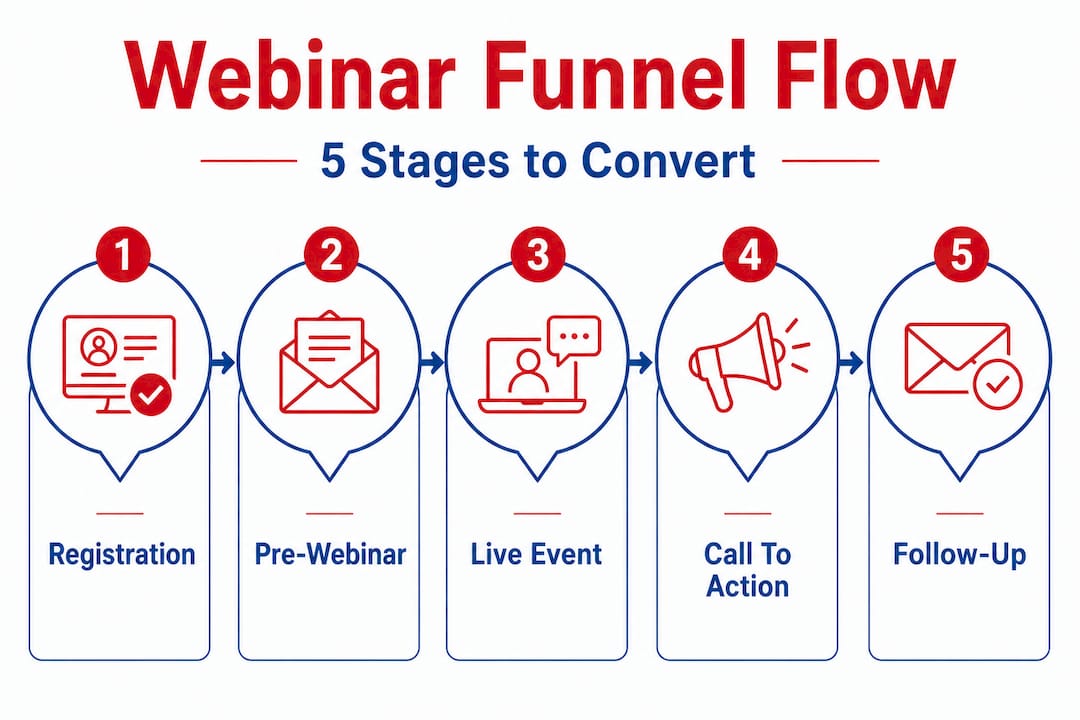
The main stages of a webinar funnel look like this:
- Registration: A prospect lands on your registration page and signs up.
- Pre-webinar engagement: You send reminder emails, warm-up content, and build anticipation.
- Live webinar: You deliver value-packed content and introduce your offer.
- Call to action (CTA): You present your product or service with a clear, compelling offer.
- Follow-up sequence: You re-engage attendees who didn't buy and reach out to no-shows.
Each stage has a specific job. Miss one and you create a gap where potential buyers fall through. The most common drop-off points are between registration and attendance, and between the CTA and the purchase. Live attendance rates average 40 to 50% in optimized funnels, which means nearly half of your registrants never even see your offer unless your follow-up sequence catches them.
"A webinar funnel is critical for moving attendees from registration to sales. Without a structured sequence, even the most valuable webinar content fails to convert consistently."
Building effective webinar funnels requires understanding that every touchpoint either builds trust or loses it. There's no neutral ground.
Key stages of a high-converting webinar funnel
With the funnel stages mapped out, let's dive into what actually drives conversions at every step.
1. Registration page and traffic source
Your registration page is the entry point. It needs one job: convince the right person to sign up. A strong headline that speaks directly to a pain point, a clear description of what they'll learn, and social proof (testimonials or attendee counts) all work together here. Traffic comes from paid ads, email lists, social media, or organic content. The source matters because cold traffic converts at a lower rate than warm traffic from your existing audience.
2. Pre-webinar email sequence
Once someone registers, the clock starts. Most people who register forget about the webinar within 24 hours. A strong pre-webinar sequence sends at least three emails: a confirmation with calendar link, a reminder 24 hours before, and a final reminder one hour before the event. These emails also serve as a warm-up. Share a quick win, a relevant story, or a teaser of what you'll cover. This builds anticipation and increases the likelihood they actually show up.
3. Live webinar delivery
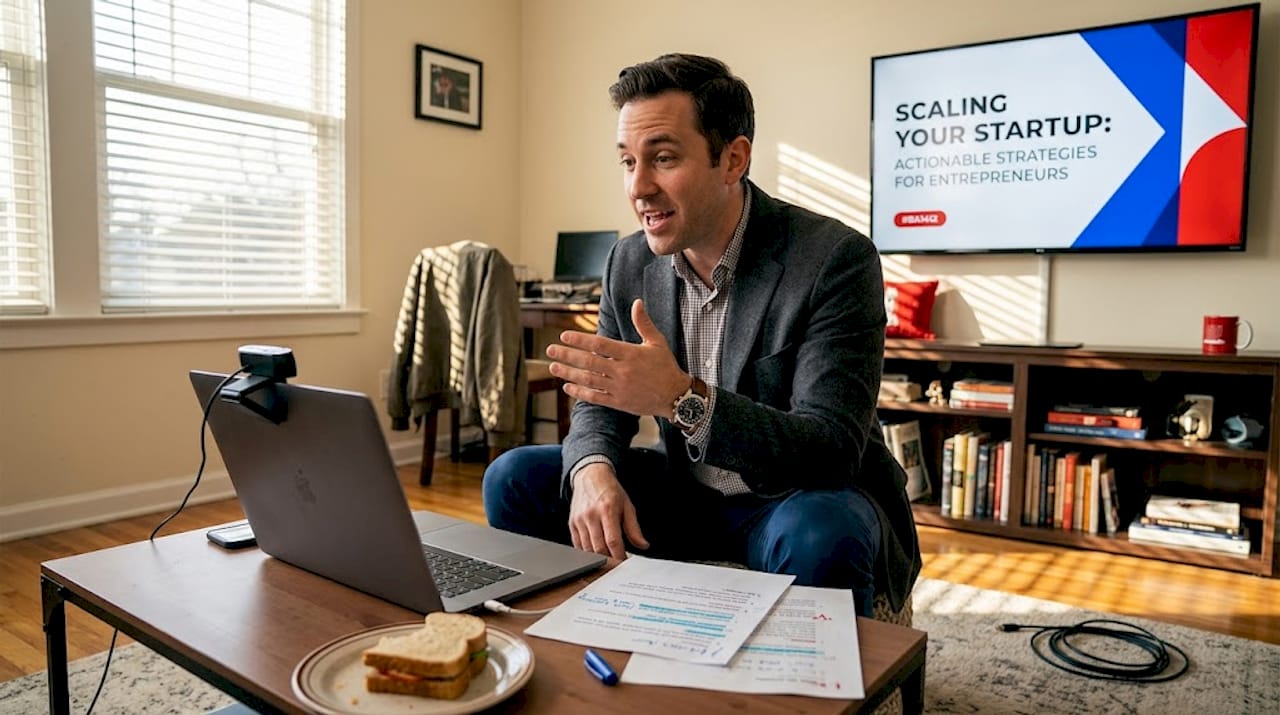
The webinar itself is where trust is built or broken. The structure that converts best follows a simple pattern: open with a story that resonates, teach a framework that creates an "aha" moment, address objections before they're raised, and then transition naturally into your offer. Interactive features like polls, live Q&A, and chat participation dramatically increase engagement. Passive viewers are far less likely to buy than those who feel involved in the conversation.
4. Call to action
The CTA is where most presenters get nervous and either rush it or over-explain it. CTA conversion averages 22%, and top-performing webinar funnels see 8 to 15% of attendees become customers. That gap between 22% and 15% represents people who clicked but didn't complete the purchase, which is why your sales page, checkout flow, and urgency elements all matter.
5. Post-webinar follow-up
This is the most underused stage. A follow-up sequence targeting non-attendees with a replay link, and non-buyers with objection-handling emails, can add 30 to 50% more revenue on top of what you made during the live event. Use email, SMS if you have permission, and even retargeting ads to stay in front of people who showed interest but didn't convert yet.
Pro Tip: Personalize your follow-up emails based on behavior. Someone who attended but didn't buy needs a different message than someone who never showed up at all. Most email platforms let you segment by attendance status, and this one change alone can significantly lift your post-webinar revenue.
How effective are webinar funnels? Stats and benchmarks
To help you benchmark success, let's look at how real webinar funnels perform and where you can aim.
Understanding what "good" looks like helps you set realistic goals and identify where your funnel needs work. Here's a breakdown of what the data shows:
| Metric | Industry average | Top performers |
|---|---|---|
| Registration to attendance | 40 to 50% | 55 to 65% |
| Attendance to CTA click | 22% | 30 to 40% |
| Attendance to sale | 2 to 5% | 8 to 15% |
| Average attendees per webinar | 216 to 239 | 400 and above |
| Post-webinar email open rate | 25 to 35% | 45 to 55% |
Industry averages show 40 to 50% live attendance, 22% CTA conversion, and 2 to 5% sales, while top performers reach up to 15% or more in conversions. The difference between average and top-performing funnels often comes down to a few specific improvements rather than a complete overhaul.
Small changes create outsized results. Adding a single text reminder 15 minutes before the webinar starts can increase attendance by 10 to 15%. Using an interactive poll in the first five minutes of your presentation can increase the percentage of attendees who stay through the CTA by a meaningful margin. These aren't massive technical changes. They're small, deliberate optimizations.
"Top-performing webinars can reach 8 to 15% attendee-to-sale conversion, which means for every 100 people who attend, up to 15 become paying customers."
Consider what that math looks like at scale. If your webinar attracts 200 attendees and you convert at 10%, that's 20 customers per event. If your offer is priced at $997, that's nearly $20,000 from a single webinar. Now multiply that across a monthly or bi-weekly schedule and you start to see why serious online entrepreneurs invest heavily in optimizing every stage of their funnel.
The average webinar attracts between 216 and 239 attendees per session, which means even at a modest 5% conversion rate, you're looking at 10 to 12 sales per event. The funnel is what makes those numbers repeatable and predictable rather than random.
Common mistakes and expert tips for your first webinar funnel
Now that you've seen what works, here's what to avoid and how you can stack the odds in your favor.
Most first-time webinar funnel builders make the same set of mistakes. Knowing them in advance saves you weeks of frustration and wasted ad spend.
Not warming up leads before the webinar
Sending a registration confirmation and then going silent until the day of the event is a conversion killer. People need multiple touchpoints to build trust. Use your pre-webinar email sequence to share relevant content, introduce yourself, and get them thinking about the problem your webinar solves. The more invested they feel before the event, the more likely they are to show up and buy.
Too much pitch, not enough value
If your webinar feels like a 90-minute sales presentation, you'll lose people fast. The rule of thumb is 80% value and 20% pitch. Teach something genuinely useful. Give attendees a win before you ask for anything. When they feel like they've already gotten value from the free content, the paid offer feels like a natural next step rather than a hard sell.
Neglecting the follow-up sequence
This is the single biggest missed opportunity in most webinar funnels. Many entrepreneurs treat the webinar as the finish line when it's actually just the midpoint. Webinar CTA conversion rates rise from 22% to as high as 33% with improved engagement, and a significant portion of that improvement comes from what happens after the live event. Build a 5 to 7 day follow-up sequence that handles objections, shares testimonials, and creates urgency.
Failing to use interactive tools
Polls, Q&A segments, chat prompts, and live reactions aren't just entertainment. They're conversion tools. When attendees interact, they become emotionally invested in the session. That investment carries over to the buying decision. Even something as simple as asking "Type YES in the chat if you've experienced this problem" can shift the energy of a webinar completely.
Skipping the debrief after each session
Every webinar you run is a data source. Track where people drop off, which questions come up repeatedly, and what objections show up most in the Q&A. Use that information to improve your next session. The entrepreneurs who build high-converting webinar funnel strategies treat each event as a learning opportunity, not just a revenue event.
Pro Tip: Start with a simple funnel and run it live at least three times before automating it. Live sessions give you real-time feedback you simply can't get from a pre-recorded version. Once you know what works, then you can automate with confidence.
The uncomfortable truth about webinar funnels most don't tell you
Here's where most guides stop short. They give you the stages, the stats, and the tips, and then send you off to build your funnel. But there's a deeper layer that separates the entrepreneurs who build funnels that consistently generate revenue from those who build technically correct funnels that still underperform.
The tactics matter. The sequence matters. But what matters more is whether your offer, your audience, and your message are in genuine alignment. You can have a perfectly structured registration page, a beautifully designed follow-up sequence, and a polished webinar presentation. If you're speaking to the wrong audience or solving a problem they don't urgently feel, none of it will convert.
The myth of the "magic funnel formula" is pervasive in the online marketing space. People buy courses, copy templates, and follow step-by-step blueprints expecting the funnel itself to do the selling. But even the best-designed funnels rely on understanding your audience and delivering value before asking for a sale. The funnel is the vehicle. Your understanding of your audience is the engine.
What actually separates high performers from everyone else is the feedback loop they build around their webinars. They don't just run events and check sales numbers. They survey attendees, review replay drop-off data, read every Q&A question, and treat each webinar as a conversation rather than a broadcast. That accumulated insight is worth more than any tool or template.
Mentorship for webinar funnels accelerates this learning curve because it compresses years of trial and error into a structured experience. When you can learn from someone who has already made the mistakes and found what works, you skip the most expensive part of the education.
The uncomfortable truth is that your first webinar funnel probably won't be your best one. And that's completely fine. The goal of your first funnel isn't perfection. It's learning. Every session teaches you something about your audience, your offer, and your delivery that no amount of pre-launch research can replicate. Commit to iteration, not just execution.
Ready to master your own high-converting webinar funnel?
Understanding the theory behind webinar funnels is one thing. Building one that actually converts, optimizing it based on real data, and scaling it into a reliable revenue system is another challenge entirely.
That's where structured mentorship changes everything. The 6-Day Money Funnel Mentorship is built specifically for online entrepreneurs who want step-by-step guidance from someone who has already generated $10 million with a single funnel. You don't need advanced technical skills or years of marketing experience. You need a proven system, direct support, and the accountability to implement it. If you're serious about turning your webinar into a consistent sales engine, this is the next step worth taking.
Frequently asked questions
What makes a webinar funnel different from a regular sales funnel?
A webinar funnel uses a live or automated webinar as its main event for lead nurturing and sales, offering higher personal engagement compared to standard sales pages. Average live attendance is 40 to 50% in optimized webinar funnels, showing higher engagement rates compared to generic funnels.
How long should my webinar funnel be from registration to final pitch?
Most effective webinar funnels span 7 to 14 days from registration through follow-ups, allowing enough time for both nurturing and conversions.
What's a realistic conversion rate for a new webinar funnel?
Expect to convert 2 to 5% of webinar attendees on average, with optimized funnels reaching up to 15%. Attendance-to-sales industry average sits at 2 to 5%, with top performers reaching 8 to 15%.
Do automated webinars work as well as live ones?
Live webinars tend to engage more and convert at higher rates, but automated webinars can still be effective when well-designed and personalized. Webinar engagement is highest during live events due to real-time interaction opportunities.
Should I offer a discount or bonus on my webinar?
Including a limited-time bonus or discount during your webinar is proven to increase conversion rates, especially during the call to action phase where urgency plays a strong role in buying decisions.