
Most people assume building an online business is either a quick path to passive income or a technical nightmare reserved for coders and marketers. Neither is true. The real story about why build online business is more interesting and more accessible than either extreme suggests. The digital economy has created a genuine opportunity for ordinary people to build scalable, location-independent income streams with far less capital than any traditional business requires. This article lays out the real advantages, the most common mistakes, a practical starting roadmap, and the brand-building strategies that separate businesses that grow from ones that stall.
Table of Contents
- Key takeaways
- Why build an online business over a traditional one
- Common mistakes that kill online businesses early
- A practical roadmap for getting started
- Brand-building strategies that create real trust
- My honest take on what building an online business really takes
- Start faster with the right mentorship
- FAQ
Key takeaways
| Point | Details |
|---|---|
| Lower costs, higher upside | You can launch with as little as $100, skipping leases, inventory, and large teams. |
| Your email list is your foundation | Email delivers up to $42 for every $1 spent, making it your most valuable owned asset. |
| Avoid the three fatal mistakes | Unclear niche, pitching before trust, and no repeatable system are the top reasons online businesses fail. |
| Validate before you scale | Your first sale gives you real data to refine your offer and channel fit. |
| Brand and systems create longevity | A clear mission paired with automated funnels turns one-time buyers into recurring revenue. |
Why build an online business over a traditional one
The most compelling reasons to start an online business have nothing to do with "freedom lifestyle" marketing. They come down to math and mechanics.
Traditional businesses carry enormous fixed costs before a single sale happens. A retail storefront means lease payments, utilities, staff, and inventory sitting on shelves. An online business eliminates most of that. Lower startup costs, location flexibility, and automation give digital businesses a structural advantage from day one.
Here is what that looks like in practice:
- No physical lease. Your "store" is a website. Monthly hosting often costs less than a single lunch.
- No geographic ceiling. A bakery in Chicago serves Chicago. An online course about sourdough serves the entire world.
- 24/7 revenue potential. A well-built sales page keeps working at 2 a.m. on a Sunday. You do not.
- Automation at scale. Automated marketing systems handle follow-up emails, upsells, and onboarding without adding headcount.
- Faster validation. You can test a product idea with a landing page and a small ad budget before building anything.
Scalability is where the advantages compound. Adding 100 new customers to a restaurant means more tables, more staff, and more food. Adding 100 new customers to a digital product business often means almost no additional cost. That asymmetry is exactly what makes online business profitable at a level brick-and-mortar stores struggle to reach.
Pro Tip: Do not wait until your product is perfect to test demand. Put up a simple opt-in page, drive 200 visitors to it, and measure sign-up rates. Real interest beats assumptions every time.
Common mistakes that kill online businesses early
Knowing the advantages is only half the picture. About 50% of new businesses fail within five years, and online businesses are not immune. The failure patterns are predictable, which means they are also avoidable.
Mistake 1: Trying to sell to everyone. When your message is designed for everyone, it resonates with no one. A fitness coach who helps "anyone who wants to get healthy" will lose every time to one who helps "busy moms over 40 lose 20 pounds without giving up wine." Specificity creates connection. Vagueness creates scrolling.
Mistake 2: Pitching before earning trust. Most beginners lead with an offer. Most buyers need a relationship first. Skipping the trust-building phase is one of the three primary reasons online businesses stall. The fix is simple: give value first. Answer real questions. Solve small problems for free. Then make your offer.
Mistake 3: No repeatable system. Random posting, sporadic emails, and inconsistent follow-up produce inconsistent income. Online business failures usually trace back to broken acquisition and retention systems, not bad products. A sales funnel with a defined entry point, a nurture sequence, and a clear conversion moment turns chaos into a process.
Pro Tip: Build your email list from week one. Only about 5% of social followers ever see your posts, but an email goes directly to the inbox. Social platforms are rented land. Your email list is property you own.
A practical roadmap for getting started
You do not need a business plan that runs 40 pages. You need a clear sequence of decisions that moves you from idea to first sale without burning months on setup.
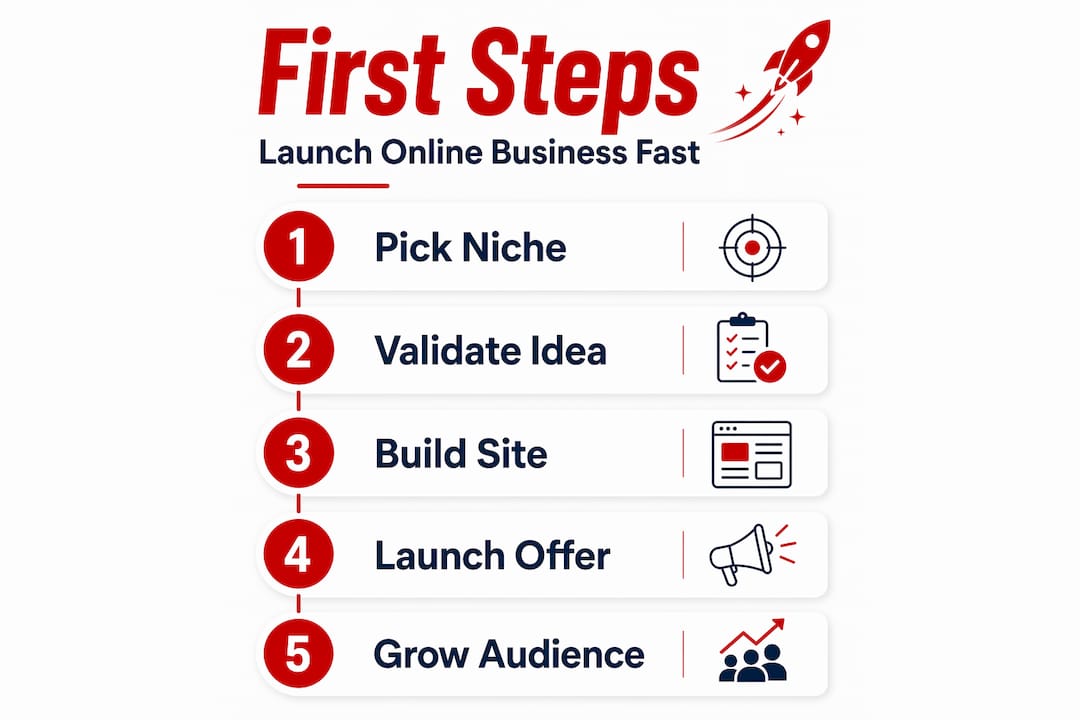
Here is what that sequence looks like:
- Validate your idea first. Search Google Trends, browse Reddit threads in your niche, and look at what competitors are already selling. Existing demand is a green light, not a red flag.
- Choose one business model. Explore business models that match your skills and available time. Digital products, services, affiliate marketing, and e-commerce all have different cost and effort profiles.
- Build a minimal website. You need one page that explains who you help, what you offer, and how to take the next step. That is it to start.
- Start capturing emails immediately. Offer a lead magnet. A specific, high-value freebie that solves a single urgent problem dramatically outperforms generic giveaways. Think "5-step checklist to fix your sleep in 3 days" over "subscribe for tips."
- Launch basic traffic. SEO takes months but costs nothing ongoing. A small paid social budget can validate demand in days. Use both, but do not let perfecting either one delay your launch.
The good news on cost: you can start with roughly $100, covering a domain, hosting, and a basic email tool. The barrier is not money. It is clarity and execution.
| Stage | Action | Estimated cost |
|---|---|---|
| Idea validation | Keyword research, competitor review | $0 |
| Minimal website | Domain + hosting + one landing page | $10–$30/month |
| Email marketing | Basic plan for list building and sequences | $0–$15/month |
| First traffic | Small paid ad test or organic content | $50–$100 |
| First sale | Offer to warm leads via email | $0 additional |
Pro Tip: Your first transaction is not just revenue. It is data. It tells you which channel brought the buyer, what language they used to describe their problem, and whether your offer resonates. That feedback is more valuable than the payment.
Brand-building strategies that create real trust
Getting traffic is one thing. Converting visitors into buyers, and buyers into repeat customers, requires trust. That is where building an online brand becomes a serious competitive advantage.

A clear brand mission is not a marketing exercise. It is an operational filter. Brand mission and values guide every decision from product development to customer service tone. When your audience senses that consistency, friction drops and conversions rise. Personal branding works as a business asset precisely because people buy from people they recognize and trust.
Here is what a trust-first marketing approach looks like in practice:
- Publish content that answers real questions. Blog posts, short videos, and email newsletters that solve specific problems build credibility before any sales conversation starts.
- Use storytelling, not features. "I help people like you" with a specific story beats a bullet list of product features every time.
- Build funnels that do the trust work automatically. A five-email welcome sequence that educates and connects is more effective than a cold pitch, and it runs without you.
The channel strategy matters as much as the message. Email marketing returns an average of $36 to $42 for every dollar spent, a figure social media cannot match. The reason is structural. Email lands in someone's personal inbox. Social posts compete with everything else in the feed.
| Channel | Ownership | Average ROI | Algorithm dependency |
|---|---|---|---|
| Email list | You own it | $36–$42 per $1 | None |
| Social media followers | Platform owns it | Low to moderate | High |
| SEO traffic | Partially owned | High (long-term) | Moderate |
| Paid ads | Rented | Varies | High |
Shifting focus from follower counts to owned audience growth is one of the most important moves any online business can make. Algorithms change. Platforms disappear. Your email list does not.
Pro Tip: To build trust faster online, check these proven trust strategies that reduce purchase hesitation and keep visitors coming back. Trust built before the pitch is always more powerful than reassurance after the ask.
My honest take on what building an online business really takes
I have seen people follow every tactic perfectly and still struggle because they never got clear on one thing: who exactly they are trying to help. Tactics are copies. Clarity is the original.
The uncomfortable truth I have learned is that patience and consistency are not motivational concepts. They are competitive advantages. Most people quit at the three-month mark when results are not obvious yet. The ones who stay past that point inherit an audience that most people never build.
What genuinely changed my own approach was shifting everything toward owned assets. When I stopped obsessing over social media reach and started growing my email list with a specific lead magnet, my results stopped depending on what platform decided that week. That shift felt small. The compounding effect was not.
Automation is real, but it rewards people who set it up thoughtfully. A poorly designed funnel that moves people too fast from stranger to sale will convert worse than no funnel at all. Take time to understand the psychology behind each step. If you want to get this right from the start, the mindset and metrics that actually matter are worth studying before you build.
The most successful people I watch are not chasing shortcuts. They are building something real, for a specific person, with a system that actually works. That combination is quieter than the big claims you see online. It is also far more durable.
— Mike
Start faster with the right mentorship
If you are serious about moving from "thinking about it" to actually building something that generates income, having a proven system behind you changes everything.
Moneyfunnel's 6-Day Money Funnel Mentorship walks you through the entire process: setting up your funnel, building your email list, driving traffic, and converting leads. It is hands-on, group-based mentorship built for people who want clear steps and real support, not another course to sit on a shelf. The program is designed for minimal technical skill and fast setup. If you have been waiting for the right moment to start, this is worth a serious look.
FAQ
Why build an online business instead of a traditional one?
Online businesses offer lower startup costs, location flexibility, and automation potential that brick-and-mortar businesses cannot match. You can reach a global audience and generate revenue around the clock without a physical location.
How much does it cost to start an online business?
You can realistically start with around $100, covering a domain, basic hosting, and an email marketing tool. Costs scale up only as your revenue grows.
What is the biggest mistake beginners make?
Trying to sell to everyone instead of a specific niche is the most common early mistake. Unclear messaging leads to no sales regardless of how much traffic you generate.
Why is email marketing better than social media for online businesses?
Email marketing delivers an average return of $36 to $42 per dollar spent, and you own the list outright. Social media audiences are controlled by platform algorithms, and only about 5% of followers typically see any given post.
How long does it take to see results from an online business?
Most consistent businesses see early traction between three and six months with daily effort. Your first sale can come much sooner and gives you real feedback to improve your offer and marketing approach.