
Most people picture a marketing funnel as a neat series of steps: stranger becomes lead, lead becomes buyer. Clean. Predictable. Simple. The reality in 2026 is far messier, and marketers who still rely on that mental model are leaving serious money on the table. Understanding what is a marketing funnel today means accepting that the classic picture has evolved into something more dynamic, more fragmented, and honestly more interesting. This guide breaks down the core framework, the modern complexity layered on top of it, and how you can use funnels strategically to grow your online sales.
Table of Contents
- Key Takeaways
- What a marketing funnel actually is
- How modern funnels have changed
- Practical ways to use marketing funnels
- Marketing funnel vs. sales funnel
- My honest take on funnels in 2026
- Ready to build a funnel that actually converts?
- FAQ
Key Takeaways
| Point | Details |
|---|---|
| Funnel = customer journey map | A marketing funnel models how strangers move from awareness to purchase and beyond. |
| Four core stages still matter | Awareness, consideration, conversion, and loyalty each require different content and tactics. |
| Modern journeys are nonlinear | Buyers loop between stages and often complete full journeys inside a single platform session. |
| Marketing and sales funnels differ | Marketing funnels work at population scale; sales funnels focus on individual opportunities. |
| Framework beats fixed pipeline | Treat the funnel as a flexible strategic language, not a rigid step-by-step checklist. |
What a marketing funnel actually is
A marketing funnel is a model that maps the stages a person moves through from first learning about your brand to becoming a paying customer and, ideally, a loyal advocate. The word "funnel" comes from the shape: wide at the top where the mass audience enters, narrow at the bottom where buyers emerge. That shape reflects a simple truth. Not everyone who discovers you will buy, and not everyone who buys will return.
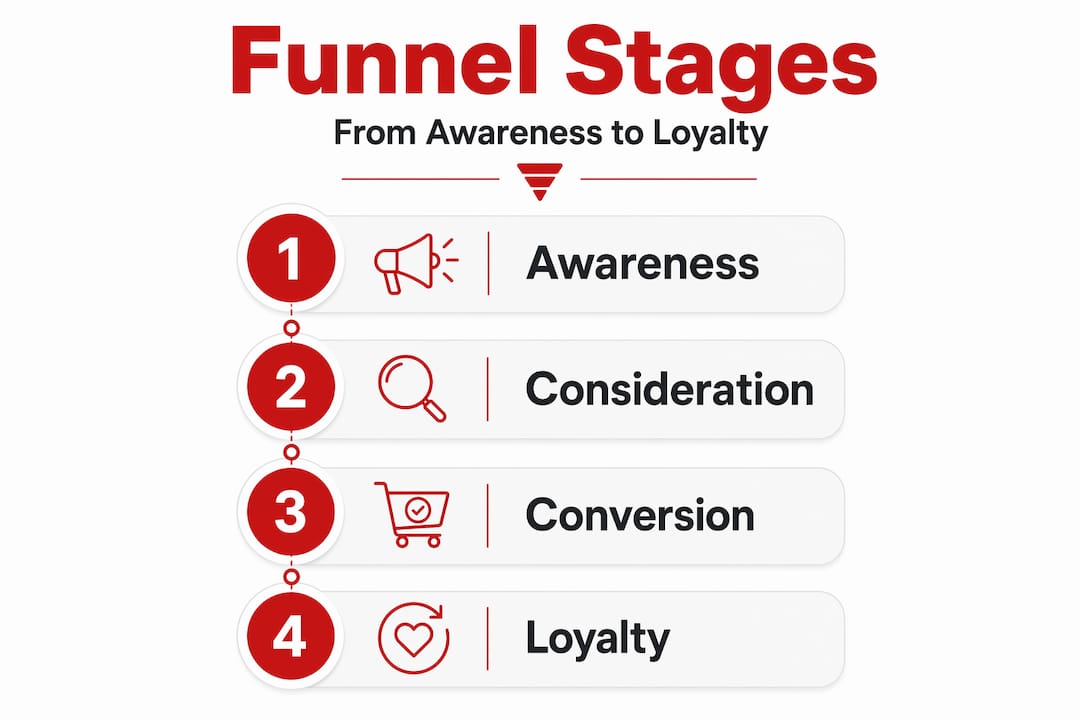
Marketers typically break the funnel into four zones:
- Top of funnel (TOFU) — Awareness: The prospect does not know you yet. Your goal is reach and recognition through content, ads, social presence, and search visibility.
- Middle of funnel (MOFU) — Consideration: The prospect knows you and is comparing options. Your goal is education, trust-building, and demonstrating why you are the right choice.
- Bottom of funnel (BOFU) — Conversion: The prospect is close to deciding. Your goal is removing friction, handling objections, and making the purchase feel obvious.
- Post-funnel — Loyalty and advocacy: The buyer has converted. Your goal shifts to retention, upsells, referrals, and turning customers into fans.
Here is a quick comparison showing how marketing goals shift across stages:
| Stage | Audience mindset | Primary marketing goal | Content types |
|---|---|---|---|
| Awareness | "I have a problem" | Build recognition and reach | Blog posts, short videos, ads |
| Consideration | "What are my options?" | Educate and build trust | Case studies, webinars, emails |
| Conversion | "Which one do I choose?" | Reduce friction and close | Free trials, demos, testimonials |
| Loyalty | "Would I come back?" | Retain and build advocacy | Onboarding, exclusive offers, referrals |
A common misconception is that funnels only drive one-time sales. Well-designed funnels support long-term relationships, audience segmentation, and personalized ongoing interactions that keep customers coming back.

How modern funnels have changed
The traditional funnel assumed people move in one direction. Awareness leads to consideration, consideration leads to purchase. But buyers frequently loop between exploration and evaluation in a single session today, making those fixed stage boundaries less predictive than they once were.
Three forces are driving this shift.
Social media as a search engine. An eye-opening 66.6% of US consumers now use social platforms as their primary search tool. That means top-of-funnel discovery is no longer dominated by Google. Your brand needs visibility across TikTok, Instagram, YouTube, and beyond. A helpful resource on AI marketing strategies explains how AI-powered content discovery is further accelerating this platform fragmentation.
AI-powered search absorbing queries. Traditional online search volume is projected to drop 25% by the end of 2026. AI assistants are directly answering questions that used to send people to websites. Marketers must now optimize for AI-generated answers and machine-readable content to stay visible in discovery phases.
Multi-device, multi-session behavior. A prospect might discover you on their phone via Instagram, research competitors on a laptop, watch a YouTube demo on a tablet, and finally convert on their phone again three weeks later. Connecting those dots requires integrating CRM data, customer data platforms, and login signals to track the actual journey across devices.
The modern approach is to think less about fixed funnel stages and more about behavioral signal scoring across touchpoints. Pricing page visits, demo engagement, email click patterns. These signals estimate decision proximity far better than assuming someone is neatly "in the consideration stage."
Pro Tip: Do not fight the nonlinear journey. Instead, map your content to multiple entry points and make sure your brand is findable and credible wherever the prospect surfaces, whether that is a Reddit thread, an AI answer, or a YouTube comment.
Practical ways to use marketing funnels
Despite the complexity, the funnel remains one of the most useful strategic frameworks you can adopt. Research confirms that funnels serve as a common language for team alignment, helping sales, content, and data teams coordinate around shared objectives rather than working in silos.
Here is a practical approach to putting your funnel to work:
- Audit your current content by stage. List every piece of content you produce and assign it to TOFU, MOFU, or BOFU. Most teams discover a massive TOFU surplus and nearly nothing at MOFU, which is exactly where prospects go cold.
- Segment your email list by funnel position. New subscribers get different content than people who have already visited your pricing page. Personalization based on funnel stage consistently outperforms one-size-fits-all email campaigns.
- Match funnel type to your product and price point. Webinar funnels for online courses typically convert products priced between $100 and $1,000, and tactics like order bumps significantly increase average transaction value. This detailed webinar funnel guide walks through how to turn viewers into buyers using these techniques. Matching funnel type with product price and buyer readiness maximizes conversions and prevents wasted resources.
- Define stage-specific metrics. Do not use a single KPI for the whole funnel. Awareness stages need reach and impression data. Consideration stages need engagement rates and time on page. Conversion stages need cost per acquisition and close rates.
- Build feedback loops. Have sales report back which leads were most qualified and what objections appeared most often. Feed that intelligence back to content and campaign teams to sharpen MOFU assets.
| Funnel metric | Stage it measures | What it tells you |
|---|---|---|
| Impressions and reach | Awareness | How broadly your brand is visible |
| Email open and click rate | Consideration | How engaged prospects are |
| Conversion rate | Conversion | What percentage of prospects become buyers |
| Repeat purchase rate | Loyalty | Whether customers trust you enough to return |
Pro Tip: If you are selling online courses or digital products, prioritize the online business metrics that connect funnel performance to actual revenue. Vanity metrics like follower counts are not funnel data.
Marketing funnel vs. sales funnel
People use these terms interchangeably. They should not. Understanding the difference will help you build better processes and stop losing revenue at the handoff.
A marketing funnel operates at the population level. It moves large groups of people from strangers to prospects. Its job is to generate awareness, nurture intent, and qualify interest across an entire audience segment.
A sales funnel operates at the individual level. It takes a specific qualified lead and walks them through a purchasing decision. It is managed by a salesperson or an automated sales sequence, and it ends with a yes or a no.
Think of it this way:
- Marketing funnel fills the pipeline with possibilities.
- Sales funnel converts those possibilities into closed deals.
The danger zone is the handoff between the two. Misalignment here wastes leads and erodes revenue. Marketing may hand off leads that sales considers unqualified. Sales may ignore leads that marketing spent months nurturing. The fix requires shared definitions of what counts as a qualified lead, shared metrics, and regular communication between both teams.
Common misalignment pitfalls and their solutions:
- Problem: Marketing measures lead volume; sales measures close rate. Neither team knows if they are working toward the same goal. Solution: Agree on a shared revenue target and trace both funnels back to that number.
- Problem: Marketing hands off leads too early. Solution: Define a minimum behavioral threshold, such as attending a webinar or downloading a case study, before leads enter the sales funnel.
- Problem: Sales never feeds insight back to marketing. Solution: Schedule monthly pipeline reviews where sales shares objection patterns and marketing adjusts content accordingly.
Sales and marketing funnels must be understood as distinct but complementary systems. One targets aggregate audiences; the other manages individual opportunities. Both need to be designed with the other in mind.
My honest take on funnels in 2026
I have spent years watching marketers wrestle with the funnel concept, and the biggest mistake I see is treating it as a literal pipeline. You set up your awareness ad, your nurture emails, your conversion page, and then you wait for people to flow through in order. It rarely works that cleanly, and when results disappoint, the temptation is to blame the funnel.
What I have learned is that the funnel is most valuable as a shared vocabulary. When content, paid media, and sales teams use the same stage definitions, the conversations change. Suddenly, people stop arguing about whether a campaign "worked" in the abstract and start asking which specific stage broke down and why.
The AI and social search shifts genuinely concern me for marketers who are not paying attention. If two-thirds of your prospects are discovering brands through social platforms rather than search engines, and you are still allocating 80% of your budget to SEO and Google ads, you have a structural mismatch. The funnel framework helps you see this because it forces you to audit each stage separately.
My advice: stop perfecting your funnel's architecture and start fixing the stage where you lose the most people. That is always where the money is.
— Mike
Ready to build a funnel that actually converts?
Understanding the theory is one thing. Building a funnel that generates consistent online sales is a different challenge entirely. Moneyfunnel was built to close that gap.
The 6-Day Money Funnel Mentorship program gives you a step-by-step framework to build a working sales funnel from scratch, even without a technical background. You will learn how to match your funnel type to your offer, how to personalize messaging at each stage, and how to align your marketing and sales processes so leads do not fall through the cracks. The program is based on a system that has generated real results, and it is designed for aspiring entrepreneurs who want practical guidance, not theory. If you are ready to move from understanding funnels to actually deploying one, this is where to start.
You can also explore funnel growth insights to see how the framework has helped other entrepreneurs accelerate their results.
FAQ
What is a marketing funnel in simple terms?
A marketing funnel is a model that describes the stages a customer moves through, from first discovering your brand to making a purchase and becoming a repeat buyer. It helps marketers design the right message for each stage of the customer journey.
What are the main marketing funnel stages?
The four core stages are awareness, consideration, conversion, and loyalty. Each stage requires different content and tactics, moving from broad reach at the top to personalized retention efforts at the bottom.
How is a marketing funnel different from a sales funnel?
A marketing funnel operates at the audience level and focuses on generating and nurturing prospects, while a sales funnel manages individual leads through a purchasing decision. Both must align to avoid losing revenue at the handoff point.
Are marketing funnels still relevant in 2026?
Yes, but the model has evolved. With traditional search projected to drop 25% and social platforms becoming discovery engines, funnels now function best as flexible frameworks for team alignment rather than rigid stage progressions.
What types of marketing funnels work best for online courses?
Webinar funnels are particularly effective for online course sales priced between $100 and $1,000, with tactics like order bumps and pricing tiers used to increase average transaction value and conversion rates.