
Most aspiring online entrepreneurs make the same costly mistake: they find a funnel success story, copy the headline, steal the layout, and wonder why the results don't follow. The real power of funnel success stories isn't in the surface details you can see. It's in the repeatable mechanics underneath that you have to actively extract. The entrepreneurs growing fastest right now aren't just inspired by these stories. They study them like blueprints, reverse engineer the systems, and then adapt those systems to their own offers and audiences.
Table of Contents
- What are funnel success stories (and why do they matter)??)
- How success stories drive learnable, repeatable growth (not magic tactics))
- Turning inspiration into action: Applying funnel story insights to your business
- Common pitfalls when learning from funnel success stories
- What most entrepreneurs get wrong about funnel success stories
- Take the next step: Launch your own funnel success story
- Frequently asked questions
Key Takeaways
| Point | Details |
|---|---|
| Mechanics over tactics | Learning repeatable frameworks from funnel stories drives real growth, not just copying tactics. |
| Benchmark and adapt | Success comes from studying stories to benchmark, then tailoring strategies for your unique audience. |
| Practical application | Break down funnel stories into actionable steps and measure results to improve your business. |
| Avoid common pitfalls | Don't just imitate; adapt insights while avoiding context mismatches and focusing on value. |
What are funnel success stories (and why do they matter)?
A funnel success story isn't just a testimonial or a screenshot of a revenue milestone. It's a detailed account of how a business moved a specific audience from cold awareness to paying customer using a structured sales funnel. The story includes the offer, the funnel architecture (meaning the sequence of pages, emails, and touchpoints), and the follow-up system that kept leads moving forward.
What makes these stories uniquely powerful for online entrepreneurs is exactly what repeatable mechanics represent: offer plus funnel architecture plus follow-up. When you read a great success story, you're not just seeing what worked. You're getting a window into why it worked and how those pieces connected to produce a result.
Here's the critical distinction that most people miss: tactics versus mechanics.
- Tactics are the surface-level executions. A specific headline, a certain button color, a particular email subject line.
- Mechanics are the underlying systems. The logic of how the offer resolves a specific pain, how the funnel stages build trust before asking for a sale, and how the follow-up sequence handles objections.
Tactics are fragile. They work in one context and fail in another. Mechanics are portable. They can be adapted across industries, offer types, and audiences because they reflect how people actually make buying decisions.
"The real value of a funnel story isn't in what the entrepreneur did. It's in understanding why each stage of the funnel moved people forward."
That shift in thinking, from copying to analyzing, is what separates entrepreneurs who bounce from tactic to tactic and those who build compounding systems. When you review a success story with this lens, you start asking different questions. Not "what did their opt-in page look like?" but "what problem did their opt-in page solve for the visitor in that moment?"
| Story element | Surface tactic | Repeatable mechanic |
|---|---|---|
| Headline | Specific wording used | Pain point and desire addressed |
| Opt-in offer | Lead magnet format (PDF, video) | Value exchange that earns trust |
| Sales page | Length, layout, design | Objection sequence and proof structure |
| Email follow-up | Number of emails sent | Nurture logic and urgency triggers |
| Upsell offer | Product name or price | Natural next step in customer journey |
The Money Funnel mentorship overview breaks down this kind of structural analysis in detail, which is exactly the type of framework that transforms inspiration into a repeatable growth system.
With this context set, let's zoom in on how and why these stories become blueprints for entrepreneurial growth.
How success stories drive learnable, repeatable growth (not magic tactics)
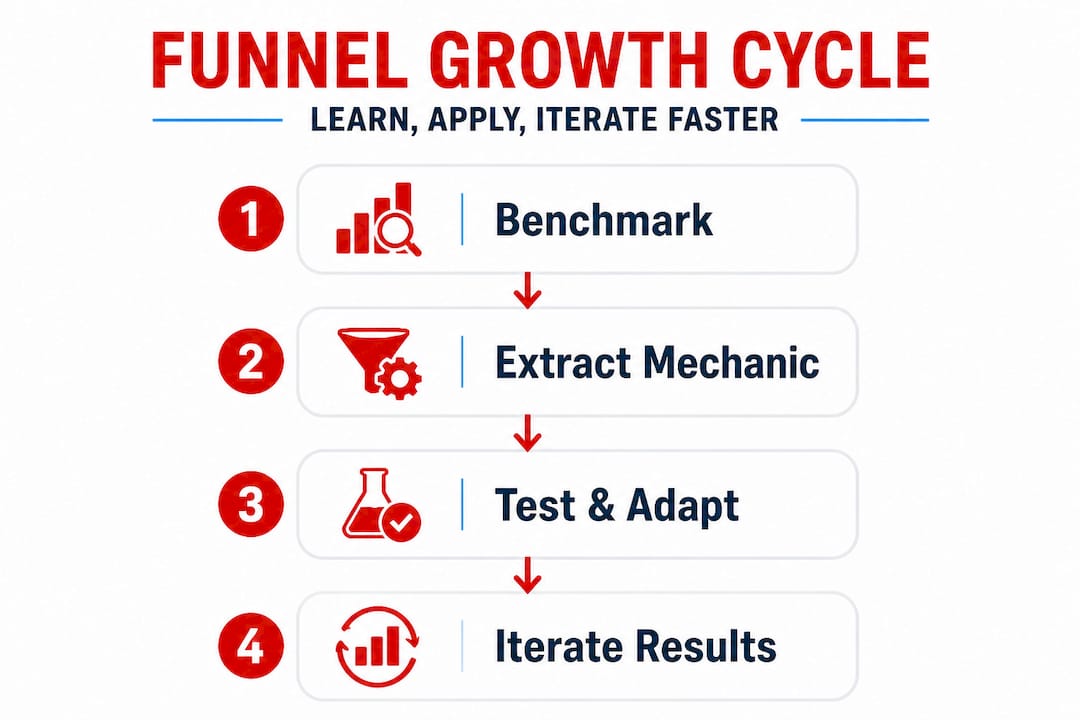
The top online entrepreneurs approach funnel success stories in a disciplined, three-step process that turns inspiration into a learning system.
- Benchmark. They identify a funnel success story that operates in a comparable market or uses a similar offer structure. They document what the funnel does at each stage, what the offer promises, and what the follow-up looks like. This gives them a reference point to measure their own funnel against.
- Extract the mechanics. They go deeper than what they can see. They ask what problem the funnel solves, how trust is built before the sale, and what objections are handled at each stage. They're building a hypothesis about why the funnel works, not just cataloging what it includes.
- Iterate with data. They apply the mechanics to their own funnel, test with their specific audience, and measure the results. Then they adjust based on what the data tells them, not what they assume should work.
This three-step cycle is sustainable because it generates learning at every stage. Even when a test doesn't produce the expected results, you gain data about your audience that refines the next iteration.
Publishing funnel success stories actively encourages the "benchmark and trend" mindset that entrepreneurs need to improve conversion over time. Benchmarking means knowing where you stand relative to proven results. Trending means tracking whether your own metrics are improving, holding steady, or declining over time.
Pro Tip: The most common failure mode for new entrepreneurs is copying a surface tactic without understanding the underlying system. If you duplicate a headline but your offer doesn't solve the same pain, or if you copy an email sequence but your funnel doesn't have the same trust-building stages before it, the tactic will produce nothing. The system is what drives results, not any single element within it.
Why systematic learning compounds over time. When you apply the benchmark-extract-iterate loop consistently, each funnel story you analyze adds to your library of working mechanics. You start recognizing patterns across multiple success stories: the way high-converting opt-ins always resolve a specific fear, the way the best sales pages lead with the customer's current situation before introducing the offer. These patterns become the raw material for your own funnel experiments.

The mentorship for funnel frameworks is designed to accelerate exactly this kind of systematic learning, giving you structured guidance so you're extracting the right lessons from the right stories from the start.
Once you understand why funnel stories are so powerful, it's easier to see the concrete steps you can take to get the most value from them.
Turning inspiration into action: Applying funnel story insights to your business
Understanding the theory is step one. Putting it into practice with your specific offer and audience is where real growth happens. Here's a practical five-step framework for adapting a winning funnel story to your own business.
- Identify a relevant success story. Look for a story where the target audience or the type of offer resembles yours. The closer the match, the more directly applicable the mechanics will be.
- Map the funnel stages. Document every touchpoint: the traffic source, the opt-in or landing page, the sales page, the email sequence, and any upsells or follow-up offers. Write down what each stage is doing for the visitor.
- Isolate the mechanics. For each stage, ask: What problem is being solved here? What objection is being handled? What emotion is being activated? Write down your answers. These are the mechanics you'll adapt.
- Translate to your offer and audience. Rewrite each mechanic in terms of your specific audience's pain points, language, and desires. Your opt-in page won't use the same words, but it should resolve a fear with the same precision.
- Test, measure, and refine. Launch your adapted funnel, track your metrics at each stage (opt-in rate, sales conversion rate, email open rate), and compare your results against the benchmark. Use the data to guide your next round of adjustments.
| Approach | What it looks like | Result |
|---|---|---|
| Surface tactics | Copy headline, layout, email templates | Rarely works; no alignment with your audience |
| Repeatable mechanics | Adapt the logic, pain resolution, objection handling | Portable and improvable over time |
As the research makes clear, the entrepreneurs who replicate real results focus on mechanics, not surface details. This isn't a subtle difference. It's the entire gap between a funnel that converts and one that doesn't.
Pro Tip: Always measure results and tweak based on your audience's specific feedback. What worked brilliantly for an entrepreneur selling a coaching program may need significant adaptation if you're selling a digital product or a physical service. The mechanic is portable. The execution must be customized.
The mentorship program for step-by-step support walks you through this entire adaptation process with structured feedback so you're not guessing at which mechanics to apply.
Now that you have a practical approach, let's address some potential pitfalls and misconceptions that could sabotage your success.
Common pitfalls when learning from funnel success stories
Even with the right framework, there are four mistakes that consistently derail entrepreneurs who are trying to learn from funnel success stories.
- Copying without context. Taking an element from a success story without understanding the audience, offer, or market conditions that made it work. A high-pressure scarcity tactic that works in one market can destroy trust in another.
- Skipping the benchmarking step. Jumping straight to implementation without first documenting where your funnel currently stands. Without a baseline, you can't tell if your changes are actually improving results.
- Measuring the wrong metrics. Tracking vanity metrics like page views or social shares instead of funnel-specific metrics like opt-in rate, cost per lead, and conversion rate at each stage. Pretty numbers that don't reflect revenue are distractions.
- Treating the first test as the final answer. Assuming that if a mechanic doesn't produce results on the first attempt, it doesn't work. Funnels require iteration. One test gives you one data point. Improvement comes from consistent testing cycles.
The most overlooked lesson here is that context shapes everything. What worked for a specific funnel story was shaped by the market timing, the audience's sophistication level, the price point, and the entrepreneur's existing reputation. None of those factors are visible in the story itself. You have to factor them in when you adapt.
"Success starts with benchmarking and trending the competition, then building a value proposition, presenting clear calls-to-action, and iterating with measurement and learning after purchase."
That quote is the most honest summary of what sustainable funnel growth actually looks like. It's not a one-time copy-and-paste operation. It's a cycle that builds compound growth through consistent measurement and adaptation.
Having avoided the common pitfalls, what's the deeper lesson most new entrepreneurs miss when they analyze funnel success stories?
What most entrepreneurs get wrong about funnel success stories
Here's an uncomfortable truth we've learned from working inside high-performing funnels: most people use success stories as motivation when they should be using them as data.
There's nothing wrong with getting excited by a story of someone generating $10 million with a single funnel. That excitement is fuel. But if you stop at "that's amazing, I want that," you've missed the entire opportunity the story offers. The real question is: what hypotheses does this story give me to test in my own funnel?
The top earners we've studied don't treat success stories as shortcuts. They treat them as research. Every story is a dataset. The offer reveals what the market wanted. The funnel architecture reveals how trust was built. The follow-up reveals how objections were handled over time. When you read a story as a researcher, you extract frameworks. When you read it as a fan, you extract surface details.
There's another layer that almost nobody talks about: your own funnel journey is a future success story. The data you collect, the tests you run, the mechanics you discover through iteration, these all create a personal case study that becomes increasingly valuable over time. Documenting your process doesn't just help you learn faster. It creates the raw material for the success story you'll one day share with others trying to do what you're doing now.
This is why our mentorship experience is structured around documented learning, not just tactics. We've seen what happens when entrepreneurs treat every funnel test as a learning event worth capturing. They improve faster, stay motivated through setbacks, and build genuine expertise rather than a patchy collection of borrowed tactics.
The mindset shift is simple but profound: you are both the student and the experiment. Every funnel you run teaches you something. The faster you collect and apply those lessons, the faster you build the kind of system that produces results worth telling a story about.
Take the next step: Launch your own funnel success story
You've just covered the frameworks that separate entrepreneurs who build compounding funnel systems from those who stay stuck copying tactics. The next move is putting this knowledge into practice with real guidance, real feedback, and a structured environment designed for rapid iteration.
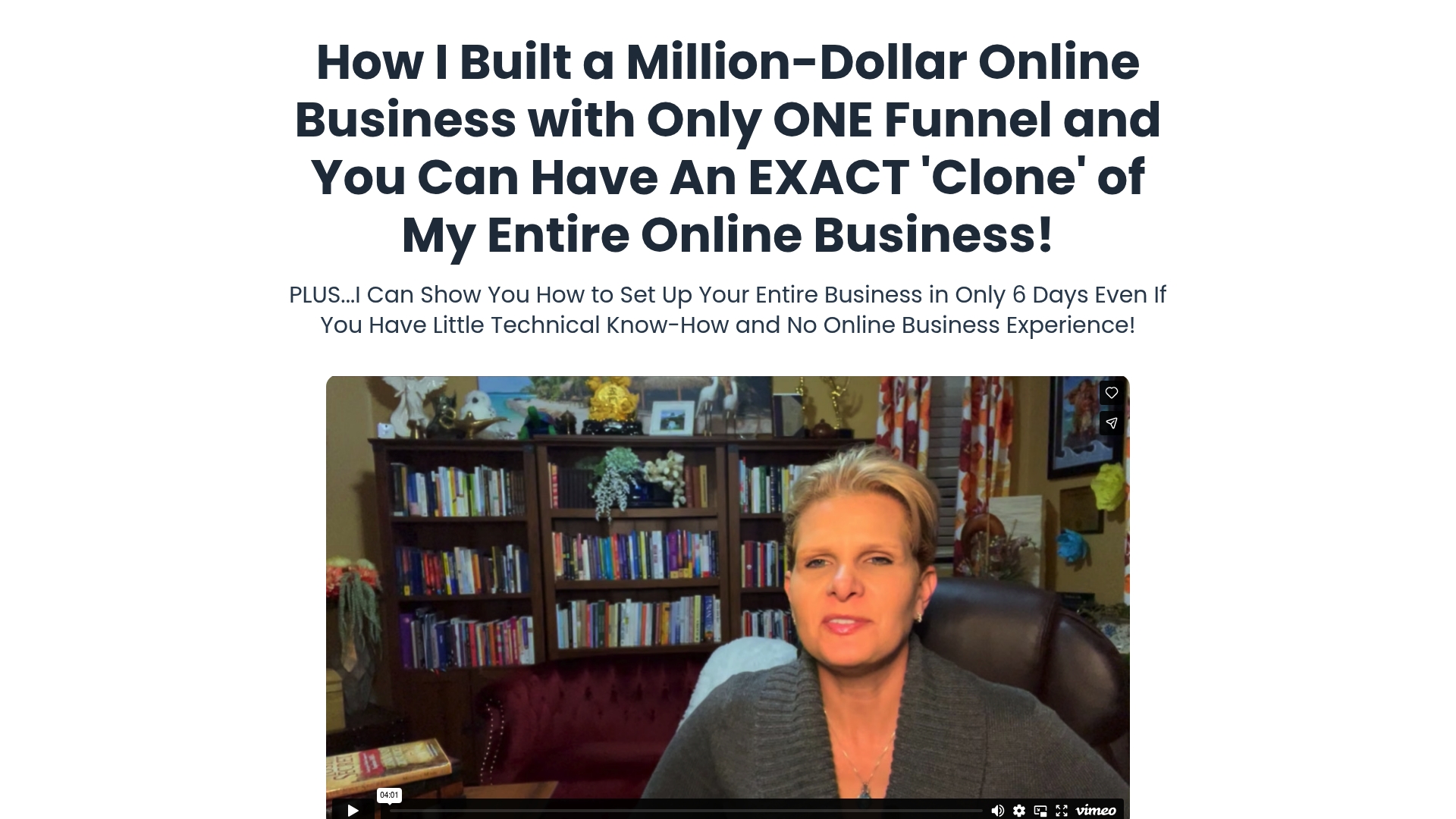
At Money Funnel, the six-day mentorship program gives you the step-by-step framework to analyze proven funnels, adapt the core mechanics to your offer, and build a system designed for measurable growth. You get access to a mentor who has generated $10 million with a single funnel, plus a small group of entrepreneurs who are actively running the same experiments you are. This isn't a course you watch and forget. It's a hands-on environment where you apply what you learn every single day, with feedback to keep you moving in the right direction. If you're ready to start your funnel journey with a proven framework behind you, this is where it begins.
Frequently asked questions
What is the most important part of a funnel success story?
The most important part is the repeatable mechanics: how the offer, funnel structure, and follow-up align to produce measurable results that can be adapted to other contexts.
How can I apply a funnel success story to my business?
Break down the story into its core stages, adapt each mechanic to your specific offer and audience, implement deliberately, and keep measuring results so each iteration improves on the last based on benchmarking and iteration.
Why shouldn't I just copy funnel tactics exactly?
Copying tactics without understanding context almost always fails because repeatable mechanics must be adapted to your specific audience, product, and market positioning to produce real results.
How do success stories help increase conversion rates?
They encourage the "benchmark and trend" mindset where you consistently compare your funnel's performance against proven results, driving step-by-step conversion improvement over time rather than random testing.