
Funnel hacking gets a bad reputation before most people even understand what it means. The word "hacking" triggers assumptions about theft, copying, or shady competitive tactics. In reality, what is funnel hacking comes down to something far more legitimate: systematic research into how successful competitors attract, nurture, and convert customers through their sales funnels. Think of it as the marketing equivalent of a chef eating at a great restaurant to understand the technique, not to steal the recipe. This article breaks down the funnel hacking explanation you actually need, from core concepts to practical steps you can apply today.
Table of Contents
- Key Takeaways
- What funnel hacking actually means
- Why funnel hacking works and where the ethical line sits
- How to funnel hack effectively
- Applying funnel hacking insights to your own funnel
- My honest take on funnel hacking
- Ready to put funnel hacking into practice?
- FAQ
Key Takeaways
| Point | Details |
|---|---|
| Funnel hacking is research | It means reverse-engineering competitor funnels to understand what works, not copying content. |
| Ethics matter in practice | Model funnel structure and psychology, never duplicate creative assets word-for-word. |
| Buying the product reveals more | Purchasing a competitor's front-end offer exposes hidden upsells and the full value ladder. |
| Alignment drives results | Marketing and sales funnels must work together to avoid losing leads mid-journey. |
| Speed of response matters | Slow lead response kills conversions; funnel hacking helps you spot and fix these gaps fast. |
What funnel hacking actually means
Funnel hacking is systematic reverse-engineering of a competitor's sales and marketing funnel. You study every touchpoint a prospect encounters: the ad that grabs attention, the landing page that captures the lead, the email sequence that nurtures interest, the offer that closes the sale, and the upsells that maximize revenue. The goal is to understand why each element works, so you can build something better for your own business.

Russell Brunson, co-founder of ClickFunnels, popularized the term and the practice. His core argument was simple: why spend months guessing what works when your competitors have already done the testing? Funnel hacking strategy is about standing on the shoulders of proven results rather than starting from scratch.
Before going further, it helps to distinguish between a marketing funnel and a sales funnel. They are related but not identical. Marketing funnels focus on population-level behavior: awareness, engagement, and lead generation measured in aggregate. Sales funnels focus on individual opportunity qualification and closure. When you funnel hack, you study both layers because the disconnect between them is often where businesses lose money.
Here is a typical funnel hacking process from start to finish:
- Identify your target competitors. Choose businesses selling to the same audience with proven traction. Look for active ad campaigns, strong social presence, and visible funnels.
- Enter the funnel as a prospect. Click their ads, opt into their lead magnets, and observe every step of the experience from a buyer's perspective.
- Document every touchpoint. Screenshot landing pages, save emails, note pricing structures, and record upsell sequences.
- Trigger retargeting. Visit the funnel without converting to see what abandoned-cart and retargeting ads they serve you.
- Buy the front-end product. This is the step most people skip, and it reveals the most. Purchasing unlocks the full upsell flow and maps the complete value ladder.
- Analyze and extract principles. Look for patterns in headlines, offer framing, urgency tactics, and email cadence. Ask why each element is structured the way it is.
Pro Tip: Create a dedicated browser profile and email address for funnel hacking research. This keeps your competitive intelligence organized and prevents your personal inbox from becoming cluttered with competitor email sequences.
Why funnel hacking works and where the ethical line sits
The strategic advantage of funnel hacking is time compression. Funnel hacking fast-tracks marketing success by learning from competitors who have already paid for the trial and error. Instead of spending months testing headlines, pricing models, and email cadences, you start with a map drawn from real market data.
Here is where the ethical question comes in, and it deserves a direct answer. Funnel hacking is not theft. Ethical funnel hacking focuses on modeling structure and psychology, not duplicating creative assets. You are studying the architecture of a funnel, not copy-pasting someone's ad copy or landing page text.
"Funnel hacking is ethical espionage. You are learning and adapting, not copying." This distinction matters legally and strategically. A funnel built by copying someone else's words and images exposes you to intellectual property risk and produces worse results because it is not calibrated to your audience or brand voice.
The practical benefits of ethical funnel hacking include:
- Faster funnel optimization. You skip the blank-page problem and build from tested frameworks.
- Better conversion benchmarks. Seeing what competitors charge and how they frame offers gives you real pricing intelligence.
- Audience insight. The way a competitor structures their messaging reveals what their shared audience actually responds to.
- Gap identification. Sometimes the most valuable finding is what a competitor does badly, which is an opening you can exploit.
The most common pitfall is over-indexing on one competitor. A funnel that works brilliantly for a well-known brand with years of trust may not translate to a new entrant. Study multiple competitors and extract principles, not templates.
How to funnel hack effectively
Good funnel hacking is methodical. Here is how to move from curiosity to competitive intelligence you can actually use.
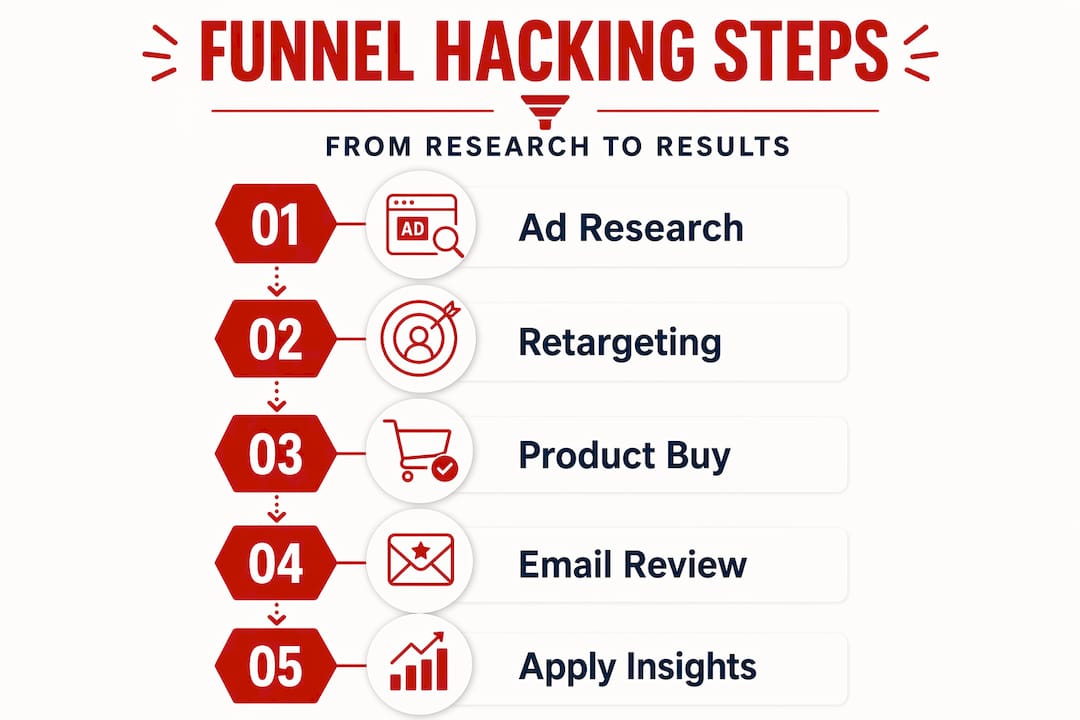
Start with ad research. Platforms like Meta's Ad Library let you see active ads from any page. Look at how competitors frame their hook, what visual style they use, and which offers they promote. Competitor analysis in funnel hacking covers headlines, offers, email sequences, and retargeting ads as a buyer would experience them.
Use retargeting as a research trigger. Visit a competitor's funnel without opting in, then watch what ads follow you around the web. Effective funnel hackers use retargeting triggers to unlock abandoned-cart messaging and email sequence insights that are invisible to casual observers. This is where you learn how aggressively they follow up and what angles they use to recover lost leads.
Buy the front-end product. This is non-negotiable for serious funnel hacking. Purchasing a competitor's front-end product reveals hidden upsells and maps the full value ladder. You will see order bumps, one-time offers, and post-purchase email sequences that are completely invisible from the outside.
Use the right tools. Here is a quick reference for common funnel hacking research tools:
| Tool | Primary use | Best for |
|---|---|---|
| Meta Ad Library | Ad creative and copy research | Identifying active competitor campaigns |
| SimilarWeb | Traffic source analysis | Understanding where competitor leads come from |
| BuiltWith | Technology stack detection | Identifying funnel platforms and tools used |
| Dedicated email account | Email sequence capture | Documenting full follow-up flows |
| Screen recording software | Funnel documentation | Capturing the full prospect experience |
Scale your prospecting efficiently. Technology now makes it possible to scan and qualify 10,000 stores in 90 minutes for minimal cost, which shows how far automated research tools have come. For funnel hacking, this means you can identify and prioritize which competitors are worth deeper investigation before spending time entering their funnels manually.
Pro Tip: After joining a competitor's email list, wait at least 30 days before drawing conclusions. Many of the most important sequences, like win-back campaigns and long-term nurture flows, only trigger weeks after the initial opt-in.
One legal note worth taking seriously: always maintain your own brand voice and never reproduce copyrighted copy, images, or proprietary frameworks. Model the structure. Write your own words. Build your own offer. You can also explore lead funnel building strategies to complement your research with proven construction methods.
Applying funnel hacking insights to your own funnel
Research without application is just expensive curiosity. Once you have gathered competitive intelligence, the real work begins: turning those insights into a funnel that performs.
Start by analyzing what you collected with a critical eye. Look for patterns across multiple competitors rather than fixating on one. If three different successful businesses all use a short-form video on their landing page and a two-step opt-in form, that is a signal worth acting on. If only one does it, it might be a test rather than a proven winner.
Aligning your marketing and sales funnels is the next priority. Sales and marketing funnels require alignment to avoid friction and lost opportunities. If your marketing funnel attracts one type of prospect but your sales funnel is built for a different buyer, you will see drop-off at the handoff point. Funnel hacking helps you spot this misalignment in competitors and fix it in your own setup before it costs you leads.
When implementing insights, focus on these areas:
- Copy and messaging. Adapt the emotional triggers and benefit framing you observed. Do not copy words; translate the logic of the message into your own voice.
- Offer structure. If competitors consistently bundle a specific type of bonus or use a particular pricing anchor, test a version of that structure with your own offer.
- Email cadence. Note how frequently competitors email, what subject line styles they use, and when they introduce offers versus pure value content.
- Funnel responsiveness. Research shows that failing to respond within 5 minutes can reduce lead qualification odds by over 80%. If your funnel hacking reveals that competitors respond faster, that is a gap to close immediately.
Track everything after you implement changes. Set a baseline conversion rate for each funnel stage before making changes, then measure the impact of each adjustment. Funnel optimization is iterative. The first version informed by your research will be better than your starting point, but it will not be your best version. You can also study marketing funnels for lead generation to see how broader funnel strategy connects to measurable growth outcomes.
My honest take on funnel hacking
I have watched a lot of people approach funnel hacking the wrong way, and the pattern is almost always the same. They find a competitor they admire, screenshot everything, and then try to rebuild it almost identically with their own logo slapped on top. The result is a funnel that looks borrowed because it is. Audiences sense inauthenticity faster than any algorithm does.
The funnel hackers who actually win do something different. They treat the research phase as a way to understand their customer, not just their competitor. When you experience a competitor's funnel as a buyer, you are also experiencing what your shared audience experiences. That is the real insight. What made you click? What felt compelling? What felt pushy or confusing? Those reactions are data points about your future customers.
I have also seen people underestimate the email sequence. Most funnel hackers spend their time on landing pages and ads because those are visible. But the true conversion magic happens in email follow-up sequences and retargeting, where most of the revenue actually gets generated. If you are not spending at least as much time analyzing the post-opt-in experience as the pre-opt-in experience, you are missing the most important part.
My strongest advice: use funnel hacking as a starting point for thinking, not a shortcut to avoid it. The research gives you a foundation. What you build on top of it, your story, your offer, your voice, is what makes it work long-term.
— Mike
Ready to put funnel hacking into practice?
Understanding funnel hacking is one thing. Knowing how to apply it inside a real funnel system, with the right sequence, offer structure, and follow-up strategy, is where most people get stuck.
That is exactly what the Moneyfunnel mentorship program is built for. The 6-Day Money Funnel Mentorship walks you through a proven funnel system step by step, built on the same principles that funnel hacking research reveals: tested offer structures, high-converting copy frameworks, and follow-up sequences that actually close. If you want to go from understanding the concept to running a funnel that works, this is where to start. Spots are limited, and the program is designed for people who are ready to act, not just learn.
FAQ
What is funnel hacking in simple terms?
Funnel hacking is the practice of researching and reverse-engineering a competitor's sales funnel to understand what makes it work, then applying those principles to your own funnel. It is strategic research, not copying.
Is funnel hacking legal and ethical?
Yes, when done correctly. Ethical funnel hacking means modeling funnel structure, psychology, and strategy without duplicating copyrighted creative assets like ad copy or landing page text word-for-word.
What do funnel hackers actually study?
Funnel hackers analyze competitor ads, landing pages, email sequences, pricing, upsells, and retargeting flows. Buying the competitor's front-end product is one of the most revealing steps because it exposes the full value ladder.
How does funnel hacking help with conversions?
By learning from competitors who have already tested and optimized their funnels, you skip costly guesswork and build from proven frameworks. This shortens the time it takes to reach strong conversion rates on your own funnel.
How is a marketing funnel different from a sales funnel?
A marketing funnel focuses on awareness and lead generation at a population level, while a sales funnel focuses on qualifying and closing individual opportunities. Funnel hacking examines both because misalignment between them is a common source of lost revenue.