
A marketing funnel is the structured path a prospect travels from first discovering your brand to completing a purchase, and the best marketing funnel examples show exactly which content, offers, and tactics belong at each stage. The industry standard framework divides this path into three zones: TOFU (top of funnel), MOFU (middle of funnel), and BOFU (bottom of funnel). Tools like HubSpot and ClickFunnels have built entire ecosystems around this model because it works. Understanding funnel stages and alignment is the difference between a funnel that leaks revenue and one that compounds it.
1. Top-of-funnel examples for attracting cold prospects
TOFU is where strangers become aware your brand exists. TOFU content types include SEO blog posts, social media campaigns, educational webinars, and free tools like calculators or quizzes. Each format serves one purpose: generate enough interest that a visitor trades their email address for something valuable.
The most effective TOFU tactics share a common structure. They offer genuine value upfront with zero purchase pressure. A SaaS company might publish a free ROI calculator. A course creator might run a short YouTube series. A B2B agency might host a live LinkedIn webinar. The lead magnet and landing page combination is where awareness converts into a trackable lead.
- SEO blog posts targeting high-volume, low-competition keywords bring consistent organic traffic without paid spend
- Free tools and calculators generate leads because they solve an immediate problem and feel like a fair exchange
- Social media campaigns on platforms like Instagram, LinkedIn, or TikTok build brand familiarity before a prospect ever visits your site
- Educational webinars attract engaged prospects who are already curious enough to register, signaling higher intent than a passive reader
Pro Tip: Reduce your lead capture form to three fields maximum: first name, email, and one qualifying question. Forms with more than five fields see significantly lower completion rates, and the data you collect rarely justifies the drop-off.
2. MOFU funnel examples that build trust and qualify leads
Middle-of-funnel content does the heavy lifting most marketers underestimate. MOFU content like case studies, product comparison guides, and targeted webinars moves a lead from "interested" to "seriously considering." This stage is where trust is built or lost.
The email nurture sequence is the backbone of any MOFU strategy. ClickFunnels identifies a follow-up system of three to five automated emails as a core funnel component, not an optional add-on. A well-structured five-email sequence might look like this:
- Welcome email delivering the lead magnet and setting expectations
- Value email sharing a relevant case study or quick win
- Education email addressing the top objection your audience has
- Social proof email featuring a testimonial or before-and-after result
- Soft pitch email introducing your offer with a clear, low-pressure call to action
Free samples, product demos, and comparison guides also belong here. They address the specific questions a buyer asks during self-serve research. B2B buyers loop through stages repeatedly, so your MOFU content needs to support repeated engagement, not just a single visit.
Lead scoring and segmentation make MOFU more precise. A lead who opens every email and visits your pricing page three times deserves a different follow-up than one who opened only the welcome email.

Pro Tip: Tag leads by behavior inside your email platform. Someone who clicks a "pricing" link in email two should enter a faster, more direct sequence than someone who only clicked the case study. Behavioral segmentation is one of the highest-leverage funnel optimization steps available.
3. BOFU funnel examples that close the sale
Bottom-of-funnel tactics exist to remove the last remaining friction between a qualified lead and a paying customer. HubSpot's BOFU content includes free trials, live demos, consultation calls, and coupon offers. Each one reduces perceived risk and reinforces the value of saying yes.
The most effective BOFU examples share a specific structure:
- Free trials let prospects experience the product before committing, which is why SaaS companies like Notion and Canva use them as their primary conversion mechanism
- Live demos work especially well in B2B, where a 30-minute call with a sales rep can answer objections that no landing page ever could
- Money-back guarantees function as risk reversals. They shift the psychological burden from the buyer to the seller and consistently lift conversion rates on high-ticket offers
- Testimonials and case studies on the sales page provide third-party confirmation at the exact moment a prospect is deciding
- Limited-time coupon offers create urgency without devaluing the product when used sparingly
Tracking conversion metrics at this stage is non-negotiable. Funnel reports that track lead, MQL, SQL, opportunity, and customer stages give you a clear view of where deals stall. If 60% of your demos never convert to paid, the problem is in your demo script or your offer structure, not your traffic source.
4. Comparison of funnel types by business model
Not every funnel fits every business. Choosing the wrong funnel type is one of the most common reasons a technically correct funnel still underperforms. The table below maps common funnel examples to the business models they serve best.
| Funnel type | Best for | Primary conversion mechanism |
|---|---|---|
| Tripwire funnel | Low-ticket e-commerce, info products | Small initial purchase builds buyer trust before upsell |
| Webinar funnel | High-ticket courses, coaching, B2B SaaS | Live or automated webinar educates and pitches in one session |
| Product launch funnel | New offers, course launches | Sequenced pre-launch content builds anticipation before cart open |
| Application funnel | Premium services, high-ticket consulting | Qualification filter ensures only serious buyers enter the sales conversation |
| Lead magnet funnel | Any business building an email list | Free resource captures email, triggers nurture sequence |
B2B funnels require more patience than B2C. B2B funnels accommodate self-serve evaluation and repeated research loops, meaning a prospect might consume 10 pieces of content before requesting a demo. B2C funnels, especially for low-ticket products, can move from ad click to purchase in under 10 minutes.
Automation decisions also depend on the offer. Low-ticket funnels can run entirely on automated email sequences and retargeting ads. High-ticket funnels almost always require a human touchpoint, whether that is a phone call, a Zoom consultation, or a personalized video. CRM pipeline templates with automation triggers for follow-up reminders and lead routing accelerate high-ticket funnels without replacing the human element.
The minimum viable funnel concept applies here too. A complete funnel built on day one with a lead magnet, landing page, email sequence, and sales page gives you something to measure immediately. Scale traffic only after you have confirmed each component converts. This prevents the common mistake of pouring ad spend into a funnel with an undetected leak.
5. How to align content assets with funnel stages
Content alignment is the practice of assigning each piece of content a specific conversion role within the funnel. HubSpot emphasizes that content tailored to buyer journey stages improves progression through the funnel. A blog post that ranks for a broad keyword serves TOFU. A detailed comparison guide serves MOFU. A pricing page with a live chat widget serves BOFU.
The mistake most marketers make is creating content without assigning it a stage. A podcast episode, a YouTube video, or a LinkedIn post all have a natural home in the funnel. When you map every asset to a stage, you can identify gaps. If you have 40 TOFU blog posts and zero MOFU case studies, your funnel will attract traffic but fail to convert it.
Funnel psychology also plays a role in content alignment. Prospects at different stages have different emotional states. TOFU content should feel exploratory and low-stakes. MOFU content should feel educational and credibility-building. BOFU content should feel decisive and reassuring. Matching the emotional tone of your content to the stage your prospect is in reduces friction at every step.
6. Funnel tracking and optimization in practice
Funnel optimization requires precise, event-based definitions of when leads move between stages. Without clear entry criteria for each stage, your funnel data becomes noise. You cannot fix a conversion problem you cannot locate.
Crazy Egg advises defining exact funnel stage entry events to quantify drop-off points rather than guessing where leads disappear. For example, a lead becomes an MQL when they download a case study and visit the pricing page within 14 days. An MQL becomes an SQL when they request a demo. These definitions let you calculate the conversion rate between each stage and identify the single biggest bottleneck.
The most productive optimization cycle follows a simple loop: measure, identify the weakest conversion point, test one change, measure again. Changing multiple funnel elements simultaneously makes it impossible to know what caused any improvement. Start with the stage that has the largest drop-off, because fixing a 20% conversion rate to 30% at a high-volume stage compounds faster than perfecting a low-volume stage.
Building a better lead funnel also means auditing your traffic sources. A funnel that converts well with organic search traffic may perform poorly with cold paid traffic because the audience intent is different. Segment your funnel analytics by traffic source before drawing conclusions about what is or is not working.
Key takeaways
The most effective marketing funnels assign specific content, offers, and conversion mechanisms to each stage, TOFU, MOFU, and BOFU, and measure drop-off precisely at every transition point.
| Point | Details |
|---|---|
| Stage-specific content | Assign every asset a funnel stage role to close content gaps and improve progression. |
| MOFU email sequences | A five to seven email nurture sequence builds trust and qualifies leads before the sales pitch. |
| BOFU risk reversals | Free trials, demos, and money-back guarantees remove friction at the final conversion point. |
| Funnel type selection | Match funnel type to business model: tripwire for low-ticket, application funnel for high-ticket. |
| Measure before scaling | Build and validate a minimum viable funnel before increasing traffic spend. |
Why most funnel advice misses the point
Most articles about funnel examples treat TOFU, MOFU, and BOFU as three neat boxes you fill with content. In practice, the hardest part is not knowing what content belongs where. It is defining exactly when a lead moves from one stage to the next.
I have seen marketers build technically correct funnels that produce zero useful data because nobody defined what an MQL actually is. Without that definition, your funnel report is just a list of names. You cannot optimize what you cannot measure, and you cannot measure what you have not defined. Crazy Egg's point about precise stage entry events is the most underrated piece of funnel advice I have encountered.
The second thing most guides skip is the operational side of automation. Email sequences matter, but so do CRM routing rules, follow-up reminders, and lead scoring updates. Automation beyond email is what separates a funnel that runs on your attention from one that runs on systems. The goal is a funnel where the right lead gets the right message and the right human follow-up without you manually triggering any of it.
My honest recommendation: start with the minimum viable funnel. One lead magnet, one landing page, one five-email sequence, one sales page. Get it live, drive 500 visitors to it, and measure every stage. You will learn more from that data than from reading 50 articles about funnel theory. Scale only after you know your baseline conversion rates. Everything else is speculation.
— Mike
Build your funnel faster with expert mentorship
Understanding funnel examples is one thing. Building a funnel that generates consistent revenue is another. Moneyfunnel's 6-Day Money Funnel Mentorship walks you through the exact system used to generate $10 million with a single funnel, covering funnel creation, email automation, and conversion optimization in a structured, six-day program.
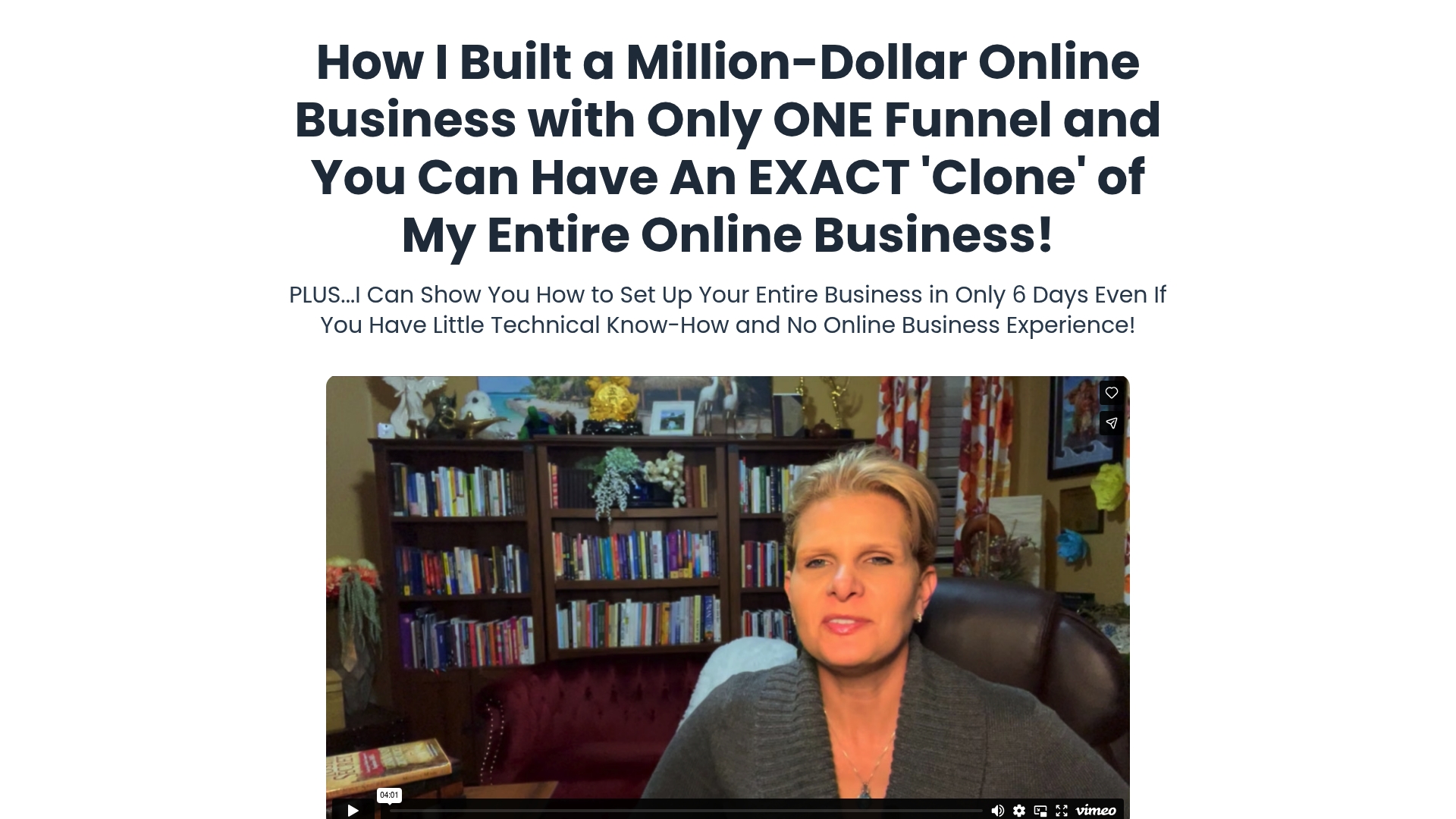
The program is built for digital marketers and entrepreneurs who want a proven framework, not generic theory. You get step-by-step guidance, minimal technical requirements, and access to group mentorship from someone who has built funnels that actually convert. Spots are limited. If you are serious about improving your conversion rates, this is the most direct path available.
FAQ
What are the three main stages of a marketing funnel?
The three main stages are TOFU (top of funnel) for awareness, MOFU (middle of funnel) for nurturing, and BOFU (bottom of funnel) for conversion. HubSpot maps these to Awareness, Consideration, and Conversion in their lead generation framework.
What is a good example of a BOFU tactic?
Free trials, live demos, and money-back guarantees are the most effective BOFU tactics because they reduce perceived risk at the final decision point. Testimonials and limited-time offers on the sales page reinforce the decision to buy.
How many emails should a MOFU nurture sequence include?
A MOFU nurture sequence should include five to seven emails, starting with value delivery and ending with a soft pitch. ClickFunnels recommends at least three to five automated follow-ups as a core funnel component.
What is a tripwire funnel?
A tripwire funnel converts cold traffic with a low-cost initial offer, typically priced between $7 and $27, to create a buyer relationship before presenting a higher-ticket upsell. It works best for e-commerce brands and digital product creators with a clear upsell path.
How do I know which funnel type to use?
Match your funnel type to your offer price and sales complexity. Low-ticket products suit lead magnet or tripwire funnels with full automation. High-ticket services and consulting require application or webinar funnels that include a human sales conversation before closing.