
Most people think sales funnels are just a sequence of pages designed to push someone toward a purchase. That framing misses almost everything that matters. What is funnel psychology? It's the practice of designing each step of your funnel around how people actually make decisions — emotion first, logic second. When you understand that buyers don't move through rational checklists but through feelings, trust signals, and mental shortcuts, you stop building funnels that confuse people and start building ones that convert them.
Table of Contents
- Key takeaways
- What is funnel psychology and why it matters
- Core psychological principles behind funnel design
- Psychological stages in funnels and buyer states
- Practical techniques for higher conversions
- Funnel psychology applied: what real results look like
- My honest take on funnel psychology
- Take funnel psychology from theory to practice with Moneyfunnel
- FAQ
Key takeaways
| Point | Details |
|---|---|
| Emotion precedes logic | Buyers form emotional impressions first and rationalize decisions later, so your funnel must address feelings before features. |
| Dual-process theory drives design | Engaging System 1 at the top of the funnel and System 2 at the bottom maps messaging to how the brain actually decides. |
| Micro-decisions reduce resistance | Asking for small commitments first makes larger asks feel natural rather than risky. |
| Cognitive overload kills conversions | Too many choices or fake urgency causes distrust and abandonment, not action. |
| Empathy is the core mechanism | High-converting funnels work because they meet the buyer's psychological needs at every stage, not because they manipulate. |
What is funnel psychology and why it matters
Funnel psychology is the discipline of building marketing and sales funnels that align with how buyers actually process decisions rather than how marketers wish they would. Traditional funnel thinking treats buyers as if they are evaluating spreadsheets. Real buyers feel uncertain, look for social confirmation, respond to visual cues before reading a word, and form emotional judgments within seconds of landing on a page.
The psychology that drives this is well established. Dual-process decision-making describes two cognitive systems working simultaneously. System 1 is fast, automatic, and emotional. It makes snap judgments based on pattern recognition and gut feeling. System 2 is slow, deliberate, and analytical. It evaluates features, prices, and risk. Effective funnels win System 1 early and give System 2 enough ammunition to justify what System 1 already wants to do.
Understanding this sequence changes how you write headlines, structure pages, sequence offers, and write calls to action. It's not a trick. It's an accurate model of human cognition that most funnel builders ignore entirely.
Core psychological principles behind funnel design
Several psychological triggers consistently move buyers through funnels. The key is knowing when and how to deploy each one.
- Social proof: People look to others when uncertain. Reviews, testimonials, user counts, and case studies build trust and urgency at stages where buyers are on the fence.
- Scarcity and loss aversion: Humans feel the pain of losing something more intensely than they feel the pleasure of gaining it. Authentic scarcity (limited seats, closing enrollment) motivates action without damaging credibility. Fake scarcity does the opposite.
- Reciprocity: When you give something genuinely useful before asking for anything, buyers feel a natural pull to give something back. Free guides, audits, and training sessions work because of this mechanism, not despite it.
- Commitment and consistency: Once someone takes a small action, they are psychologically inclined to remain consistent with that identity. Agreeing with a headline, opting in for a free resource, or answering a quiz question are all small commitments that prime larger ones.
- Cognitive load reduction: Reducing friction in each funnel step is as important as any persuasive copy. Every unnecessary choice, confusing layout, or slow-loading element erodes the mental energy buyers have to make a decision.
Funnel marketing psychology is not about deploying every trigger on every page. Overloading a page with urgency timers, pop-ups, and competing CTAs creates cognitive chaos. The goal is one clear psychological job per funnel step.
Pro Tip: Before writing a single word of funnel copy, write a one-sentence description of the dominant emotional state your buyer is in when they hit that page. Every design and copy decision for that page flows from that sentence.
Psychological stages in funnels and buyer states
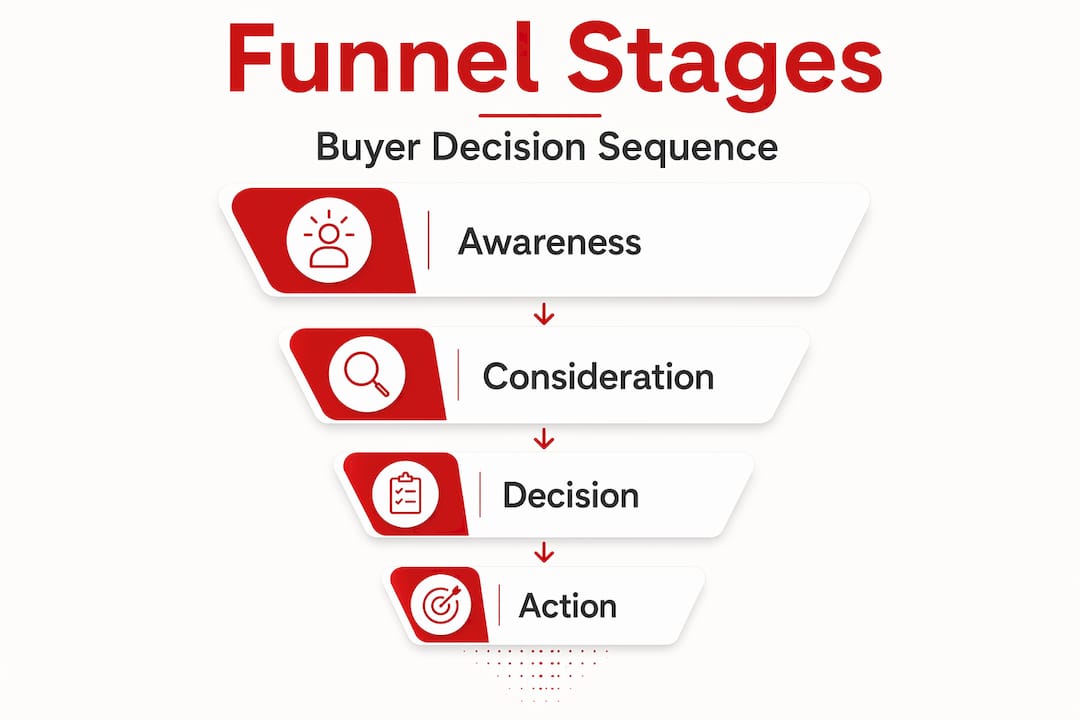
The funnel stages everyone knows — awareness, consideration, decision, and retention — are not just marketing categories. Each stage corresponds to a distinct psychological state, and the messaging that works in one stage will fail in another.
- Awareness: The buyer doesn't know you yet or has just noticed a problem. System 1 is running the show. Your job here is emotional resonance, not information. Simple visuals, a headline that names their exact frustration, and a single next step. Nothing more.
- Consideration: The buyer is comparing options and looking for reasons to trust you. This is where social proof and trust signals do the heaviest lifting. Testimonials, authority markers, transparent pricing, and clear answers to objections shift the buyer's risk perception.
- Decision: System 2 is engaged and the buyer is looking for logical justification. This is where detailed breakdowns, comparison tables, guarantees, and specific outcome claims matter. The analytical justification you provide here is the buyer talking themselves into a decision their emotions already want to make.
- Retention: Post-purchase psychology is underrated. Buyers experience doubt after purchasing (buyer's remorse is real). Onboarding sequences, community belonging, and progress tracking use principles like status and ownership to lock in satisfaction and reduce churn.
Here is how the psychological emphasis shifts across funnel stages:
| Funnel stage | Dominant system | Primary psychological lever |
|---|---|---|
| Awareness | System 1 | Emotional recognition, pattern matching |
| Consideration | System 1 and System 2 | Social proof, trust, risk reduction |
| Decision | System 2 | Logical justification, guarantees, specifics |
| Retention | Both | Identity, status, ownership, community |
This table isn't just theoretical. It dictates what you write, what visuals you choose, and what offers you make at each stage. Misalignment between stage and psychological lever is one of the most common reasons funnels stall.
Practical techniques for higher conversions
Getting funnel psychology to work in practice comes down to structure, sequencing, and restraint.
Micro-decisions and progressive commitment are where most conversions actually happen. Small initial yeses make larger asks feel like a natural continuation rather than a leap. A free checklist opt-in leads to a free webinar registration, which leads to a low-cost offer, which leads to the core product. Each step increases trust and reduces perceived risk. Skipping this sequence and leading with your highest-ticket offer forces buyers to do all the trust-building work in their own heads, which most won't do.

First impressions are structural, not just visual. Funnel page structure should follow the natural decision-making sequence: problem identification, empathetic framing, solution introduction, social proof, offer clarity, FAQ, and CTA. This sequence mirrors how the brain wants to receive information. Pages that open with a product description instead of a problem statement skip the emotional hook that makes the rest of the page worth reading.
Authentic urgency outperforms fabricated scarcity every time. Countdown timers on perpetually available offers, fake "only 3 left" copy, and artificially inflated original prices are common pitfalls that buyers recognize immediately. One moment of distrust unravels the trust built across an entire funnel. Use real deadlines, real enrollment limits, and real reasons why now is the right moment.
Pro Tip: Try starting any progress bar in your checkout or onboarding flow at 20% rather than 0%. The goal gradient effect shows that users who feel closer to a goal are more motivated to complete it. A bar that starts at zero signals a long road ahead. A bar that starts at 20% signals that they're already on their way.
Here's a quick reference for what works versus what backfires in funnel psychology:
| Technique | Effect when done right | Effect when done wrong |
|---|---|---|
| Social proof | Builds trust and lowers perceived risk | Fake or unverifiable reviews destroy credibility |
| Scarcity | Creates genuine urgency and action | Artificial scarcity causes distrust and exit |
| Progressive commitment | Smooths the path to larger purchases | Jumping to big asks too soon triggers resistance |
| Cognitive load reduction | Increases completion and reduces dropout | Too many choices cause decision paralysis |
| Progress indicators | Increases motivation to complete | Showing 0% progress discourages users at start |
Funnel psychology applied: what real results look like
The difference between a traditional funnel and a psychology-driven funnel is not subtle. You see it clearly when you look at how each approach handles the buyer's actual experience.
A conventional funnel treats every visitor as ready to buy. It leads with product features, pricing, and a CTA. A psychology-driven funnel treats every visitor as someone in the middle of an uncertain emotional journey. It leads with a recognized problem, builds empathy, earns trust incrementally, and only then presents the offer.
The modern buyer's journey is non-linear and multi-touchpoint. Someone might encounter your brand on social media, leave, see a retargeted ad, read a blog post, watch a webinar, and then buy. Funnel psychology applied well means that every one of those touchpoints is psychologically coherent. The emotional tone, the trust signals, and the ask are all appropriate for where that buyer is mentally, not just where they are in your marketing sequence.
"Funnels that convert are empathy in action. They meet people's emotional and logical needs at every stage rather than forcing buyers through a process designed for the seller's convenience." — The Psychology of Sales Funnels
The benefits of funnel psychology are measurable. Marketers who optimize for conversion using psychological principles consistently report higher opt-in rates, shorter sales cycles, and lower refund rates. The reason is simple. When buyers feel understood, trusted, and respected throughout a funnel, they arrive at the purchase decision with confidence rather than anxiety.
- Psychology-driven funnels reduce dropout at high-friction stages by addressing objections before the buyer voices them.
- Trust-building sequences lower refund requests because buyers enter with accurate expectations.
- Progressive commitment structures increase average order value by making upsells feel like logical next steps rather than hard sells.
- Emotionally resonant top-of-funnel content improves ad performance because it speaks to identity, not just features. You can explore funnel success examples to see how this plays out across different business models.
My honest take on funnel psychology
I've seen funnel psychology misrepresented so many times that it's worth addressing directly. Most of the skepticism about it comes from people who've seen it weaponized. Fake scarcity. Dark patterns. Manipulative copy that exploits insecurity. That's not funnel psychology. That's cynical marketing that happens to borrow the vocabulary.
The version of funnel psychology that actually produces durable results is rooted in something closer to empathy than persuasion. When I started paying attention to what buyers were feeling at each stage rather than what I wanted them to do, everything changed. The copy got simpler. The offers got clearer. The results got better.
The sequencing lesson took me longer to internalize. You cannot win someone's trust rationally before you've won it emotionally. System 2 is literally easier to disrupt when someone is feeling negative emotions or uncertainty. That means if your funnel makes someone feel confused, pressured, or skeptical at any stage, their analytical system becomes your enemy rather than your ally.
The practical takeaway I return to constantly is this: if your funnel requires deception to work, it's not working. Cognitive ease and authentic trust are what make buyers move forward willingly, not reluctantly. And willing buyers come back.
— Mike
Take funnel psychology from theory to practice with Moneyfunnel
Understanding funnel psychology conceptually is the first step. Applying it to a real funnel that generates actual revenue is a completely different challenge.

Moneyfunnel's 6-Day Mentorship Program is built specifically for people who want to stop theorizing and start building. The program walks you through implementing the exact psychological principles covered in this article into a working funnel, with guided feedback and real-world structure. You don't need deep technical skills. You need a framework grounded in how buyers actually think, and a mentor who has used it to generate results at scale. If you're ready to build your funnel with psychological precision built in from day one, the mentorship program is where that work happens. Spots are limited by design. The learning environment only works when it stays small.
FAQ
What is funnel psychology in simple terms?
Funnel psychology is the practice of designing each step of a sales funnel to match how buyers actually make decisions — addressing emotions first, then providing logical reasons to act. It's less about persuasion tactics and more about aligning your funnel with natural human decision-making patterns.
How does funnel psychology differ from traditional funnel building?
Traditional funnels focus on product features and sequential steps toward a sale. Funnel psychology focuses on the buyer's emotional and cognitive state at each stage, matching messaging and structure to what the buyer needs psychologically, not just informationally.
What are the main psychological stages in funnels?
The four main psychological stages are awareness (System 1 emotional recognition), consideration (trust and risk reduction), decision (System 2 logical justification), and retention (identity and ownership reinforcement). Each stage requires different psychological triggers and messaging strategies.
Does funnel psychology work for small businesses?
Yes. The psychological principles behind funnel design — social proof, cognitive ease, progressive commitment, and authentic urgency — apply regardless of business size. A one-person business using a simple three-step funnel benefits from these principles just as much as a large marketing team.
What is the biggest mistake in applying funnel psychology?
Using fake scarcity or cognitive overload. Both destroy the trust that funnel psychology is designed to build. Buyers recognize artificial pressure quickly, and once trust is broken, no amount of persuasive copy recovers it.