
Most people assume testing funnel offers means swapping a headline or changing a button color. That misconception costs real money. Understanding why test funnel offers matters goes much deeper than surface tweaks. Your offer, meaning the specific combination of price, bonus, guarantee, and framing you present at each funnel stage, is the single highest-leverage variable in your entire marketing system. Get it wrong and even the prettiest funnel quietly bleeds revenue. This guide walks you through the real reasoning, the right sequence, and the practical frameworks to test offers that actually move conversion numbers.
Table of Contents
- Key takeaways
- What funnel offers actually are
- Why test funnel offers: diagnosing bottlenecks first
- Strategic sequencing of offer tests
- Designing effective funnel offer tests
- Interpreting results and iterating
- My honest take on why most funnel tests fail
- Take your funnel offer testing further with Moneyfunnel
- FAQ
Key takeaways
| Point | Details |
|---|---|
| Diagnose before you test | Map your funnel drop-offs first so you test the right stage, not just the most visible one. |
| Offers outperform creative | The framing of your offer influences conversions more than design or copy alone. |
| Sequence tests strategically | Fix activation problems before testing retention or expansion offers to avoid noisy data. |
| Measure full-funnel impact | A page-level metric win means nothing if downstream sign-ups or purchases do not rise. |
| Iterate with guardrail metrics | Use secondary metrics to catch false positives and protect revenue while testing. |
What funnel offers actually are
Before you can understand the importance of testing funnel offers, you need a clear picture of what funnel offers are. A funnel offer is not just your product. It is the specific package of value you present at a defined stage in the customer journey. That package can include a price point, a time-limited discount, a bonus bundle, a money-back guarantee, a free trial, or a risk-reversal mechanism like a "pay after results" structure.
Funnel offers appear at every stage. On a landing page, the offer might be a free lead magnet in exchange for an email. On a pricing page, it could be a discount for annual billing. At checkout, it might be an order bump with a complementary product. Each of these is a distinct offer, and each one shapes the decision your prospect makes at that exact moment.
Here is why offers carry more weight than most marketers realize. Buyer psychology and offer framing determine whether a prospect feels like they are getting a deal or paying a premium, even when the price is identical. Two offers at the same price, one framed as "save $50" and the other framed as "get $50 of bonuses free," can produce dramatically different conversion rates because of how the human brain processes gain versus loss.
Key components of a funnel offer you should always evaluate:
- Price framing: Anchor price versus actual price versus perceived value
- Risk reversal: Guarantees, trials, and refund policies that reduce friction
- Bonuses: Stacked value adds that tip undecided buyers
- Urgency triggers: Deadlines and scarcity that create action without feeling manipulative
- Social proof integration: Testimonials and results data embedded within the offer itself
Pro Tip: Before running any test, write your offer hypothesis in plain English: "I believe changing X will cause Y because Z." This forces clarity and prevents you from running vague tests that yield vague answers.
Why test funnel offers: diagnosing bottlenecks first
Here is the mistake most aspiring marketers make. They notice conversions are low, pick the page they think looks worst, run an offer test, and declare success or failure. They skip the diagnostic step entirely. Funnel analysis is the blueprint. Running A/B tests without it is like prescribing medication before examining the patient.
The diagnostic step means mapping every stage of your funnel and measuring conversion rate between each step. What you are looking for is not just the biggest percentage drop but the biggest absolute user loss. A step that converts at 60% instead of 80% looks bad in percentage terms. But if only 50 people reach that step, fixing it rescues 10 users. Compare that to a step where 1,000 people drop off at a 5% lower rate. That is where your testing budget actually creates impact.

Consider this example: You spend two weeks testing a new bonus offer on your sign-up page. You see a modest lift. But your pricing page was converting at a fraction of its potential the whole time. Optimizing a sign-up form converting at 78% wastes time if the pricing page is where most users actually exit.
| Funnel stage | Visitors | Conversions | Drop-off | Priority |
|---|---|---|---|---|
| Landing page | 5,000 | 3,500 | 1,500 | Medium |
| Pricing page | 3,500 | 1,400 | 2,100 | High |
| Checkout | 1,400 | 980 | 420 | Low |
| Confirmation | 980 | 975 | 5 | Ignore |
The table above shows that the pricing page loses the most absolute users. That is where you test your offer, not the landing page or the checkout. Sales funnel reports that link activity to revenue by tracking stage-by-stage leakage give you this exact view. Tools like Google Analytics 4, Hotjar, or purpose-built funnel software can surface this data within days.
Pro Tip: Segment your funnel analysis by traffic source before running any offer test. High bounce rates from one channel often indicate audience quality problems, not offer problems. Testing a new offer into bad traffic just wastes your test budget.
Strategic sequencing of offer tests
Even after you identify the right funnel stage to test, the order in which you run tests matters enormously. Experiment sequencing should prioritize activation before retention or expansion. In plain terms: fix the leaky early stages before worrying about whether your upsell offer converts better.
Why? Because if your activation step is broken, the users who reach your upsell or retention offer are already a skewed sample. The data you collect from downstream tests is contaminated by the upstream leak. You might conclude your upsell offer is weak when the real problem is that only your most motivated prospects are making it that far.
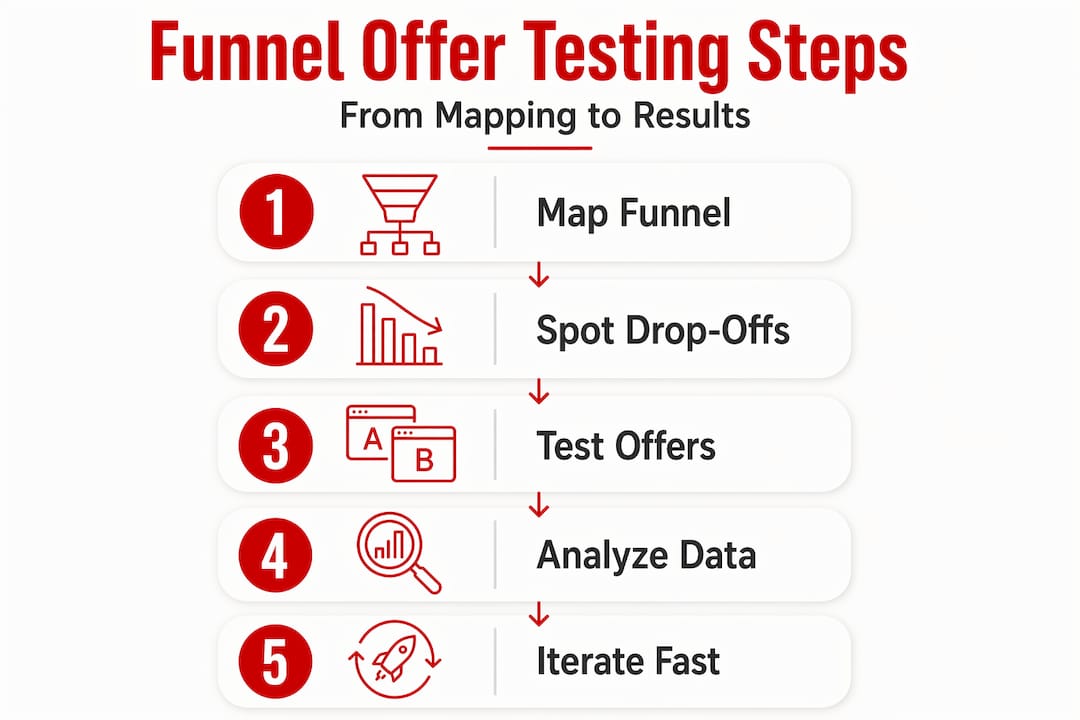
Here is the sequencing framework that consistently produces clean, actionable results:
- Fix the traffic quality problem first. Check audience fit signals like MQL-to-SQL ratio before assuming your offer needs work.
- Test your activation offer. This is the first conversion event in your funnel. Optimize the offer that gets someone to opt in, register, or start a trial.
- Test your core purchase offer. Once activation is stable, move to the offer that converts leads into buyers. This is where price framing, bonuses, and guarantees have the biggest revenue impact.
- Test your upsell or expansion offer. Only after your core offer is optimized does it make sense to refine what you present to existing buyers.
- Document every hypothesis and result. Experimentation without strategy leads to ambiguous results and repeated mistakes.
The discipline here is what separates entrepreneurs who build reliable funnels from those who run endless tests and never get traction. When you prioritize marketing experiments based on where users actually exit rather than where tests feel easiest, your results compound.
Pro Tip: Calculate minimum detectable effect before starting each test. If you need a 30% lift to reach statistical significance with your current traffic, you are either testing the wrong stage or you need to wait until your traffic volume grows.
Designing effective funnel offer tests
The practical side of funnel offer optimization comes down to isolation. When you change too many variables at once, you cannot tell which change drove the result. A strong offer test changes one dimension of the offer while holding everything else constant.
The A/B/C offer test framework is especially useful here. Running three offer variants simultaneously identifies which framing resonates best because you are targeting different buyer psychologies at once. One variant might lead with the discount, one with the bonus stack, and one with the guarantee. The winner tells you what your specific audience values most.
Here is how the three core offer dimensions compare as test variables:
| Offer element | What it tests | Risk level |
|---|---|---|
| Discount depth | Price sensitivity and minimum effective incentive | Medium — margin impact |
| Bonus bundle | Perceived value without price change | Low — no margin cost |
| Guarantee strength | Risk tolerance and trust deficit | Low to medium |
On the topic of discounts, experienced testers do not assume that bigger discounts equal better conversion. Testing discounts involves finding the minimum effective incentive because excessive discounting either trains customers to wait for sales or erodes margin without meaningful lift.
Common pitfalls to avoid in offer testing:
- Peeking at results early: Stopping a test as soon as you see a trend produces false positives at an alarming rate.
- Running uncontrolled tests: Launching a new paid traffic campaign during a live offer test contaminates the data.
- Ignoring audience fit: A strong offer shown to the wrong audience will lose every time, making the offer look weak when the problem is targeting.
- Measuring only page-level metrics: An 18% improvement in pricing-page CTA click-through means nothing if sign-ups do not rise.
You also want to look at what's working for others through funnel hacking research. Studying how successful funnels in your market structure their offers gives you high-quality hypotheses to test instead of guessing.
Interpreting results and iterating
Reading your test results correctly is where most entrepreneurs stumble. They see a winning variation and immediately roll it out without checking whether the win holds across the full funnel. Funnel improvement efforts should be judged by true downstream revenue impact, not just clicks or lead counts.
Here is a practical framework for interpreting your offer test results:
- Primary metric: Full-funnel conversion rate from entry point to purchase or desired outcome
- Secondary guardrail metrics: Refund rate, customer lifetime value signals, support ticket volume
- Downstream check: Did your winning offer produce buyers who stick, or did it attract low-quality conversions that churn fast?
- Segment the results: Does the winning offer work equally well across traffic sources, or only for one segment?
When a test shows no winner, that is data too. It often means your audience fit needs work before your offer can do its job. Pivot to segmentation or traffic quality analysis before running another offer variation. Iterating based on what your funnel data actually tells you, rather than what you hoped it would say, is the skill that separates sustainable growth from random results.
Pro Tip: Always run a one-week post-test check after declaring a winner. Some offer changes produce a novelty effect that fades quickly. If your conversion rate drops back to baseline within a week, the test was not a true win.
My honest take on why most funnel tests fail
I have worked with a lot of aspiring entrepreneurs who come frustrated that their funnel tests produce nothing useful. When I look at what they are doing, the pattern is almost always the same. They jump straight to testing offers without ever diagnosing where their funnel is actually broken.
I have seen funnels where the landing page copy was excellent, the offer was genuinely strong, and the test still showed no improvement. Why? Because a structural problem upstream was filtering out the wrong traffic before it ever reached the offer. No amount of offer testing fixes a traffic quality problem.
The other failure pattern I see consistently is testing too many things at once because marketers feel pressure to move fast. Speed without discipline produces noise, not insight. My approach is always the same: diagnose the funnel first, write a specific hypothesis, run one isolated test, and measure the full downstream impact before drawing conclusions.
What I find most encouraging is that once entrepreneurs adopt this sequencing discipline, their results improve quickly. Not because they found a magic offer, but because they stopped wasting tests on the wrong problems. Disciplined experimentation compounds. Each clean test builds your understanding of your audience, and that understanding makes every future offer stronger. That is how funnels grow from converting at 1% to 3% to 5% over time.
— Mike
Take your funnel offer testing further with Moneyfunnel
If reading this made you realize you have been testing offers without a clear diagnostic foundation, you are not alone. Most marketers start where you are.

The 6-Day Money Funnel Mentorship at Moneyfunnel was built specifically for aspiring entrepreneurs who want a structured, proven system rather than trial and error. Inside the program, you get hands-on guidance for building your funnel from the ground up, identifying the right stages to test, designing offer hypotheses that reflect real buyer psychology, and reading results without second-guessing yourself. Moneyfunnel walks you through the exact frameworks covered in this article, with expert feedback on your specific funnel. Spots are limited, so this is not a resource you want to bookmark and forget.
FAQ
What are funnel offers?
Funnel offers are the specific combinations of price, bonuses, guarantees, and framing presented to prospects at each stage of a sales funnel to drive conversion.
Why test funnel offers instead of just redesigning the page?
Page design affects aesthetics, but the offer determines the decision. Testing the offer isolates the highest-leverage variable in any conversion equation.
How do you know which funnel stage to test first?
Use funnel analysis to find the step with the largest absolute user loss, then start your offer tests there for maximum impact.
What is the biggest mistake in funnel offer testing?
Running offer tests before diagnosing where users actually drop off, which leads to testing the wrong stage and producing meaningless results.
How many offer variants should you test at once?
Three variants using the A/B/C framework work well. This lets you compare different offer framings, such as discounts, bonuses, and guarantees, without overcomplicating your test setup.