
A sales funnel is the structured path a prospect travels from first hearing about your business to becoming a paying, loyal customer. Explaining sales funnel stages means breaking that path into distinct phases, each with its own buyer mindset, required content, and measurable outcome. Frameworks used by Salesforce, monday.com, and Pipedrive consistently point to a six-stage model as the most actionable structure for online businesses. When you understand what each stage demands, you stop guessing and start converting with precision.
What are the six classic sales funnel stages?
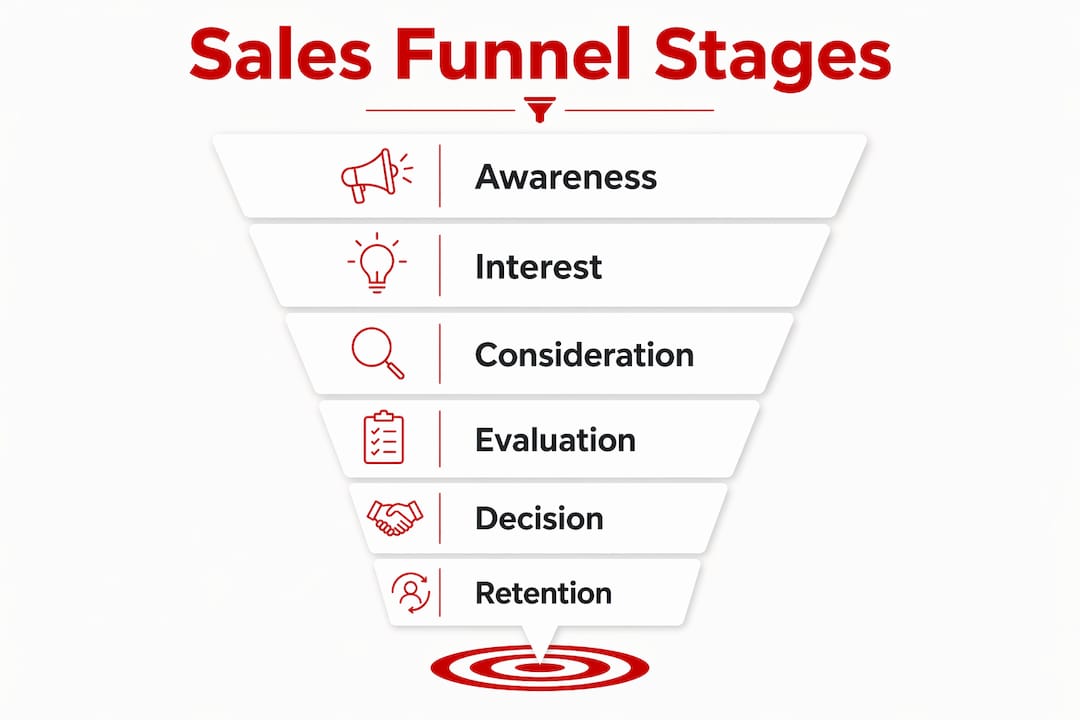
The six-stage sales funnel moves from Awareness through Interest, Consideration, Evaluation, Decision, and Retention. Each stage reflects a shift in what the buyer is thinking and what your business needs to deliver. Think of the funnel as a narrowing pipe: many prospects enter at the top, and a smaller, more qualified group exits at the bottom as customers.
Stage 1: Awareness. The buyer recognizes a problem and discovers your brand for the first time. Your goal here is not to sell. Awareness success is measured by establishing a helpful, authoritative presence. Blog posts, social media content, and SEO-driven articles are the primary tools.

Stage 2: Interest. The prospect actively seeks information about solutions. They subscribe to your email list, follow your social profiles, or read multiple pages on your site. Your messaging should educate, not pitch.
Stage 3: Consideration. The buyer compares options. They download case studies, read reviews, and attend webinars. This is where funnel psychology matters most. Your content must prove you understand their specific problem better than anyone else.
Stage 4: Evaluation. The prospect requests a demo, asks for pricing, or starts a free trial. In B2B contexts, multiple stakeholders get involved here. Your sales team takes the lead, and marketing supports with proof assets.
Stage 5: Decision. The buyer chooses a vendor. Urgency, guarantees, and frictionless checkout all influence this moment. A single confusing step can kill a conversion that took weeks to build.
Stage 6: Retention and Expansion. The customer renews, upgrades, or refers others. This stage is where lifetime value is built. Most entrepreneurs underinvest here, which is a costly mistake.
| Stage | Buyer Mindset | Your Goal | Example Action |
|---|---|---|---|
| Awareness | "I have a problem" | Build visibility | Prospect reads a blog post |
| Interest | "What solves this?" | Educate and attract | Prospect subscribes to email list |
| Consideration | "Which option fits me?" | Prove relevance | Prospect downloads a case study |
| Evaluation | "Can I trust this?" | Demonstrate value | Prospect requests a demo |
| Decision | "I'm ready to buy" | Remove friction | Prospect completes checkout |
| Retention | "Is this worth keeping?" | Deepen relationship | Customer renews or upgrades |
Pro Tip: Tailor your content format to the stage. Top-of-funnel content should educate broadly. Bottom-of-funnel content should answer the single objection standing between the prospect and a purchase.
How do funnel stages connect to measurable metrics?
Each funnel stage produces a measurable transition rate. Stage-to-stage conversion analysis tracks Visitor to Lead, Lead to Marketing Qualified Lead (MQL), MQL to Sales Qualified Lead (SQL), SQL to Opportunity, and Opportunity to Closed-Won. That sequence tells you exactly where prospects are dropping off, not just whether your overall numbers are up or down.
The marketing-to-sales handoff between MQL and SQL is where most funnels leak. The largest funnel leaks are concentrated in middle stages, and focusing only on end-to-end conversion masks these bottlenecks entirely. If your MQL-to-SQL rate is low, the problem is qualification criteria, not your closing skills.
| Funnel Transition | What It Measures | Why It Matters |
|---|---|---|
| Visitor → Lead | Top-of-funnel attraction | Shows if your content draws the right audience |
| Lead → MQL | Lead quality filter | Reveals if marketing attracts buyers, not browsers |
| MQL → SQL | Sales readiness | Exposes alignment gaps between marketing and sales |
| SQL → Opportunity | Pipeline health | Indicates if demos and calls are converting |
| Opportunity → Closed-Won | Revenue efficiency | Measures your actual close rate |
Aligning content goals and KPIs per stage sharpens this further. Engagement metrics belong to Awareness. Proof metrics like case study downloads belong to Consideration. Win rate belongs to Decision. Lifetime value (LTV) belongs to Retention. When each stage has its own KPI, you can diagnose and fix problems with surgical precision.
Pro Tip: Track stage-to-stage conversion rates weekly, not just monthly. A single week of low MQL-to-SQL conversion often signals a content or targeting problem you can fix before it compounds.
How do b2b and b2c funnels differ?
B2B and B2C funnels share the same six phases but operate at completely different speeds and complexities. B2B funnels involve longer sales cycles, multiple decision-makers, and a much heavier Evaluation stage where demos, pricing negotiations, and legal reviews all occur. A B2C purchase can happen in minutes. A B2B deal can take six months.
Here is how the two contexts diverge in practice:
- Awareness: B2B relies on LinkedIn content, whitepapers, and industry events. B2C leans on Instagram ads, influencer posts, and search traffic.
- Consideration: B2B buyers read detailed comparison guides and request references. B2C buyers read reviews on Amazon or Google.
- Evaluation: B2B requires product demos, security reviews, and procurement sign-off. B2C rarely has a formal evaluation stage at all.
- Decision: B2B decisions involve contracts and legal teams. B2C decisions involve a credit card and a checkout button.
- Retention: B2B retention is driven by account management and quarterly reviews. B2C retention is driven by loyalty programs and email sequences.
The practical implication for entrepreneurs is this: define clear entry and exit criteria for each stage based on observable buyer actions. Funnel stages should reflect your prospect's actual buying journey, not a generic template you copied from a blog. A prospect who downloads a pricing PDF has crossed a different threshold than one who just opened your homepage. Treat them differently.
How to apply funnel stage knowledge to your online business
Understanding the sales funnel process is only useful when you act on it. Here is a practical sequence for putting funnel stage knowledge to work in your online business:
- Map your customer's buying journey. Interview recent customers and ask what they searched, read, and compared before buying. Their answers define your real funnel stages, not a theoretical model.
- Assign content to each phase. Top-of-funnel content should answer broad questions. Mid-funnel content should compare and prove. Bottom-of-funnel content should eliminate the last objection. The role of copywriting at each transition point is what separates funnels that convert from ones that leak.
- Set up tracking for every stage transition. Use a CRM like Pipedrive or Salesforce to log when a prospect moves from one stage to the next. Without this data, you are optimizing blind.
- Identify your biggest leak. Pull your stage-to-stage conversion rates and find the single transition with the lowest rate. Fix that before touching anything else. This is where funnel conversion rate analysis pays off immediately.
- Update stages dynamically. A sales funnel is a visual roadmap updated as prospect behavior changes, not a fixed classification. If a prospect who was in Consideration suddenly requests a demo, move them to Evaluation immediately and respond accordingly.
- Build a retention system. Post-purchase email sequences, loyalty offers, and referral programs belong inside your funnel, not outside it. Customer lifetime value growth is the highest-return activity in any online business.
The entrepreneurs who grow fastest are not the ones with the most traffic. They are the ones who know exactly where their funnel breaks and fix it systematically.
Key takeaways
A well-defined six-stage sales funnel, tracked by stage-to-stage conversion rates and aligned to real buyer behavior, is the most reliable system for growing an online business predictably.
| Point | Details |
|---|---|
| Six stages cover the full journey | Awareness through Retention maps every buyer mindset shift from problem recognition to loyalty. |
| Stage-to-stage metrics reveal leaks | Track Visitor to Lead, MQL to SQL, and Opportunity to Closed-Won to find and fix specific drop-off points. |
| Mid-funnel is the biggest risk | The marketing-to-sales handoff between MQL and SQL is where most funnels lose qualified buyers. |
| B2B and B2C require different tactics | B2B funnels need demos, references, and longer nurture sequences; B2C funnels prioritize speed and social proof. |
| Funnels must update in real time | Move prospects between stages as their behavior changes to keep messaging relevant and conversion rates high. |
Why most entrepreneurs get the middle funnel wrong
I have reviewed dozens of online business funnels, and the pattern is almost always the same. Entrepreneurs obsess over top-of-funnel traffic and bottom-of-funnel close rates. The middle, specifically the Consideration and Evaluation stages, gets ignored. That is where the money is being left on the table.
The instinct to focus on traffic makes sense. More visitors feel like progress. But a funnel with 10,000 monthly visitors and a broken MQL-to-SQL handoff will consistently underperform a funnel with 2,000 visitors and a clean, well-defined qualification process. I have seen this play out repeatedly. The fix is almost never more ad spend. It is clearer stage definitions tied to observable buyer actions, exactly what objective entry and exit criteria are designed to create.
The other mistake I see constantly is treating the funnel as a static document. You build it once, label the stages, and assume it reflects reality. It does not. Buyer behavior shifts. A prospect who went cold in Consideration can re-enter at Evaluation three months later because a competitor raised prices. If your CRM still shows them as cold, you miss the window entirely.
My honest advice: spend one hour this week pulling your stage-to-stage conversion data. If you do not have it, that is your first problem to solve. The sales funnel overview is not just a marketing concept. It is the operating system of your revenue.
— Mike
Ready to build a funnel that actually converts?
Understanding the phases of a sales funnel is the foundation. Building one that generates consistent revenue is the next step. Moneyfunnel's 6-Day Mentorship Program walks you through the entire sales funnel process, from mapping your buyer's journey to tracking the metrics that matter, in a structured, hands-on format.
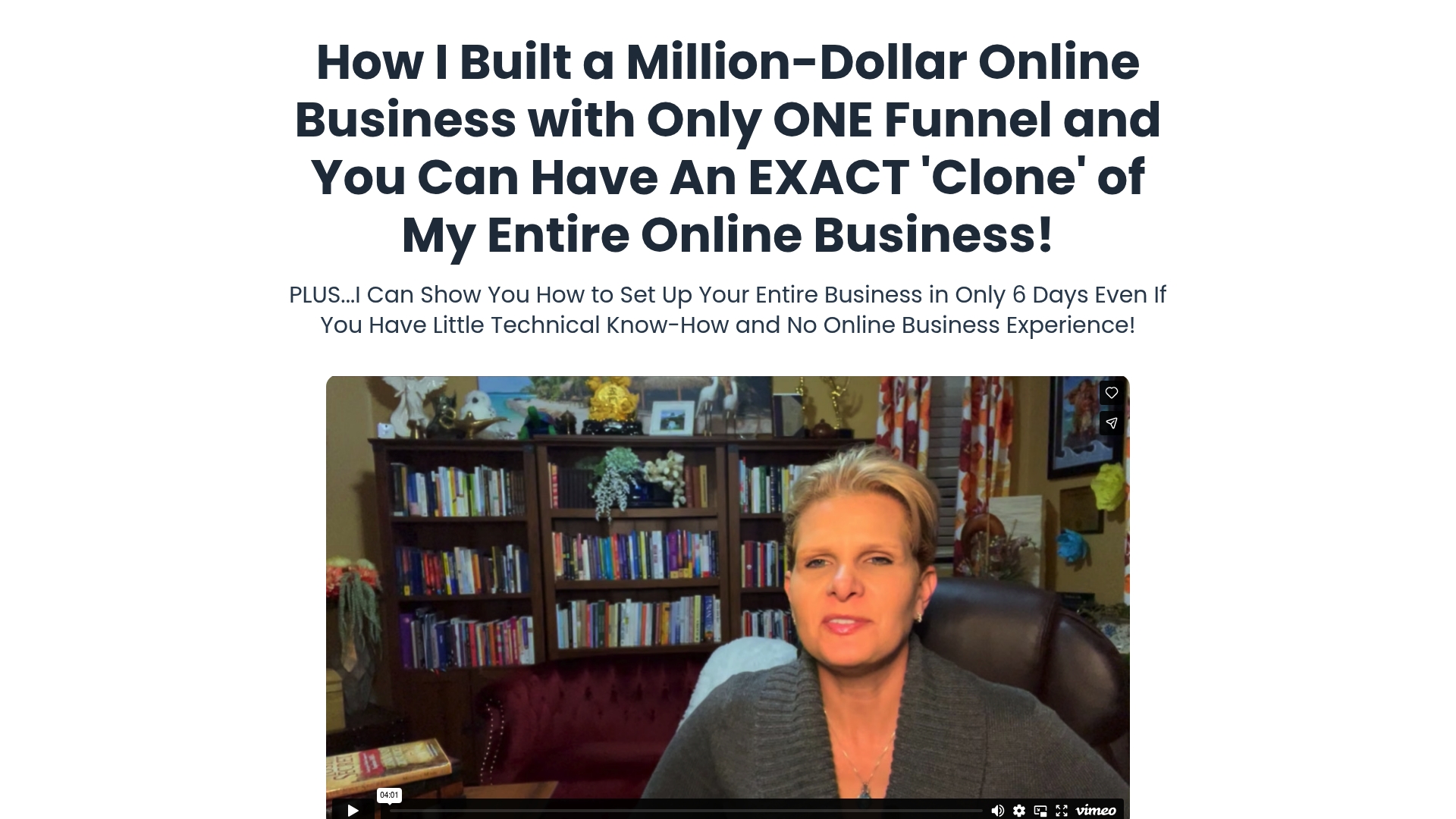
Moneyfunnel was built on the back of a single funnel that generated $10 million. The mentorship program distills that experience into six focused days, with direct group access to guidance you can apply immediately. If you are serious about turning funnel knowledge into real revenue, this is where to start.
FAQ
What are the six sales funnel stages?
The six stages are Awareness, Interest, Consideration, Evaluation, Decision, and Retention. Each stage reflects a distinct buyer mindset and requires specific content and messaging to move prospects forward.
Why does the middle funnel matter most?
The marketing-to-sales handoff between MQL and SQL is where most funnels lose qualified buyers. Fixing this transition typically produces faster revenue gains than increasing top-of-funnel traffic.
How do b2b sales funnel stages differ from b2c?
B2B funnels have longer cycles, multiple stakeholders, and a heavy Evaluation stage involving demos and procurement reviews. B2C funnels move faster and rely more on social proof and frictionless checkout.
What metrics should i track per funnel stage?
Track Visitor-to-Lead, Lead-to-MQL, MQL-to-SQL, SQL-to-Opportunity, and Opportunity-to-Closed-Won rates. Each transition reveals a specific strength or weakness in your funnel.
How often should i update my funnel stages?
Update prospect stages in real time as their behavior changes. A sales funnel is a live roadmap, not a fixed classification, and outdated stage data leads to missed conversion opportunities.