
Funnel copywriting is the practice of writing targeted, stage-specific messages that move prospects from first contact to purchase inside a structured sales funnel. It covers every touchpoint: ad headlines, landing pages, email sequences, CTAs, sales pages, and post-purchase follow-ups. The role of copywriting in funnels is not decorative. It is the mechanism that determines whether a visitor keeps reading, clicks, or buys. Without copy that matches intent at every stage, even a technically perfect funnel will bleed conversions. This article breaks down how funnel copy works, what the data says about its impact, and how you can write it better starting today.
How does copywriting influence each stage of the sales funnel?
Funnel copywriting, also called conversion copywriting in professional CRO circles, moves people stage-by-stage toward a single conversion action using cohesive messaging across all touchpoints. Each stage of the funnel demands a different copy goal, and confusing those goals is one of the most common mistakes new marketers make.
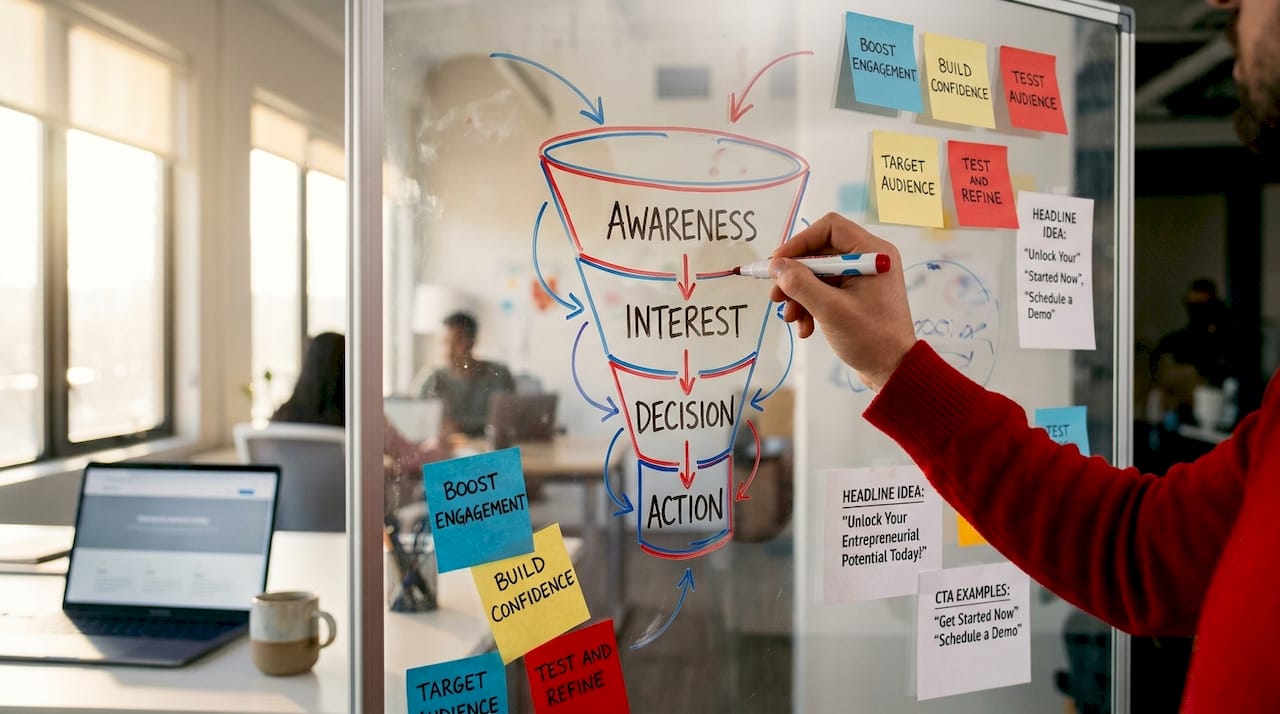
The AIDA framework (Awareness, Interest, Desire, Action) maps directly to what your copy must accomplish at each step:
- Awareness: The headline is your only job here. It must stop the scroll and signal relevance within three to five seconds. A Facebook ad headline like "Struggling to get leads from your funnel?" speaks directly to a pain point and earns the click.
- Interest: Once on the landing page, copy shifts to educating. Subheadlines, short paragraphs, and benefit-focused bullets hold attention and build curiosity. This is where you explain what you offer and why it matters.
- Desire: This is where social proof, case studies, and specific outcome statements do the heavy lifting. Copy here answers the unspoken question: "Will this actually work for me?" Testimonials, data points, and before-and-after scenarios build emotional conviction.
- Action: CTA copy must reduce friction and create urgency without feeling manipulative. Phrases like "Start your free trial" or "Get instant access" outperform generic "Submit" buttons because they describe what happens next.
Message match is the thread that ties all four stages together. When your ad promises "a six-day system to build your first funnel," your landing page headline must echo that exact promise. Breaking this continuity causes intent mismatches that kill conversions before the visitor reads a second sentence.
Pro Tip: Write your landing page headline before you write your ad. Then reverse-engineer the ad copy to match the landing page promise. This forces message match from the start instead of patching it later.
What does conversion data reveal about the impact of copy elements?
The numbers on copy versus design are not even close. Headline and value proposition changes produce conversion lifts of 50 to 200 percent. CTA copy changes produce lifts of 20 to 50 percent. Design changes, by contrast, produce only 5 to 20 percent. This means the words on your page are doing three to ten times more work than the visual layout.
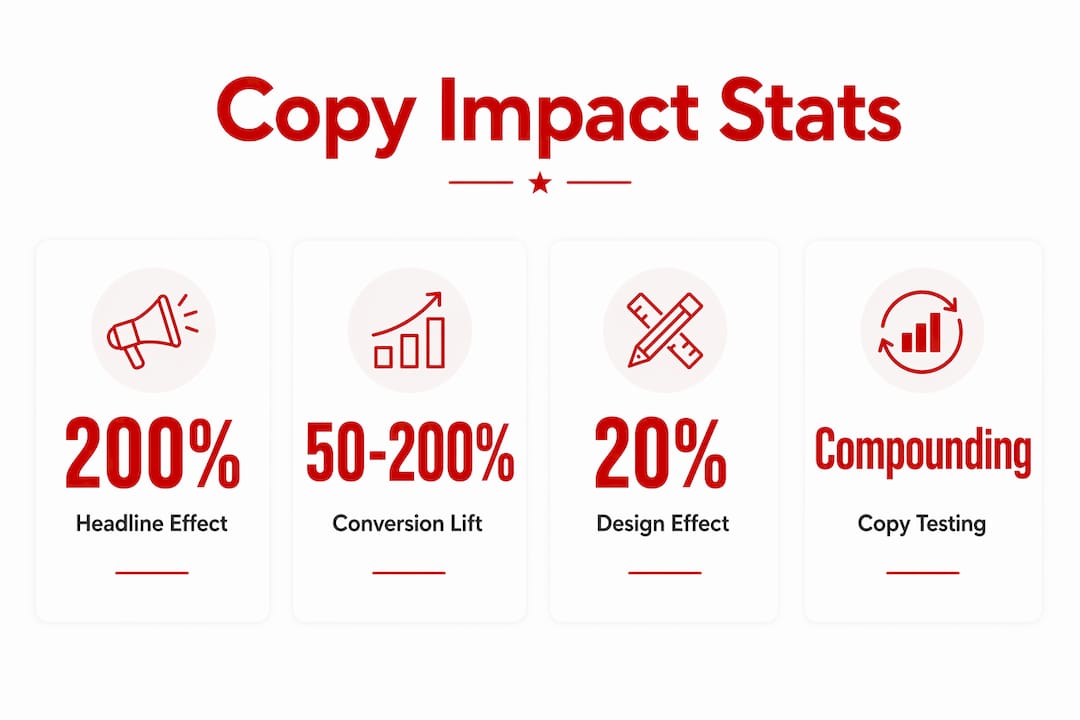
The compounding effect makes this even more significant. When you run copy experiments in the right order, the gains multiply rather than add. A 15 to 20 percent lift from a headline test followed by a 15 to 20 percent lift from a CTA test does not produce 30 to 40 percent total improvement. It produces 50 to 200 percent overall increases because each improvement builds on the last. This is why copy-first testing is the standard approach in serious CRO work.
Conversion benchmarks also vary far more than most marketers realize. A 2026 study of 2,000 landing pages found that median conversion rates differ sharply by category: webinar registrations convert at around 11.4 percent, B2B SaaS at 4.1 percent, and DTC ecommerce at 2.3 percent. Chasing a universal 5 percent target is misleading because it ignores what is actually achievable in your specific funnel type.
| Funnel category | Median conversion rate | Top quartile benchmark |
|---|---|---|
| Webinar registration | 11.4% | ~17–22% |
| B2B SaaS free trial | 4.1% | ~6–8% |
| DTC ecommerce | 2.3% | ~3.5–4.5% |
| Lead gen (general) | ~5–7% | ~10–12% |
"Copy optimizations compound when ordered properly: headline first, then CTA, then proof elements to maximize ROI on funnel conversions." — PulseCRO, 2026
The practical implication is clear. Before you redesign your funnel, rewrite your headline. Before you hire a designer, test your CTA copy. The data consistently shows that copy is the highest-leverage variable in funnel performance.
How to write effective funnel copy that maximizes conversions
Writing copy that converts is a skill built on a small number of repeatable principles. Here is the order that produces the best results:
- Lead with the benefit, not the feature. "Lose 10 pounds in 30 days" outperforms "Our program uses a proprietary metabolic protocol" every time. Prospects buy outcomes, not mechanisms.
- Match your message to your traffic source. Cold traffic from a Facebook ad needs more context and trust-building than warm traffic from an email list. The same landing page copy will not perform equally across both sources.
- Use social proof that is specific. "Over 10,000 customers" is weaker than "Sarah from Austin doubled her email list in 11 days." Specificity makes proof believable. Vague claims create skepticism.
- Reduce friction in your CTA. Risk-reducing language such as "no obligation," "cancel anytime," or "free to start" lowers anxiety and measurably improves click-through rates. The next step must feel safe.
- Edit for clarity before you edit for persuasion. If a reader cannot understand what you are offering in ten seconds, no amount of clever wordsmithing will save the conversion.
- Test AI-generated copy carefully. A 2026 study found that AI copy underperforms on DTC and webinar pages due to generic adjectives and tonal flatness. Heavily edited AI copy, however, performs at or above human-written levels. Use AI as a first draft, not a final product.
Pro Tip: When editing AI-generated funnel copy, replace every generic adjective ("amazing," "powerful," "proven") with a specific number or outcome. "Proven results" becomes "clients report 3x more leads in 60 days." Specificity is the single fastest way to lift AI copy from average to high-converting.
Effective funnel copy reduces cognitive friction by keeping language consistent and benefit-focused throughout the entire funnel. When a visitor never has to stop and wonder what you mean or what happens next, conversion probability rises at every stage.
How to measure and optimize funnel copy performance
Writing good copy is step one. Knowing whether it is working, and improving it systematically, is what separates marketers who plateau from those who scale. Here is how to approach optimization without wasting time on inconclusive tests:
- Segment your data by traffic source before drawing conclusions. Cold paid traffic and warm organic traffic behave differently. Pooling them hides which copy is actually performing and for whom.
- Test one variable per experiment. Changing the headline and the CTA in the same test makes it impossible to know which change drove the result. Clean tests produce usable data.
- Follow the priority order. Headline testing is the fastest route to conversion improvement because it affects every visitor's first impression. After the headline, test CTA copy and placement. Then move to proof elements like testimonials and guarantees.
- Wait for statistical significance. Running a test for three days and declaring a winner based on 80 visitors is how marketers make expensive mistakes. Most tools require at least 100 conversions per variant before results are reliable.
- Use category-specific benchmarks to set realistic goals. Misapplying benchmarks wastes time optimizing copy that is already performing well for its funnel type. Know your category median before deciding whether your funnel has a copy problem or a traffic problem.
You can find a detailed breakdown of what realistic targets look like for different funnel types in this funnel conversion rate guide. Understanding where you stand relative to your category is the first step toward knowing where to focus your copy efforts.
Key takeaways
Funnel copywriting is the highest-leverage variable in conversion performance, and optimizing headlines, CTAs, and proof elements in the correct order produces compounding gains that design changes alone cannot match.
| Point | Details |
|---|---|
| Copy outperforms design | Headline changes produce 50–200% lifts vs. 5–20% for design changes. |
| Stage-specific messaging matters | Each funnel stage requires a distinct copy goal tied to the AIDA framework. |
| Message match is non-negotiable | Ad-to-landing-page continuity prevents intent mismatches that kill conversions. |
| Test in the right order | Headline first, then CTA, then proof elements for compounding conversion gains. |
| Benchmarks vary by category | Webinar funnels convert at 11.4% median; DTC ecommerce at 2.3%. Use the right target. |
Why I think most funnel builders are solving the wrong problem
I have reviewed hundreds of funnels built by aspiring entrepreneurs, and the pattern is almost always the same. The design is clean. The colors are on-brand. The layout follows every best practice. And the copy is an afterthought written in an hour and never touched again.
Here is what that costs: good funnel copy acts as infrastructure for sustainable business growth, not just a conversion tactic. When your copy is specific, clear, and matched to your audience's actual language, it attracts higher-intent visitors and filters out people who were never going to buy. That means better revenue quality, not just higher volume.
The trap I see most often is treating a copy problem as a design problem. Conversion drops, so the funnel gets a new color scheme or a different layout. The numbers barely move. Then the entrepreneur concludes that funnels do not work, when the real issue was a headline that did not match the ad promise or a CTA that asked for too much too soon.
The other mistake is treating content and conversion copy as separate disciplines. Strong funnel copywriting integrates both: content builds the audience and earns trust, while conversion copy turns that trust into action. The best funnels I have seen treat every email, every blog post, and every ad as part of one continuous conversation with the prospect. That continuity is what makes the eventual sale feel like a natural next step rather than a pitch.
If you want to understand how funnel psychology shapes the way copy should be written at each stage, that is worth studying before you write another word of funnel copy.
— Mike
Ready to put this into practice with real mentorship?
If you have been building funnels and not seeing the conversions you expected, the gap is almost always in the copy. Knowing the principles is one thing. Applying them to your specific offer, audience, and traffic source is where most people get stuck.
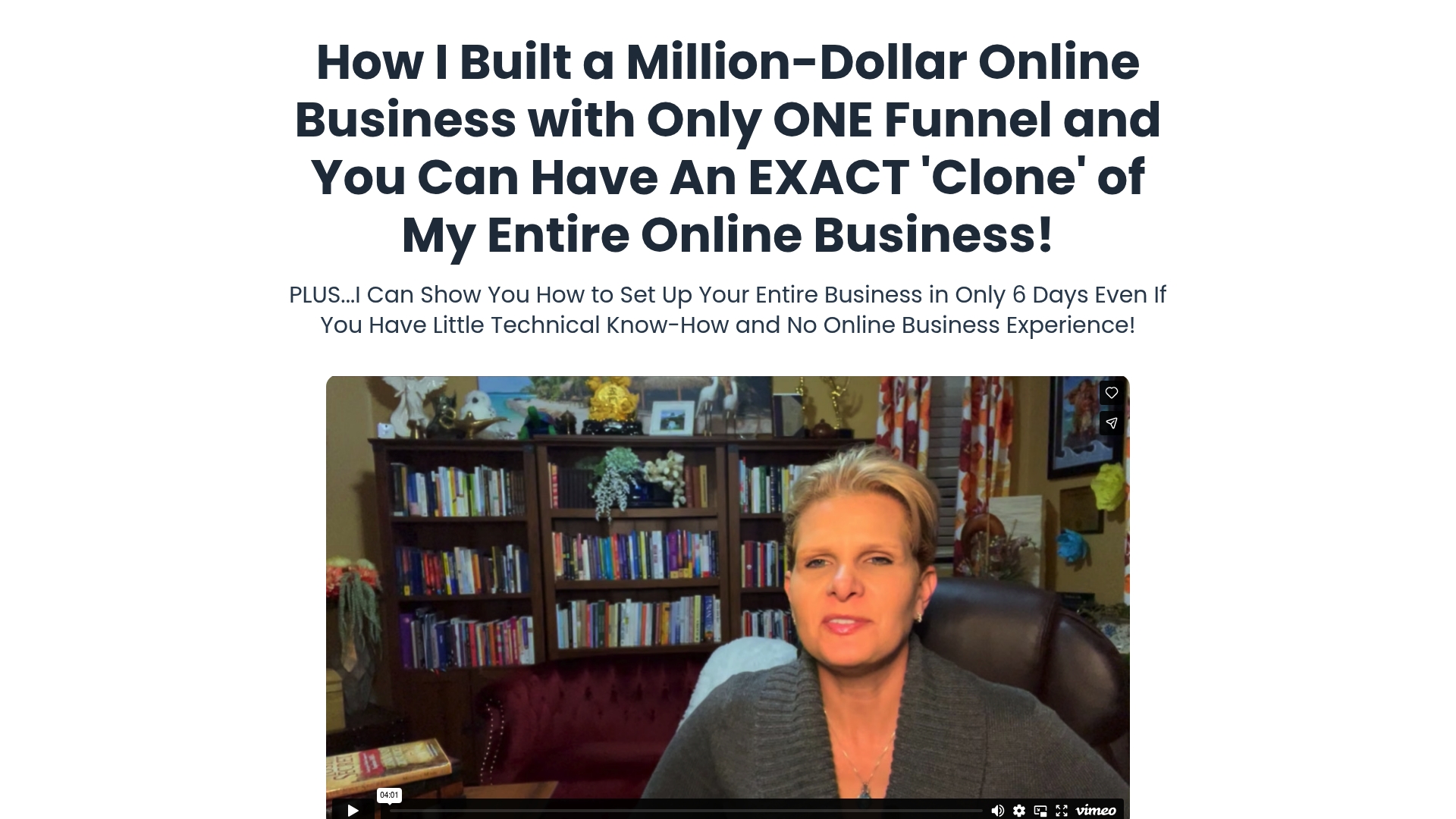
Moneyfunnel's 6-Day Mentorship Program walks you through building and writing a high-converting funnel from scratch, with direct guidance on crafting headlines, CTAs, and email sequences that actually move people to buy. The program is built around the same funnel system that generated $10 million in sales, and it is designed for people who want results without needing a technical background. Spots are limited. If you are serious about making your funnel copy work, this is the next step.
FAQ
What is funnel copywriting?
Funnel copywriting is the practice of writing targeted messages for each stage of a sales funnel, from awareness ads to post-purchase emails, with the goal of moving prospects toward a specific conversion action.
How much does copy affect funnel conversion rates?
Headline and value proposition copy changes produce conversion lifts of 50 to 200 percent, compared to 5 to 20 percent for design changes, making copy the highest-leverage variable in funnel optimization.
What is message match in a sales funnel?
Message match means the headline and promise on your landing page directly reflect the ad or link that brought the visitor there. Breaking this continuity creates confusion and causes visitors to leave before converting.
Should I test copy or design first in my funnel?
Test copy first. Start with the headline, then move to CTA wording, then proof elements like testimonials. Design testing produces smaller gains and should come after copy has been optimized.
What conversion rate should I aim for in my funnel?
Targets depend on your funnel category. Webinar registration funnels average around 11.4 percent, B2B SaaS trials around 4.1 percent, and DTC ecommerce around 2.3 percent. A universal 5 percent target is not a reliable benchmark.