
Online credibility is the measure of whether people believe your business is trustworthy, competent, and worth their money. Why credibility matters online becomes clear fast: 89% of shoppers have abandoned a purchase because a website raised doubts, and 94% are wary of AI-generated fake content. That skepticism is not a passing trend. Trust cannot be growth-hacked. It is built interaction by interaction, touchpoint by touchpoint, and lost in seconds when something feels off.
Why credibility matters online more than ever in 2026
The digital environment has never been noisier. AI-generated content floods every channel, and consumers have developed a sharp instinct for what feels manufactured. 40% of people now avoid online news entirely because they cannot distinguish credible sources from AI noise. That trust fatigue spills directly into how people evaluate businesses.
"Credibility is not a message you broadcast. It is an experience you deliver across every touchpoint, consistently."
Visitors make snap judgments fast. 75% of users form credibility judgments based on website design within the first three seconds. That means your layout, font choices, and page load speed are doing credibility work before a single word is read. The digital credibility significance of first impressions cannot be overstated.
Trust in digital commerce follows a specific logic. Trust results from a formula that balances credibility, intimacy, and perceived risk. Raise credibility and intimacy while reducing perceived risk, and buying velocity increases. Ignore any one of those three variables, and the formula breaks. This is why online entrepreneurs who focus only on looking polished often still lose sales.

What are the main factors that build or damage online credibility?
Credibility online is built from multiple layers working together. Each layer either reinforces trust or quietly erodes it.
Trust signals that build credibility:
- Website design and user experience. A clean, fast, mobile-friendly site signals professionalism before any content is read. Cluttered layouts, slow load times, and broken navigation all register as red flags.
- Third-party verification. Sites with verified trust badges are 82% more likely to be trusted by shoppers. These badges work because they shift the credibility judgment from self-reported to externally confirmed.
- Authentic social proof. Specific, named client references outperform generic five-star ratings. A testimonial that names a real person, their role, and a concrete result carries far more weight than a polished anonymous quote.
- Transparency signals. Clear contact information, visible refund policies, and honest disclosures about AI-assisted content are emerging as baseline expectations in 2026.
- Consistent messaging. Every ad, landing page, email, and checkout screen must tell the same story. Contradictions between your ad copy and your checkout page trigger abandonment.
What damages credibility fast:
- Typos and grammatical errors in headlines or product descriptions
- Broken links anywhere on the site
- Mismatched brand voice between social media and the website
- Vague or hidden refund and privacy policies
- Generic stock photography that feels disconnected from the brand
Pro Tip: Run a credibility audit on your site every 90 days. Check every link, review every trust badge for expiration, and read your own copy as a first-time visitor would.
How can online entrepreneurs build and maintain credibility?
Building credibility is not a one-time project. It is an ongoing operational discipline. Here is a practical framework for embedding it across your digital presence.
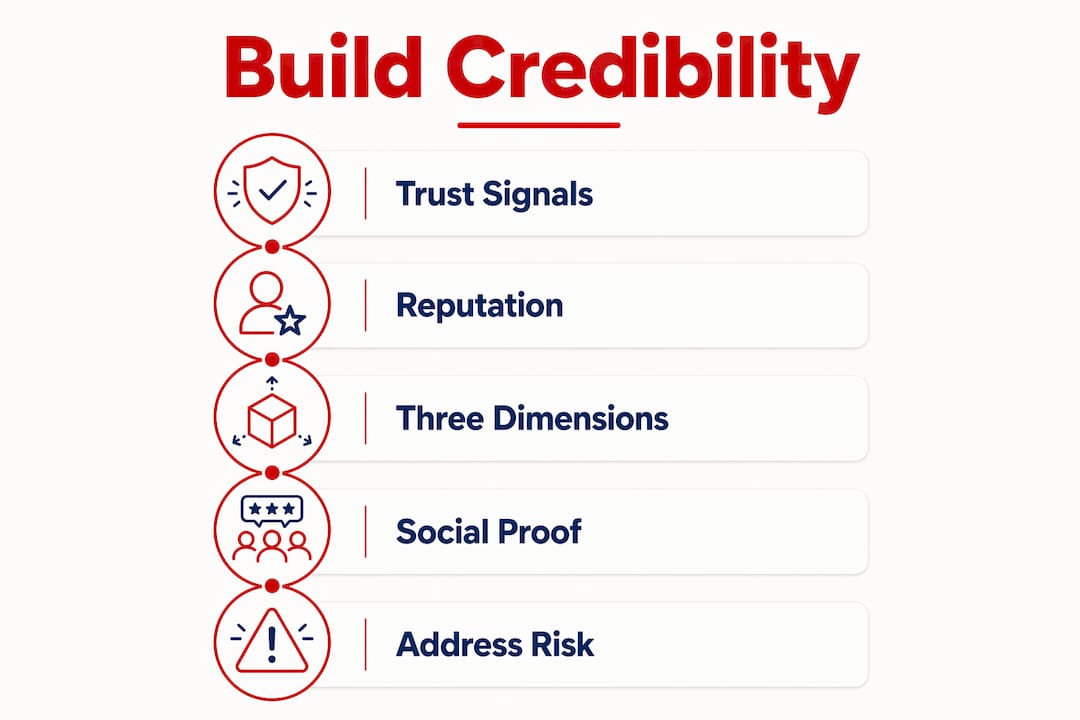
1. Design trust signals above the fold
Place your most credible proof points where visitors see them immediately: verified badges, media mentions, client logos, or a clear value statement. Visitors who do not see a reason to trust within three seconds will leave. Do not save your best proof for the bottom of the page.
2. Manage your online reputation proactively
81% of consumers use Google to look up reviews before making a purchase decision, and 57.5% of all reviews originate on Google. Online reputation management is not damage control. It is a proactive discipline of soliciting reviews, responding to feedback publicly, and maintaining a visible track record. Ignoring your Google presence means letting strangers write your credibility story for you.
3. Signal trustworthiness across three dimensions
Trustworthiness beliefs break into three distinct dimensions: expertise, benevolence, and integrity. Expertise means you know your subject. Benevolence means you genuinely care about the customer's outcome. Integrity means you do what you say. All three must be signaled explicitly in your content, your policies, and your customer interactions. Missing any one of them creates a gap that skeptical buyers will notice.
4. Use social proof that is verifiable and specific
Generic five-star ratings can actually reduce trust when they look manufactured. Use named testimonials with real details, case study results with specific numbers, and mixed ratings that show you have nothing to hide. A 4.7-star average with 200 reviews reads as more credible than a perfect 5.0 with 12 reviews.
5. Address risk directly
Clear refund policies and secure checkout features reduce perceived purchase risk. Do not make buyers hunt for your return policy. Put it near the buy button. State your security credentials visibly. Risk reduction is as important as authority building when it comes to converting skeptical visitors.
Pro Tip: Link your online customer attraction strategy directly to your credibility signals. Every traffic source should land visitors on a page that immediately answers the question: "Why should I trust this?"
| Credibility signal | What it communicates | Where to place it |
|---|---|---|
| Third-party trust badge | External validation of legitimacy | Above the fold, near CTA |
| Named client testimonial | Real-world proof with accountability | Product and sales pages |
| Visible refund policy | Risk reduction for the buyer | Near checkout and buy buttons |
| Media or press mentions | Authority from recognized sources | Homepage and about page |
| Response to negative reviews | Integrity and transparency | Google Business, review platforms |
What are the common mistakes that undermine online credibility?
Most credibility failures are not dramatic. They are quiet, cumulative, and entirely avoidable.
Treating credibility as a branding aesthetic. A polished logo and professional color palette do not equal credibility. Credibility is a fully integrated experience. Even subtle inconsistencies across ads, landing pages, and checkout processes can trigger abandonment. Buyers notice when your ad promises one thing and your landing page delivers another.
Relying on generic social proof. A wall of anonymous five-star reviews raises suspicion, not confidence. Generic high ratings may actually reduce trust when buyers perceive them as manufactured. Real credibility comes from specific, verifiable proof that a real person got a real result.
Broadcasting without delivering. Many online entrepreneurs invest heavily in marketing messages that promise expertise and results, then fail to back those promises operationally. Slow customer support, confusing checkout flows, and vague policies all contradict the credibility signals in the marketing. The gap between what you promise and what you deliver is where trust dies.
Ignoring risk signals while chasing authority. Entrepreneurs often focus on building authority through content and credentials while neglecting the risk side of the trust equation. A buyer who believes you are an expert but cannot find your refund policy will still abandon the cart.
Underestimating compounding trust. Every positive interaction adds a layer. Every negative one removes several. Credibility compounds over time, which means the cost of a single broken promise is disproportionately high. Consistent, small acts of reliability build the kind of trust that survives a bad day.
Key Takeaways
Online credibility is the single most controllable factor that separates digital businesses that convert visitors into buyers from those that lose them at first glance.
| Point | Details |
|---|---|
| First impressions are credibility judgments | 75% of users judge credibility by design within three seconds of landing on a page. |
| Trust follows a formula | Credibility, intimacy, and risk reduction must all be addressed to convert skeptical buyers. |
| Social proof must be specific | Named, verifiable testimonials outperform generic five-star ratings in building real trust. |
| Reputation management is proactive | Soliciting and responding to Google reviews directly shapes consumer perception and sales. |
| Credibility is operational, not cosmetic | Every touchpoint from ads to checkout must deliver a consistent, trustworthy experience. |
The credibility gap most entrepreneurs never close
I have worked with enough online entrepreneurs to see the same pattern repeat. They spend weeks perfecting their brand visuals and writing compelling copy, then wonder why conversion rates stay flat. The answer is almost always a credibility gap hiding in plain sight.
The most common place I find it is the checkout page. The homepage looks credible. The sales page is polished. Then the buyer hits a checkout screen that looks like it was built in 2015, with no visible security badge and a refund policy buried three clicks away. That single moment erases everything the rest of the funnel built.
What I have learned is that credibility is not a department. It is not something you hand off to a designer or a copywriter. It is a discipline that touches every decision, from how fast your page loads to how quickly you respond to a negative review. The entrepreneurs I see win long-term are the ones who treat every touchpoint as a credibility signal, not just the ones that feel like marketing.
The metrics and mindsets that drive sustainable online business growth all trace back to trust. Revenue follows reputation. Reputation follows consistency. Consistency is a choice you make every single day, not a campaign you run once a quarter.
Audit your own funnel the way a skeptical first-time visitor would. You will find the gaps. Closing them is the highest-return work you can do.
— Mike
How Moneyfunnel helps you build trust that converts
Credibility-focused funnel design is exactly what separates online businesses that scale from those that stall. Moneyfunnel is built around the principle that trust signals must be engineered into every stage of the funnel, not added as an afterthought.

The Moneyfunnel mentorship program walks you through a proven system for building a funnel that communicates expertise, reduces buyer risk, and delivers consistent proof at every touchpoint. The creator built a single funnel to $10 million in results, and the six-day program teaches the exact credibility architecture behind that outcome. If you are ready to build a digital presence that earns trust and converts it into revenue, the program gives you the framework to do it.
FAQ
Why does credibility matter online for new entrepreneurs?
Credibility determines whether a first-time visitor trusts your business enough to buy. Without it, even strong traffic and good offers fail to convert.
How does website design affect online credibility?
75% of users form credibility judgments based on website design within three seconds. Poor design signals low professionalism and drives visitors away before they read a word.
What is the fastest way to build credibility online?
Place third-party verified trust badges and named client testimonials above the fold. Sites with verified badges are 82% more likely to be trusted by shoppers.
How does online reputation management affect sales?
81% of consumers check Google reviews before buying. Proactive reputation management, including soliciting reviews and responding publicly, directly shapes purchase decisions.
Can generic five-star reviews hurt credibility?
Yes. Generic high ratings can reduce trust when buyers perceive them as manufactured. Specific, named testimonials with verifiable details perform significantly better.