
Attracting online customers is defined as the strategic practice of placing your business in front of the right people, earning their trust, and converting their attention into purchases. The businesses winning in 2026 are not the ones spending the most on ads. They are the ones combining customer-centric SEO, precise channel selection, and consistent messaging across Google, Instagram, TikTok, and AI-powered search platforms. This guide gives you the exact framework to do that, starting with the tactics that produce results fastest.
How to attract online customers with customer-centric SEO
Customer-centric SEO is defined as designing your website and content around solving visitor needs rather than chasing rankings. This distinction matters because Google's ranking signals in 2026 reward pages that keep users engaged, not just pages that include the right keywords. Business growth comes from building trust and keeping users on your site long enough to act.
The behavioral metrics that matter most are session duration, pages per session, and scroll depth. Session duration around 8 minutes signals genuine engagement and directly correlates with lower bounce rates and higher conversion probability. That number tells you whether your content is actually answering the question a visitor came with.
To build a site that holds attention, focus on these fundamentals:
- Site navigation: Visitors should find what they need in three clicks or fewer. Confusing menus push people to competitors.
- Page speed: A page that loads in under two seconds retains significantly more visitors than one that takes four. Use Google PageSpeed Insights to identify and fix bottlenecks.
- Mobile-friendliness: More than half of all web traffic comes from mobile devices. Test every page on a phone before publishing.
- Trust signals: Place testimonials, star ratings, and case studies where visitors make decisions, not buried at the bottom of a page. Visible trust factors reduce friction and increase the likelihood of conversion.
Content freshness also plays a direct role in rankings. Run a monthly audit of your top 10 pages using Google Search Console. Look for queries where your page ranks between positions 8 and 20, then update those pages with sharper answers, more current examples, and cleaner structure.
Pro Tip: Pull your Search Console data every 30 days and identify which queries are gaining impressions but not clicks. Rewrite those title tags and meta descriptions to match the exact language your audience uses.
Which acquisition channels should you prioritize first?
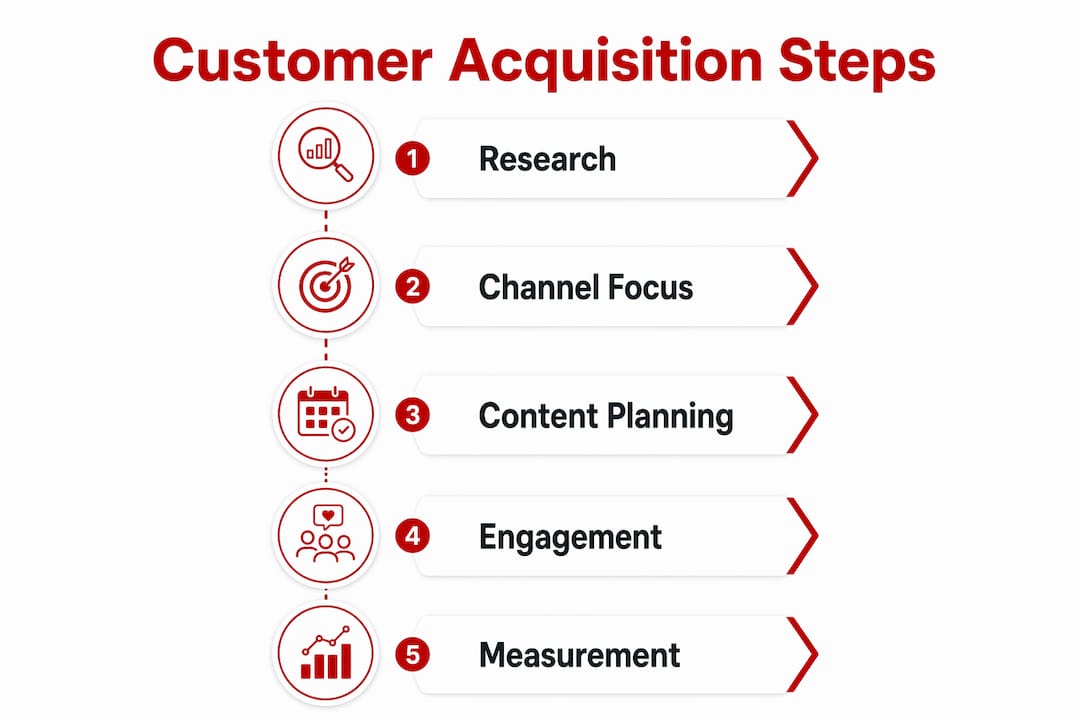
Customer acquisition falls into four buckets: Search, Advertising, Direct outreach, and Word-of-mouth. Most new online business owners try all four at once and get mediocre results from each. The smarter move is to pick one, achieve predictability, and then layer in the next.
Here is how to sequence your channel strategy:
- Start with Direct outreach or Advertising if you need fast feedback. Paid search and direct email give you data within days, not months. You learn what messaging resonates, which offers convert, and which audience segments ignore you. Paid search effectiveness depends on matching your ad copy to the exact language buyers use when they are ready to purchase.
- Build Search in parallel, but expect a longer runway. Organic SEO compounds over 6 to 12 months. It is not slow because it is weak. It is slow because it is building an asset that pays dividends without ongoing ad spend.
- Activate Word-of-mouth deliberately. Referral programs, affiliate partnerships, and review requests do not happen by accident. Build them into your post-purchase sequence from day one.
- Map each channel to a funnel stage. Paid ads drive awareness. Search captures intent. Direct outreach closes warm leads. Word-of-mouth reactivates past buyers. Understanding this structure is covered in depth in the marketing funnel guide from Moneyfunnel.
Pro Tip: Before choosing a channel, ask where your audience already spends 30 minutes a day. That platform is your starting point, not the one your competitor is using.
How can social media attract and engage online customers?
Social media works as a customer acquisition tool when you treat it as a conversation platform rather than a broadcast channel. Building relationships rather than broadcasting promotions leads to conversions and referrals. The difference in practice is whether your posts ask questions, respond to comments, and share stories versus simply announcing products.

Platform selection is the first decision that determines everything else. LinkedIn works for B2B offers because decision-makers research vendors there. Instagram and TikTok work for B2C products because visual content and short video drive discovery and emotional connection. Spreading yourself across five platforms with thin content is less effective than owning one platform with depth.
Value-first content is the mechanism that turns followers into buyers. Educate your audience on a problem your product solves. Show the process behind your service. Share a customer result in specific, measurable terms. Each of these content types builds credibility before you ever make an offer.
Common missteps that stall social media growth include:
- Chasing viral moments instead of posting consistently on a schedule
- Posting only promotional content without providing genuine value
- Ignoring comments and DMs, which signals low trust to new visitors
- Measuring success by follower count rather than engagement rate or click-throughs
Pro Tip: Use your platform's native analytics to find which post types generate the most saves and shares, not just likes. Saves indicate that someone found your content worth returning to, which is a stronger buying signal.
How to align messaging across organic, paid, and AI platforms
Buyers in 2026 move fluidly between organic search results, paid ads, and AI-generated answers from tools like ChatGPT, Perplexity, and Google's AI Overviews. If your messaging changes tone or promise between a Google ad and its landing page, you lose the sale at the moment of highest intent.
Follow this sequence to align your messaging across every touchpoint:
- Identify your core value proposition in one sentence. It should describe who you help, what outcome you deliver, and why you are different. Every piece of content you publish should reflect this sentence.
- Match ad copy to landing page headlines word for word. If your ad says "Build a profitable online store in 30 days," your landing page headline must echo that exact promise. Mismatches create doubt.
- Optimize your calls to action for clarity, not cleverness. "Start your free trial" outperforms "Unlock your potential" because it tells the visitor exactly what happens next.
- Structure content for AI citation. AI search tools favor content that opens with direct definitions, uses named entities, and answers questions in the first paragraph. Transparent, well-structured content earns more AI-generated referrals than content optimized purely for traditional keyword density.
Pro Tip: Pull your customer support transcripts and sales call recordings monthly. The exact phrases customers use to describe their problem are the phrases you should use in your ads, headlines, and product descriptions.
What local SEO and trust-building strategies increase visibility?
Google Business Profile (GBP) is the most underused free tool for attracting online customers with local intent. Claiming and verifying your GBP, keeping your name, address, and phone number consistent across every directory, and selecting the most specific business category available are the three actions that move the needle fastest on local search rankings.
Beyond the basics, the following GBP actions directly influence both rankings and conversions:
| GBP Action | Impact on Customer Attraction |
|---|---|
| Post weekly updates | Signals active business and surfaces in local search feeds |
| Respond to every review | Builds trust with new visitors and improves local ranking signals |
| Add photos monthly | Listings with photos receive significantly more direction requests and website clicks |
| Enable messaging | Reduces friction for customers who prefer chat over phone calls |
| Sync GBP info with website | Consistent NAP data strengthens local authority and prevents ranking confusion |
Trust factors on your website work in tandem with GBP. Place testimonials near your primary call to action, not on a separate "Reviews" page that few visitors find. Case studies with specific numbers, such as "increased revenue by 40% in 90 days," outperform vague praise. For a deeper look at how trust and engagement tactics support long-term growth, the Moneyfunnel guide on scaling your online business covers the retention side of this equation.
For a tactical breakdown of GBP optimization steps, this local SEO guide from ChitChat Marketing LLC walks through the full setup process with current best practices.
Pro Tip: Add UTM parameters to every link inside your Google Business Profile. This lets you track exactly how much traffic and how many conversions come from your GBP listing versus other sources.
Key takeaways
Attracting online customers in 2026 requires combining behavioral SEO, single-channel focus, value-first social content, consistent cross-platform messaging, and an optimized Google Business Profile.
| Point | Details |
|---|---|
| Customer-centric SEO first | Design content around solving visitor needs, then measure engagement time to confirm it works. |
| One channel before many | Pick one acquisition channel, achieve predictable results, then add a second to scale. |
| Social selling over broadcasting | Post value-first content and respond to every comment to convert followers into buyers. |
| Message consistency converts | Match ad copy to landing page headlines word for word to eliminate doubt at the decision point. |
| GBP as a trust layer | Keep your Google Business Profile active with weekly posts, photos, and review responses to lift local visibility. |
Why most online businesses attract traffic but not customers
I have worked with dozens of aspiring online business owners who had decent traffic numbers and almost no sales. The pattern is almost always the same. They optimized for clicks and ignored what happened after the click.
The insight that changed how I think about this comes from watching real customer behavior data rather than vanity metrics. A page with 500 monthly visitors and an 8-minute average session duration will outperform a page with 5,000 visitors and a 40-second session every single time. The first page has an audience. The second has a traffic problem disguised as a success.
What I tell every person starting out is this: pick the one channel where your specific buyer already spends time, and go deep on it for 90 days before touching anything else. Not because the other channels do not work, but because you need a learning loop first. You need to know what language makes your audience stop scrolling, what offers make them click, and what objections kill the sale. You cannot learn that by spreading thin across Search, Instagram, TikTok, and email simultaneously.
The other thing most articles will not tell you is that trust is not a feature you add later. It is the foundation. Testimonials, case studies, and transparent messaging are not nice-to-haves for when you have more customers. They are what gets you the first customers. Build them in from day one, even if that means asking your first three buyers for a detailed written review before you do anything else.
— Mike
Ready to put these strategies into a working system?
Understanding how to attract online customers is one thing. Building the system that does it consistently is another. Moneyfunnel's 6-Day Mentorship Program walks you through building a sales funnel from scratch, writing messaging that converts, and selecting the acquisition channels that fit your specific business model. The program is built for people who want a structured, step-by-step path rather than scattered advice.
If you are serious about turning your online business idea into a customer-generating machine, the mentorship gives you the frameworks, the feedback, and the community to make it happen faster than going it alone. Spots are limited, and the program is designed for people ready to act, not just learn.
FAQ
What is the fastest way to attract online customers?
Paid advertising and direct outreach deliver the fastest feedback because results appear within days rather than months. Use these channels to test messaging and offers before investing heavily in organic SEO.
How many acquisition channels should a new online business use?
Start with one channel and build predictable results before adding a second. Spreading across multiple channels too early splits your attention and slows your learning curve.
Does social media actually convert followers into customers?
Yes, when the approach focuses on relationship-building rather than promotion. Posting value-first content, responding to comments, and sharing specific customer results converts followers into buyers more reliably than running frequent sales posts.
How does Google Business Profile help attract online customers?
An optimized Google Business Profile improves local search visibility and acts as a trust signal for new visitors. Keeping your profile active with photos, posts, and review responses directly increases the number of people who click through to your website.
Why does messaging consistency matter across ads and landing pages?
When your ad copy and landing page headline say the same thing, visitors feel confident they are in the right place. Any mismatch between the two creates doubt at the exact moment a buyer is deciding whether to trust you.