
A legal disclaimer is a clear statement that limits a business's legal liability by specifying what it is and is not responsible for on its website or digital platform. The role of legal disclaimers online goes far beyond boilerplate text. For online entrepreneurs and affiliate marketers, disclaimers define the boundary between protected and exposed. They signal to regulators, courts, and visitors that your business operates with transparency and intent. The FTC treats conspicuous disclosures as a baseline requirement for digital marketing, not an optional courtesy. Getting this right from day one protects your revenue, your reputation, and your legal standing.
What makes an online legal disclaimer legally enforceable?
Enforceability is the difference between a disclaimer that protects you and one that looks official but fails in court. The single most important factor is how users encounter and accept your disclaimer.
Courts draw a sharp line between two consent models:
- Clickwrap agreements require users to take an affirmative action, such as checking a box or clicking "I Agree," before proceeding. Clickwrap agreements provide significantly stronger legal protection than passive alternatives because they create a clear record of consent.
- Browsewrap agreements rely on passive notice, typically a footer link stating that continued use implies acceptance. Courts routinely reject browsewrap as insufficient because users can proceed without ever seeing the terms.
The FTC adds another layer of requirements. FTC guidance mandates that disclaimers appear as close as possible to the qualifying claim they modify. A disclosure buried three pages deep in a terms document does not satisfy this standard. That means if your affiliate marketing page claims a product delivers specific results, the disclaimer qualifying that claim must appear near the claim itself, not in a footer.
Plain language is equally critical. Courts look for fundamental fairness, and dense, one-sided agreements that strip away consumer rights are commonly rejected. A disclaimer written in accessible, unambiguous language is far more likely to be upheld than one written to impress lawyers.

Making disclaimers enforceable depends on treating them as contracts with conspicuous presentation and user acceptance. Integrating your disclaimer into a checkout flow, a download gate, or a registration form creates the affirmative consent record courts require.
Pro Tip: Place a short, plain-language disclaimer directly beneath any earnings claim, testimonial, or product result on your page. Do not rely on a footer link to carry that legal weight.
What are the limitations of legal disclaimers online?
Disclaimers are powerful, but they are not a legal force field. Every online entrepreneur needs to understand exactly where protection ends.
-
Fraud and gross negligence are never covered. Disclaimers do not protect against fraud, gross negligence, or public policy violations. Courts invalidate disclaimers that attempt to eliminate liability for intentional wrongdoing. No disclaimer language, however carefully worded, changes this.
-
Consumer protection laws override disclaimer language. Federal and state consumer protection statutes set minimum rights that businesses cannot contract away. A disclaimer stating "all sales are final and no refunds will be issued" may be unenforceable in jurisdictions where refund rights are legally guaranteed.
-
Fundamental fairness is a real legal standard. Courts examine whether a disclaimer is so one-sided that enforcing it would be unjust. An agreement that eliminates every possible remedy for a consumer while imposing unlimited obligations on them will not survive judicial scrutiny.
-
Disclaimers do not replace business practices. Relying solely on disclaimers for risk coverage is described by legal experts as "building on sand." Liability insurance, sound operational practices, and documented compliance processes are all necessary alongside your disclaimer language.
-
Passive placement kills enforceability. A disclaimer buried in a site's footer or long terms document is unlikely to provide legal protection without meaningful user consent. Placement matters as much as wording.
Pro Tip: Treat your disclaimer as one layer in a risk management stack. Pair it with liability insurance, a clear refund policy, and documented business processes. None of these replaces the others.
How do legal disclaimers build user trust and transparency?
The legal protection angle gets most of the attention, but disclaimers also do something equally valuable. They build credibility with your audience.
Clear, transparent disclaimers foster user trust by defining service boundaries and stating that content is informational rather than professional advice. A visitor who sees an honest earnings disclaimer on an affiliate marketing page is more likely to trust the rest of the content, not less. Transparency signals that the business is not hiding anything.
For affiliate marketers specifically, transparent disclaimers contribute to ethical reputation and customer loyalty by clarifying boundaries and informational intent. The FTC's affiliate disclosure requirement exists precisely because undisclosed relationships damage consumer trust. Disclosing your affiliate relationship upfront, clearly and near the relevant link, is both a legal requirement and a credibility signal.
Disclaimers that define scope also set accurate expectations. When your site states that content is educational and not legal, medical, or financial advice, you prevent the misunderstandings that generate complaints and refund requests. That is a direct business benefit, not just a legal formality.
Consider how credibility in affiliate marketing connects to every piece of content you publish. A disclaimer is part of that credibility infrastructure. It tells your audience you respect them enough to be honest about what you are and are not offering.
Best practices for creating and placing legal disclaimers online
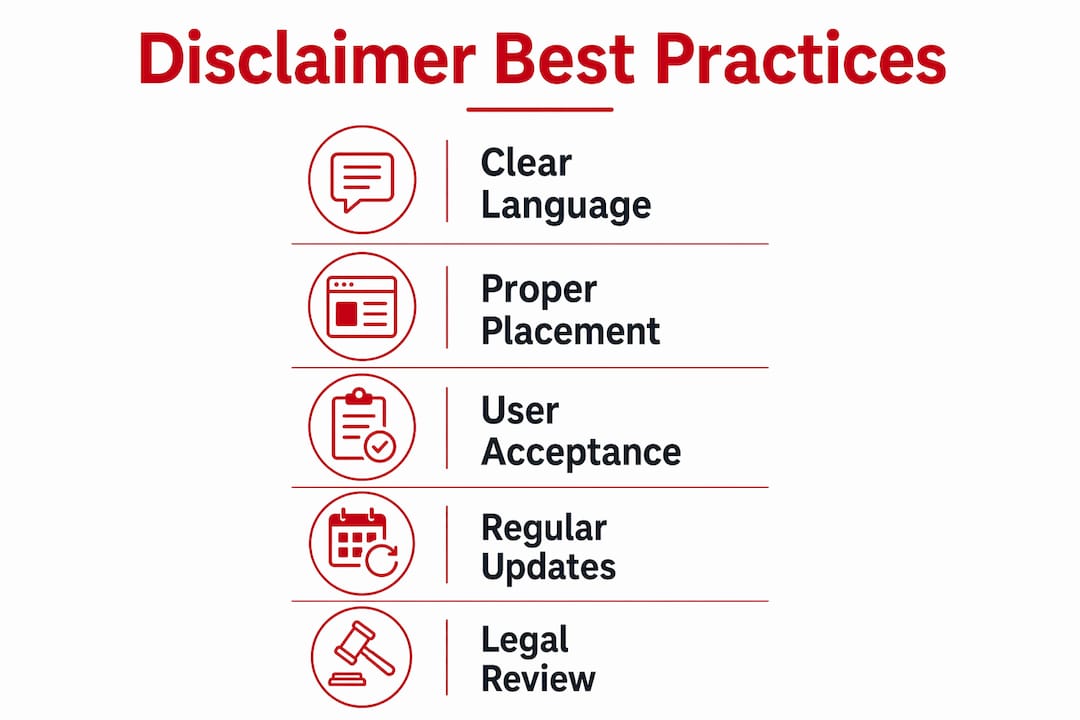
Effective disclaimers require both the right language and the right placement. Getting one without the other leaves you exposed.
Placement rules that courts and regulators recognize
The FTC's proximity rule is non-negotiable. Place your disclaimer as close as possible to the claim it qualifies. On a sales page with an income claim, the disclaimer belongs directly beneath that claim, in readable font, not in a footer. On a product review page with affiliate links, the disclosure belongs at the top of the page before the reader encounters any links.
Avoid the common mistake of treating your terms and conditions page as a catch-all disclaimer location. Terms pages serve a different function. They govern the overall relationship between your business and users. Specific disclaimers for specific claims need to live near those claims.
Clickwrap vs. passive notice: a practical comparison
| Scenario | Recommended approach | Why it matters |
|---|---|---|
| User purchases a digital product | Clickwrap with checkbox before payment | Creates enforceable consent record at the highest-risk transaction point |
| User downloads a free lead magnet | Clickwrap or opt-in with visible terms link | Establishes consent before delivering content |
| User reads a blog post with affiliate links | Visible disclosure at top of post | FTC proximity rule requires disclosure before links appear |
| User browses a general information page | Conspicuous notice with clear language | Browsewrap is weak; add a banner or inline notice where possible |
| User registers for a webinar or program | Clickwrap during registration | Consent is documented before any service is delivered |
Language that holds up
Write every disclaimer in plain English. Avoid Latin phrases, legal shorthand, and sentences longer than 25 words. A disclaimer that a 10th grader can read is more likely to be enforced than one that requires a law degree to parse. Courts treat clarity as evidence of good faith.
Combine your disclaimer with your privacy policy and terms of service to create a complete compliance framework. These documents work together. A disclaimer limits liability for content. A privacy policy governs data. Terms of service govern the user relationship. All three belong on every serious online business.
Pro Tip: Review your disclaimers every time you add a new product, service, or content category. A disclaimer written for a blog may not cover a coaching program or a digital course.
For entrepreneurs building their first online business, understanding how disclaimers fit into your launch plan from day one prevents costly corrections later.
Key takeaways
Legal disclaimers protect online businesses only when they are conspicuous, written in plain language, and paired with genuine user consent through clickwrap agreements.
| Point | Details |
|---|---|
| Clickwrap beats browsewrap | Require affirmative user action at key moments to create an enforceable consent record. |
| Placement is as critical as wording | Place disclaimers near the specific claims they qualify, not buried in footers or terms pages. |
| Disclaimers have hard limits | Fraud, gross negligence, and consumer protection violations cannot be disclaimed away. |
| Transparency builds trust | Clear disclaimers improve credibility and reduce complaints by setting accurate expectations. |
| Disclaimers are one layer, not the whole stack | Pair them with liability insurance, sound practices, and documented compliance processes. |
Why I stopped treating disclaimers as an afterthought
Most online entrepreneurs treat disclaimers the way they treat smoke detectors. They install one, forget about it, and assume it will work if something goes wrong. That assumption is expensive.
The reality I have seen repeatedly is that a disclaimer placed in the wrong location, written in legalese, or accepted passively provides almost no protection when it actually matters. Courts are not impressed by the presence of a disclaimer. They examine whether a real person could have read it, understood it, and genuinely agreed to it. That is a much higher bar than most business owners realize.
The other mistake I see constantly is treating disclaimers as purely defensive. A well-written disclaimer that honestly states what your content is and is not does something most marketing tactics cannot. It makes your audience trust you more. When I see an affiliate site that clearly discloses its relationships and honestly states that results vary, I trust its recommendations more than a site that makes every claim sound like a guarantee.
The entrepreneurs who get this right treat their disclaimer as part of their brand voice. It is honest, readable, and placed where people will actually see it. That combination protects them legally and builds the kind of audience relationship that generates long-term revenue.
— Mike
Moneyfunnel's approach to building protected online businesses
Building an online business without the right legal foundation creates risk that grows with every new visitor and every new sale. Moneyfunnel addresses this directly by combining practical marketing education with the compliance awareness that serious entrepreneurs need from the start.

The 6-Day Money Funnel Mentorship walks you through building a complete online business system, including the legal and ethical frameworks that protect your income and your reputation. Moneyfunnel's program is built on the principle that education and transparency are the foundation of sustainable online revenue. If you are ready to build something that lasts, the mentorship program gives you the structure to do it right.
FAQ
What is the role of legal disclaimers online?
A legal disclaimer limits a business's liability by clearly stating what it is and is not responsible for on its website or platform. It also sets accurate expectations for visitors and satisfies regulatory requirements from bodies like the FTC.
Are disclaimers legally binding?
Disclaimers are enforceable when they are conspicuous, written in plain language, and accepted through affirmative user consent such as a clickwrap agreement. Passive browsewrap disclaimers are frequently rejected by courts.
Can a disclaimer protect against all legal claims?
No. Disclaimers cannot protect against fraud, gross negligence, or violations of consumer protection law. Courts invalidate disclaimer language that attempts to eliminate liability for intentional or reckless wrongdoing.
Where should I place a disclaimer on my website?
Place disclaimers as close as possible to the specific claims they qualify. FTC guidance requires proximity to the relevant content, not placement in a footer or a separate terms page.
Do affiliate marketers need a special disclaimer?
Affiliate marketers must disclose their financial relationships with brands near every affiliate link or recommendation. The FTC treats undisclosed affiliate relationships as deceptive, regardless of whether a general disclaimer exists elsewhere on the site.