
Credibility is the single factor that separates affiliate marketers who build lasting income from those who burn through audiences and disappear. The role of credibility in affiliate marketing goes far beyond avoiding bad reviews. It directly shapes whether a consumer trusts your recommendation enough to buy. A 2025 study using Structural Equation Modeling with 350 digital consumers confirmed that affiliate credibility reduces perceived risk and increases perceived transaction value. Shopify and the University of Illinois have both published research reinforcing this finding. If you are building an affiliate business, credibility is not a soft skill. It is your core economic asset.
How does credibility affect consumer perception and buying decisions?
Credibility directly changes how consumers evaluate risk before they click "buy." When a shopper lands on an affiliate recommendation, their brain runs a quick threat assessment. They ask: "Can I trust this person? Are they recommending this because it's good, or because they get paid?" The answer they arrive at determines whether they convert or leave.
The 2025 International Journal of Economics study made this concrete. It showed that high affiliate credibility lowers perceived risk and raises perceived value simultaneously. That combination drives higher transaction value. The implication is significant: credibility does not just make people feel good. It changes the math of a purchase decision.
Digital purchase scenarios amplify this effect. When someone buys a physical product in a store, they can touch it. Online, they rely entirely on the information in front of them. An affiliate who has built a track record of honest, accurate recommendations fills that trust gap. One who has not leaves the consumer with nothing but doubt.
- Credibility reduces the consumer's perceived financial and emotional risk.
- It increases the perceived value of the product being recommended.
- It shortens the decision cycle, moving readers from consideration to purchase faster.
- It creates repeat visitors who return specifically because they trust the source.
Pro Tip: Before you write a recommendation, ask yourself: "Would I tell my closest friend to buy this?" If the answer is no, do not publish it.
What specific actions build and maintain credibility for affiliate marketers?
Building credibility online is not a one-time setup. It is a practice, and credibility requires intentional cultivation through transparency, accuracy, and consistency over time. The good news is that the actions required are straightforward once you commit to them.

Disclose your affiliate relationships clearly. The Federal Trade Commission requires it, but the real reason to do it is trust. Readers who see a clear disclosure do not feel tricked. They feel respected. The University of Illinois found that FTC-compliant disclosures actually increase engagement rather than reduce it. Transparency signals honesty, and honesty builds loyalty.
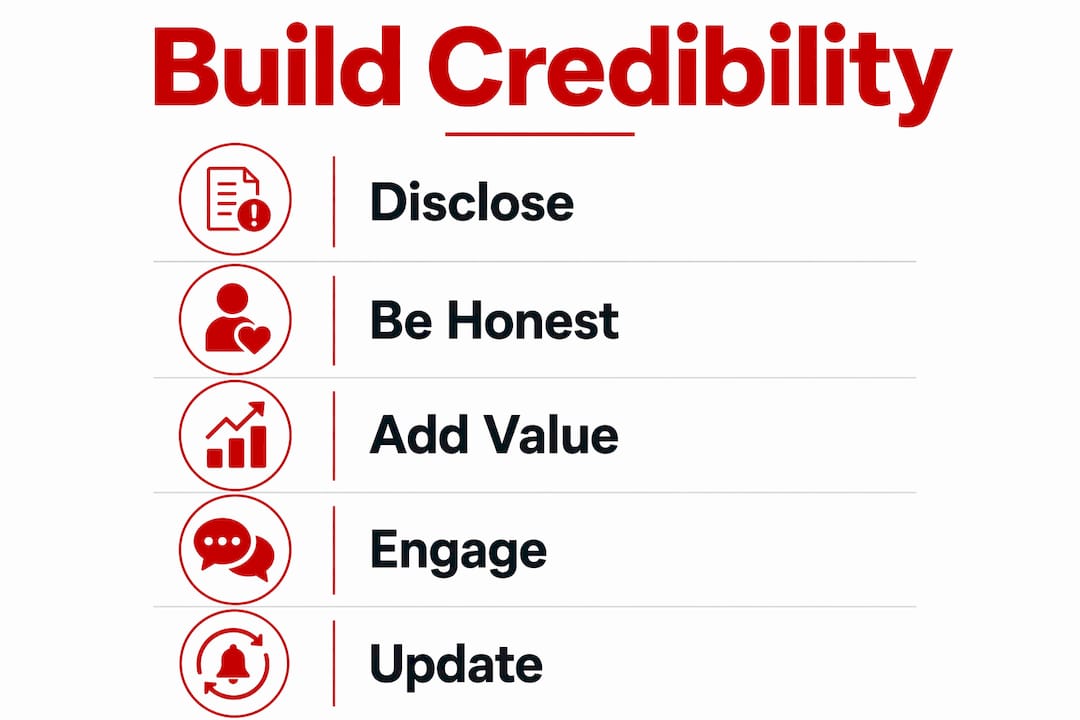
Write honest product reviews, including the limitations. Most affiliate content reads like a sales brochure. Readers notice. When you acknowledge a product's weaknesses alongside its strengths, you signal that your opinion is real. Lucky Buddha Affiliates identifies visible caveats and honest criteria as among the most effective trust-building methods available to affiliates.
Produce educational content that solves real problems. Readers who find genuine answers to their questions begin to see you as a consultant, not a salesperson. That shift is worth more than any commission rate. When your content reduces uncertainty, readers return. When they return, they buy.
- Publish a clear disclosure statement at the top of every affiliate post.
- Include at least one honest limitation in every product review.
- Prioritize answering specific reader questions over promoting product features.
- Avoid promoting products you have not personally used or thoroughly researched.
Affiliate expert Jason Ansell makes a point worth remembering: chasing high commissions at the expense of honest recommendations is the fastest way to destroy the asset you are building. The commission from one sale is worth far less than the trust of an audience that buys from you repeatedly.
Pro Tip: Create a simple review template that forces you to include a "who this is NOT for" section. That one habit will set your content apart from 90% of affiliate sites.
How do transparency and disclosure affect long-term affiliate success?
Transparency in affiliate marketing means telling your audience exactly what your relationship with a product or brand is, why you chose to recommend it, and what it does not do well. It is not just a legal checkbox. It is the foundation of every trust signal you build.
The numbers here are striking. Shopify reports that 71% of consumers say transparency is key to their trust in a brand or publisher. A separate PwC report found that 80% of consumers say a lack of authenticity destroys their confidence. Those two figures together describe the stakes clearly: most of your audience is actively looking for reasons to trust you, and a large portion will walk away the moment they sense inauthenticity.
A common fear among new affiliate marketers is that disclosures will hurt conversions. The 2026 University of Illinois research dismantles that fear directly. Content with clear disclosures outperforms non-disclosure content in both engagement and credibility scores. Disclosures activate what researchers call "persuasion knowledge," which is a reader's awareness that they are being marketed to. When that awareness is triggered honestly, it builds trust rather than resistance.
Effective disclosure statements share three qualities:
- They appear at the top of the content, before any recommendation.
- They use plain language: "This post contains affiliate links. If you buy through them, I earn a commission at no extra cost to you."
- They are consistent across every piece of content, not just occasional posts.
"Substantive transparency means clearly stating your affiliate relationships, explaining why you chose a product, and honestly discussing its limitations. That level of openness paradoxically increases conversions." — AffiliateBooster
What mistakes damage credibility and how do you recover from them?
The most common credibility mistake in affiliate marketing is promoting products based on commission rate rather than product quality. Readers who follow a recommendation and feel let down do not come back. They also tell others. One bad recommendation can undo months of trust-building.
- Vague or missing disclosures signal that you have something to hide. Even readers who do not know FTC rules instinctively distrust content that feels like a hidden advertisement.
- Exaggerating product benefits creates a gap between expectation and reality. When a reader buys based on your review and the product underdelivers, you own that disappointment.
- Hiding product limitations is the affiliate equivalent of a used car salesman skipping over the engine problems. Readers who discover the omission later will not forgive it.
- Promoting too many products dilutes your authority. AffiliateBooster recommends limiting recommendations to one quality product per article to maintain depth and authority.
Recovering lost credibility takes longer than building it the first time. The path back runs through radical honesty. Publish a transparent update to any misleading content. Acknowledge the gap between what you said and what readers experienced. Then commit publicly to a higher standard going forward. Readers respect accountability. What they cannot forgive is silence.
Pro Tip: Set a calendar reminder every six months to audit your top affiliate posts. Update any claims that no longer hold, and add a visible "Updated" note at the top. That habit signals ongoing honesty to both readers and search engines.
How do you apply credibility principles to grow a sustainable affiliate business?
Credibility functions as an economic asset that compounds over time. Jason Ansell describes it this way: trust accumulates, and accumulated trust produces higher conversions, repeat visitors, and brand partnership opportunities that traffic alone cannot generate. That framing changes how you should think about every piece of content you publish.
The deep engagement model outperforms the volume model consistently. Instead of publishing 50 thin reviews with affiliate links scattered throughout, publish 10 thorough guides that each solve a specific problem and recommend one product with full context. Readers who finish a 2,000-word guide that genuinely helped them are far more likely to click and buy than readers who skim a 400-word listicle.
Measuring trust requires looking beyond click-through rates. Engagement metrics like time on page, return visitor rate, and email reply rates tell you whether your audience actually values what you publish. Brand partnership inquiries are another signal. Companies seek out affiliates with credible audiences because credibility transfers. When a brand wants to be associated with your name, you have built something real.
| Approach | Short-term traffic focus | Credibility-driven growth |
|---|---|---|
| Content style | High volume, thin reviews | Deep guides, honest analysis |
| Recommendation count | Many links per post | One focused recommendation |
| Disclosure practice | Minimal or buried | Clear, consistent, upfront |
| Audience behavior | One-time visitors | Repeat visitors, email subscribers |
| Revenue pattern | Volatile, click-dependent | Stable, relationship-driven |
Pro Tip: Track your return visitor rate monthly. A rising return visitor rate is one of the clearest signals that your credibility is growing. It means people came back because they trusted what they found the first time.
For a deeper look at how credibility fits into the broader picture, the affiliate marketing basics guide on the Moneyfunnel blog covers the foundational principles that make trust-building possible from day one.
Key Takeaways
Credibility in affiliate marketing is a compounding economic asset: affiliates who build it through transparency, honest reviews, and clear disclosures consistently outperform those who chase commissions without it.
| Point | Details |
|---|---|
| Credibility reduces perceived risk | A 2025 study confirmed that affiliate credibility lowers consumer risk perception and raises transaction value. |
| Disclosures increase engagement | University of Illinois research shows FTC-compliant disclosures improve credibility and engagement, not reduce them. |
| Transparency is non-negotiable | 71% of consumers require transparency to trust a publisher, and 80% lose confidence when they sense inauthenticity. |
| Depth beats volume | Recommending one quality product per article with full context outperforms scattering many links across thin content. |
| Credibility compounds | Trust built over time generates repeat visitors, higher conversions, and brand partnership opportunities. |
Why I think most affiliate marketers misunderstand credibility entirely
Most new affiliate marketers treat credibility as a reputation management problem. They think: "If I don't get caught lying, I'm credible." That misses the point completely.
Credibility is not the absence of dishonesty. It is the active, consistent practice of putting your reader's interests ahead of your commission. I have watched marketers with technically accurate content still lose their audiences because the content felt transactional. Readers are perceptive. They sense when a recommendation exists to serve the writer rather than them.
The shift that changes everything is moving from "how do I get this person to click" to "how do I help this person make the best decision." When that becomes your actual goal, your content changes. Your disclosures get clearer. Your reviews get more honest. Your audience grows more loyal. And paradoxically, your income grows faster.
The commercial pressure to promote high-commission products regardless of quality is real. Every affiliate marketer faces it. The ones who resist it and stay honest with their audiences are the ones still operating five years later. The ones who cave are the ones starting over on a new niche every year, wondering why nothing sticks.
Credibility is not a strategy you layer on top of your business. It is the foundation the whole thing stands on. Build it first, and everything else gets easier.
— Mike
Build your affiliate business on a foundation that lasts
Credibility is the asset that makes everything in affiliate marketing work better: higher conversions, stronger audience loyalty, and real brand partnerships. If you want to build that kind of business with a clear system behind it, Moneyfunnel's 6-Day Mentorship Program walks you through the exact steps to set up a credibility-first affiliate operation.

The program covers how to position yourself as a trusted authority, how to structure honest recommendations that convert, and how to build an audience that comes back. For marketers who want to go further, the affiliate income growth guide on the Moneyfunnel blog pairs well with the mentorship content. You can also access the full program details to see exactly what is covered before you commit.
FAQ
Why does credibility matter more than traffic in affiliate marketing?
Traffic without credibility produces low conversion rates and no repeat visitors. Credibility converts existing traffic more effectively and generates the repeat visits and brand opportunities that sustain long-term income.
Do affiliate disclosures hurt my conversion rate?
No. The 2026 University of Illinois study found that content with clear FTC disclosures outperforms non-disclosure content in both engagement and credibility, making disclosures a trust-building tool rather than a conversion obstacle.
How does credibility affect sales directly?
A 2025 study of 350 digital consumers confirmed that affiliate credibility reduces perceived risk and increases perceived transaction value, both of which drive higher purchase rates.
What is the fastest way to lose credibility as an affiliate marketer?
Promoting products based on commission rate rather than genuine quality is the fastest way to erode trust. Readers who follow a bad recommendation rarely return and often warn others.
How long does it take to build credibility as an affiliate marketer?
Credibility builds incrementally with every honest review, clear disclosure, and helpful piece of content you publish. Most affiliates see measurable trust signals, such as rising return visitor rates and direct audience engagement, within three to six months of consistent, transparent publishing.