
Mentorship in business is defined as a structured relationship where an experienced professional guides another toward faster growth, better decisions, and stronger results. The role of mentorship in business goes far beyond casual advice. Professionals with mentors are promoted five times more frequently, and mentored businesses report up to 83% higher revenue growth. That gap between mentored and unmentored professionals is not accidental. Organizations like Techstars and research from Harvard's corporate governance program confirm that mentorship functions as strategic infrastructure, not a soft benefit. Whether you are building a startup or climbing inside a company, mentorship is one of the highest-return investments you can make in your career.
What role does mentorship play in business success?
Mentorship accelerates every phase of professional development. A mentor compresses your learning curve by sharing pattern recognition built over years of real experience. According to research from Invention to Venture, mentors help mentees anticipate and navigate crises by drawing on situations they have already survived. That kind of foresight is impossible to buy and difficult to develop alone.

Mentors also serve as confidential sounding boards. Unlike a manager or board member, a mentor carries no organizational agenda. Harvard's corporate governance research identifies C-suite mentoring as essential strategic infrastructure because it gives executives access to honest, agenda-free advice that sharpens thinking and supports emotional regulation under pressure. That benefit applies equally to a first-time founder and a seasoned CEO.
The core functions a mentor fulfills include:
- Decision support. Mentors help you evaluate options using experience you do not yet have.
- Risk management. They identify blind spots before those blind spots become expensive mistakes.
- Accountability. Regular check-ins create external pressure to follow through on commitments.
- Network access. Mentors open doors to customers, investors, and partners that would take years to reach alone.
- Emotional grounding. They normalize the stress of building something and help you stay focused when things get hard.
Mentorship also benefits the mentor. Mentors report gaining fresh perspectives and diverse insights from their mentees. That exchange keeps experienced professionals sharp and engaged.
Pro Tip: Treat every mentorship session as a working meeting, not a conversation. Bring a specific problem, a decision you are wrestling with, or a goal you want to pressure-test. Mentors give better guidance when you give them something concrete to work with.
How does formal mentorship improve organizational performance?
Formal mentoring programs produce measurable business results. Companies with structured mentoring report 18–20% higher profit growth and 67% increased productivity. Those are not marginal gains. They reflect what happens when knowledge transfer becomes systematic rather than accidental.
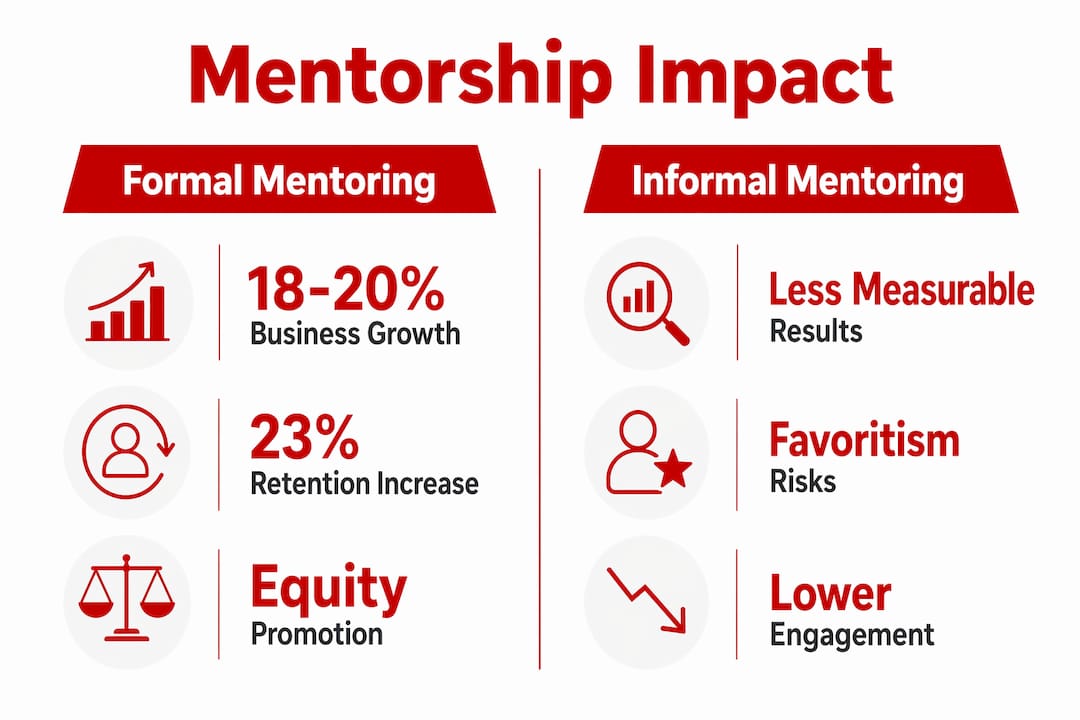
Retention improves too. Organizational mentoring programs increase employee retention by 23% and strengthen internal talent pipelines. Replacing a skilled employee costs a company far more than retaining one through a well-run mentoring relationship.
The critical design principle for any mentoring program is alignment. Research from isEazy confirms that programs must connect to specific strategic goals to generate maximum impact. A mentoring program designed around vague personal development goals produces vague results. One tied to leadership succession, digital capability building, or market expansion produces outcomes you can measure.
Here is how formal and informal mentoring compare across key performance dimensions:
| Dimension | Formal mentoring | Informal mentoring |
|---|---|---|
| Retention impact | 23% increase in employee retention | Variable, depends on relationship quality |
| Productivity gains | Up to 67% improvement reported | Moderate, often inconsistent |
| Strategic alignment | Built into program design | Rarely aligned with business goals |
| Knowledge transfer | Structured and trackable | Organic but hard to scale |
| Access equity | Available to all enrolled employees | Favors well-networked individuals |
Formal programs also create equity. Informal mentoring tends to favor employees who are already well-connected or visible. A structured program gives every participant access to guidance regardless of their existing network.
The benefits flow in both directions. Mentors inside organizations report higher engagement and a stronger sense of purpose. That engagement has real value. A mentor who feels invested in a mentee's growth becomes a more committed employee and a more effective leader.
What types of mentorship exist for entrepreneurs?
Techstars identifies two distinct mentorship types that entrepreneurs need. Understanding both helps you build a mentoring strategy that covers the full range of challenges you will face.
Type I mentoring focuses on human and social capital. This is the mentorship most people picture: an experienced operator who helps you build scale, establish legitimacy, access customers, and raise capital. Mentors providing human capital share expertise, open their networks, and help founders avoid the mistakes they made themselves. This type of mentoring is transactional in the best sense. It delivers concrete tools and connections.
Type II mentoring focuses on psychological and identity support. This is the mentorship that most entrepreneurs undervalue until they desperately need it. Type II mentors help you maintain mental resilience, manage the identity pressure of being a founder, and sustain performance through failure and uncertainty. Techstars research shows that Type II mentoring focused on mental health improves entrepreneurial performance significantly. The reason is simple: a founder who burns out or loses confidence cannot execute on even the best strategy.
The most effective mentoring relationships combine both types. A mentor who only gives business advice leaves you exposed to the psychological weight of entrepreneurship. A mentor who only provides emotional support leaves you without the tactical knowledge to compete.
Practical ways to leverage both mentorship types:
- Seek a Type I mentor with direct experience in your industry or business model.
- Find a Type II mentor who has navigated the personal pressures of building a company, not just the business mechanics.
- Use peer mentoring groups to supplement both types with real-time accountability from people at your same stage.
- Revisit your mentoring mix as your business grows. Early-stage needs differ sharply from growth-stage needs.
Pro Tip: Do not rely on a single mentor to cover every gap. Build a small board of advisors where each person brings a different strength. One mentor for sales, one for operations, one for the mental game. That combination is more powerful than any single relationship.
What strategies maximize the impact of mentorship?
Effective mentorship requires active preparation from the mentee and deliberate design from the organization. Passive participation produces passive results.
For individual entrepreneurs and professionals, the most important habit is preparation. Successful mentorship requires active goal setting, structured preparation before each session, and consistent follow-through on commitments made. Showing up without a clear agenda wastes both parties' time and signals that you are not serious about growth.
When selecting a mentor, Techstars recommends prioritizing mentors who combine relevant expertise with genuine openness and coaching ability. A mentor who is technically brilliant but unwilling to listen or adapt their advice to your specific situation delivers limited value. Look for someone who asks good questions, not just someone who gives good answers.
For organizations, the design principle is integration. Mentoring cannot sit outside the talent management system as a standalone perk. It must connect to promotion criteria, succession planning, and capability goals. That connection is what separates programs that change careers from programs that fill a calendar.
| Context | Best practice | Key outcome |
|---|---|---|
| Individual mentee | Prepare a specific agenda before each session | Focused guidance and faster progress |
| Individual mentee | Set measurable goals with your mentor | Clear accountability and trackable growth |
| Organization | Align program to strategic business goals | Measurable ROI and talent pipeline strength |
| Organization | Match mentors based on expertise and coaching style | Higher engagement and relationship quality |
| Both | Build in regular check-ins and progress reviews | Sustained momentum and early course correction |
Mentorship also works best when both parties treat accountability as non-negotiable. A mentor who never challenges you is a cheerleader, not a guide. A mentee who never follows through on commitments wastes the relationship. The most productive mentoring relationships are honest, direct, and built on mutual respect for each other's time.
For entrepreneurs looking to connect mentorship with business growth, the combination of structured guidance and clear performance metrics creates a feedback loop that compounds over time.
Key Takeaways
Mentorship is the single most reliable accelerator of professional growth, combining experience-based guidance, accountability, and psychological support into one relationship.
| Point | Details |
|---|---|
| Mentored professionals advance faster | Professionals with mentors are promoted five times more often and earn 20% higher salary increases. |
| Formal programs outperform informal ones | Structured mentoring delivers 18–20% higher profit growth and 23% better employee retention. |
| Two mentorship types are both necessary | Type I builds business skills and networks; Type II builds mental resilience and sustained performance. |
| Alignment drives program results | Mentoring programs tied to strategic goals produce measurable outcomes; generic programs do not. |
| Active preparation multiplies value | Mentees who set goals and prepare agendas get significantly more from every mentoring session. |
Why I think most people are using mentorship wrong
Most entrepreneurs treat mentorship as a resource to tap when things go wrong. They reach out when they are stuck, overwhelmed, or facing a crisis. That reactive approach extracts a fraction of what mentorship can deliver.
The entrepreneurs I have seen grow fastest treat their mentors like a board of directors. They show up prepared, they bring real decisions, and they follow through on every commitment they make. They also do not wait for problems. They bring their best opportunities to their mentors and ask hard questions about what could go wrong. That proactive posture changes the entire dynamic.
The other mistake I see constantly is ignoring the psychological side of mentorship. Founders obsess over finding someone with the right network or the right exit history. Those things matter. But the mentor who helps you stay mentally sharp through a brutal quarter is often worth more than the one who introduces you to three investors. Mentorship for startup success requires both dimensions working together.
Organizations make a parallel mistake. They launch mentoring programs as HR initiatives disconnected from actual business strategy. Participation rates look good in a report, but the program changes nothing because it is not tied to anything that matters. The fix is simple: connect every mentoring relationship to a specific business outcome and measure it.
Mentorship is not a luxury for people who have extra time. It is a precision tool for people who want to move faster and make fewer expensive mistakes. Use it that way.
— Mike
Moneyfunnel's mentorship program for entrepreneurs
Moneyfunnel was built around one core belief: the fastest path to online business success runs through structured mentorship, not trial and error.

The 6-Day Money Funnel Mentorship gives entrepreneurs a step-by-step program built on a system that has generated $10 million through a single funnel. The program is designed for people with minimal technical skills who want a proven framework, not a theory. Group mentorship keeps the experience personal and the accountability real. Spots are limited by design, because the program only works when every participant gets genuine attention. If you are ready to apply what you have read here and build with guidance rather than guesswork, see the full program details and find out whether you qualify.
FAQ
What is the role of mentorship in business?
Mentorship in business provides experienced guidance, accountability, and network access that accelerates professional growth and improves decision-making. Mentored professionals are promoted five times more often and report significantly higher revenue growth than those without mentors.
How does mentorship help entrepreneurs specifically?
Mentors help entrepreneurs compress their learning curves, navigate crises using pattern recognition, and maintain the mental resilience needed to sustain performance. Techstars research identifies both business skill development and psychological support as critical components of effective entrepreneurial mentoring.
What is the difference between Type I and Type II mentoring?
Type I mentoring builds human and social capital, including expertise, networks, and business strategy. Type II mentoring focuses on psychological support and identity resilience, which Techstars research shows significantly improves long-term entrepreneurial performance.
Do formal mentoring programs outperform informal ones?
Formal programs consistently outperform informal mentoring on measurable outcomes. Companies with structured programs report 18–20% higher profit growth, 67% increased productivity, and 23% better employee retention compared to organizations without formal programs.
How should a mentee prepare for a mentoring session?
Bring a specific problem, a decision in progress, or a measurable goal to every session. Research from Invention to Venture confirms that active preparation, clear goal setting, and consistent follow-through are the three habits that separate high-growth mentees from those who plateau.