
A proven sales funnel strategy is a structured path that moves prospects from first awareness of your brand through purchase and into long-term retention. In the industry, this framework is also called a "conversion funnel" or "purchase funnel," and the terminology matters because it signals that every stage has one job: advance the prospect forward. Entrepreneurs who build funnels with clear stage logic, matched messaging, and tracked metrics consistently outperform those who rely on ad-hoc outreach. The difference between a struggling business and a profitable one often comes down to whether a real funnel exists at all. Tools like HubSpot CRM, ActiveCampaign, and ClickFunnels give small business owners the infrastructure to build, measure, and improve every stage of this process.
What are the core stages of a high-converting sales funnel?
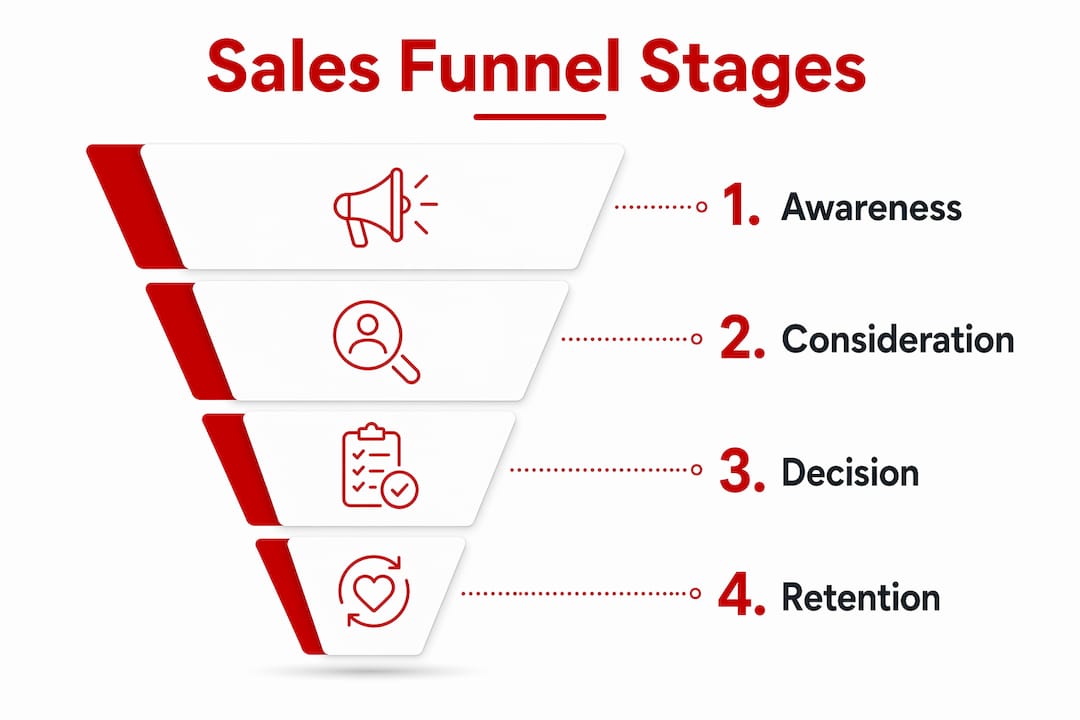
Every high-converting funnel is built on four stages: awareness, consideration, decision, and retention. Each stage reflects a different buyer mindset, and your messaging must match where the prospect actually is, not where you want them to be.

Top of funnel: generating awareness
The top of funnel (TOFU) is where cold audiences first encounter your brand. SEO content, paid ads on Meta and Google, and organic social media posts are the primary traffic drivers here. The goal is volume and relevance. You want the right people entering the funnel, not just any people.
Middle of funnel: building trust
The middle of funnel (MOFU) is where you convert visitors into leads. Lead magnets like free guides, checklists, or mini-courses capture email addresses. Webinars and email sequences then build trust over days or weeks. This is the stage where funnel psychology does the heavy lifting: social proof, authority signals, and consistent value delivery all move prospects closer to a buying decision.
Bottom of funnel: closing the sale
The bottom of funnel (BOFU) is where conversion happens. Free trials, product demos, limited-time offers, and customer testimonials are the most effective tactics here. Prospects at this stage need one final push. Urgency and specificity close more deals than any amount of general persuasion.
Retention: the stage most entrepreneurs skip
Retention is where the real profit lives. Acquiring a new customer costs 5–7 times more than keeping an existing one. That single fact reframes the entire funnel. Loyalty programs, post-purchase email sequences, upsells, and referral incentives all extend customer lifetime value (LTV) without the cost of new acquisition.
Pro Tip: Set up a simple post-purchase email sequence in ActiveCampaign or Klaviyo within your first week. Even three emails covering onboarding, a complementary offer, and a referral ask will outperform doing nothing.
How do you build a sales funnel starting with one ICP?
Starting with one ICP and one funnel goal is the fastest path to real conversion data. Trying to serve multiple audiences from day one creates a funnel that speaks clearly to no one.
Here is a practical sequence to launch your first funnel in 1–2 weeks:
- Define your Ideal Customer Profile. Write down the specific person you are selling to: their job, their problem, their objection, and their desired outcome. Be specific enough that you could describe them to a stranger in two sentences.
- Choose one funnel goal. That goal is either lead capture or direct sale. Do not try to do both with the same funnel at launch.
- Build a lead magnet and landing page. The lead magnet solves one specific problem for your ICP. Landing page opt-in rates range from 20–40% for cold traffic and 40–60% for warm traffic in healthy funnels. If your page falls below 20%, the offer or headline needs work.
- Write a nurture email sequence. A five to seven email sequence that delivers value, handles objections, and closes with urgency is the minimum viable version. Include a deadline-driven final email.
- Drive traffic and collect data. Run paid ads or publish SEO content to send targeted traffic. Your first 200–500 visitors will tell you more than any planning session ever could.
The table below shows realistic timelines and what to expect at each phase:
| Phase | Timeline | Primary Goal |
|---|---|---|
| MVP Launch | Week 1–2 | Get traffic and first opt-ins |
| Initial Optimization | Month 1–3 | Improve opt-in and conversion rates |
| Scaling | Month 3–6 | Increase ad spend and traffic volume |
| Full Optimization | Month 6+ | Maximize LTV and add audience segments |
Building a minimum viable funnel takes 1–2 weeks, but reaching a stable, high-converting state requires 3–6 months of active iteration. Set that expectation now so you do not quit at month two when the data is still thin.
Pro Tip: Use a tool like Carrd or Leadpages to build your first landing page. Both have templates optimized for opt-in conversion and require zero coding knowledge.
Which metrics should you track to optimize your funnel?
Tracking the right numbers separates entrepreneurs who grow from those who guess. The metrics below are the non-negotiables for any sales funnel strategy guide worth following.
The average sales funnel converts 3–7% of visitors into customers. Top-performing funnels in SaaS and ecommerce reach 15–35%. That gap is not luck. It is the result of deliberate optimization at every stage.
Here are the core benchmarks to measure against:
- Landing page opt-in rate: Target 20–40% for cold traffic, 40–60% for warm traffic.
- Email open rate: A healthy nurture sequence averages 25–35% open rates. Below 20% signals a subject line or list quality problem.
- Earnings Per Click (EPC): Target $1.00 or more per click on your offer. Below that threshold, either the offer price, the conversion rate, or both need adjustment.
- CAC:LTV ratio: A profitable CAC to LTV ratio is at least 3:1. If you spend $100 to acquire a customer, that customer needs to generate at least $300 in lifetime revenue for the funnel to be sustainable.
The comparison below shows how average funnels stack up against top performers:
| Metric | Average Funnel | Top-Performing Funnel |
|---|---|---|
| Overall conversion rate | 3–7% | 15–35% |
| Landing page opt-in (cold) | Below 20% | 20–40% |
| CAC:LTV ratio | Below 2:1 | 3:1 or higher |
| EPC | Below $0.50 | $1.00 or more |
Funnel leaks are almost always visible in these numbers. If your opt-in rate is strong but your email click-through rate is low, the problem is in your nurture sequence. If clicks are high but sales are low, the offer or the sales page needs work. Track each stage separately and fix one variable at a time.
What are the biggest mistakes that kill funnel growth?
Most funnel failures come from a short list of repeatable mistakes. Recognizing them early saves months of wasted effort.
Stopping the funnel at purchase. This is the most expensive mistake in the list. Retention is where margin lives. Stopping your funnel after the sale means leaving repeat purchases, upsells, and referrals on the table. A simple loyalty email sequence or a post-purchase upsell page costs almost nothing to build and compounds over time.
Targeting too many audiences at once. A funnel built for "anyone who might buy" converts no one well. Focusing on one ICP and one goal first allows faster learning and better refinement before you scale to additional segments.
Misaligned lead qualification. Aligning sales and marketing on lead qualification criteria reduces funnel leaks and improves overall efficiency. When marketing sends unqualified leads into the pipeline, the sales stage wastes time and conversion rates drop across the board.
Skipping the last-call email. Most revenue in nurture sequences occurs in the final 4–24 hours of a campaign. That means the deadline email is often your highest-revenue email. Skipping it because it feels pushy is a direct revenue loss.
Expecting fast results. A funnel is never a set-and-forget system. Sustainable high performance requires 3–6 months of active iteration. Entrepreneurs who quit after four weeks never see the compounding returns that come from consistent optimization.
Pro Tip: Review your funnel metrics every two weeks, not monthly. Shorter review cycles let you catch and fix leaks before they cost you a full month of revenue.
Key takeaways
A proven sales funnel strategy works because it matches the right message to the right buyer at every stage, from cold awareness through post-purchase retention.
| Point | Details |
|---|---|
| Start with one ICP | Build your first funnel for a single audience to collect clean conversion data fast. |
| Track stage-level metrics | Measure opt-in rate, EPC, and CAC:LTV ratio separately to pinpoint where leads drop off. |
| Never skip retention | Post-purchase sequences cost little and generate repeat revenue without new acquisition spend. |
| Use deadline-driven emails | Last-call emails drive the majority of revenue in any nurture sequence. |
| Plan for 3–6 months | Stable, high-converting funnels require months of iteration, not weeks of setup. |
What i have learned from building funnels that actually work
The single biggest mistake I see entrepreneurs make is building a funnel that is too clever before it is proven. They spend weeks designing multi-audience flows, complex automation trees, and elaborate offer stacks before a single real customer has moved through the funnel. The result is a beautiful system that generates no data and no revenue.
What actually works is embarrassingly simple at first. One audience. One offer. One landing page. One email sequence. You run traffic, you watch the numbers, and you fix what is broken. Then you do it again. The compounding effect of small, consistent improvements over six months is what separates a $10,000 funnel from a $1,000,000 one.
Retention is the part I wish someone had told me to prioritize earlier. Acquisition gets all the attention because it feels like growth. But the customers you already have are your most profitable asset. A single well-timed upsell email to an existing buyer outperforms most cold traffic campaigns I have ever run.
The other thing worth saying plainly: patience is a skill. Funnel optimization is not a sprint. The entrepreneurs I have seen build real, durable revenue streams are the ones who stayed in the game long enough to let the data accumulate and the iterations compound. If your funnel is not converting at month two, that is normal. Keep going.
You can explore real funnel examples that show what these principles look like in practice across different business models.
— Mike
Ready to build your funnel the right way?
Understanding the theory behind a high-converting funnel is one thing. Executing it correctly, in the right sequence, with the right offer and messaging, is where most entrepreneurs get stuck. Moneyfunnel's 6-Day Money Funnel Mentorship is a structured program designed to take you from zero to a live, optimized funnel in less than a week. The program covers ICP definition, lead magnet creation, landing page setup, email sequences, and traffic strategy, all with direct mentorship support.
Spots in each cohort are limited to keep the mentorship quality high. If you are serious about building a funnel that generates consistent revenue, this is the fastest path from strategy to results that Moneyfunnel offers.
FAQ
What is a proven sales funnel strategy?
A proven sales funnel strategy is a structured, stage-by-stage system that moves prospects from first awareness through purchase and into retention. It uses matched messaging, lead capture tools, and tracked metrics to convert cold traffic into paying customers.
How long does it take to build a high-converting funnel?
A minimum viable funnel takes 1–2 weeks to launch, but reaching a stable, high-converting state typically requires 3–6 months of active testing and optimization.
What conversion rate should my funnel hit?
The average funnel converts 3–7% of visitors. Top-performing funnels in SaaS and ecommerce reach 15–35%. If your funnel falls below 3%, start by auditing your landing page and lead magnet offer.
Why is the last-call email so important?
The majority of revenue in any nurture sequence is generated in the final 4–24 hours of a campaign. Skipping the deadline-driven email means missing the highest-converting moment in your entire sequence.
What is the right CAC to LTV ratio for a profitable funnel?
A sustainable funnel targets a CAC:LTV ratio of at least 3:1. That means every dollar spent acquiring a customer should return at least three dollars in lifetime revenue.