
A sales funnel is a visual roadmap that guides potential customers through a structured buying journey, from first discovering your brand to taking a specific action like making a purchase or joining your email list. This beginner's guide to sales funnels covers everything you need to launch your first funnel fast, using tools like Systeme.io and ChatGPT to get results without a technical background. The standard industry term is "conversion funnel," though "sales funnel" is the phrase most entrepreneurs use daily. A basic funnel can be built in 2–3 hours, which means you could have something live and generating leads before the end of today.
What is a sales funnel and why does it matter?
A sales funnel is the step-by-step path a stranger takes to become a paying customer. The funnel shape is intentional: many people enter at the top, and fewer convert at the bottom. That narrowing is not a flaw. It is the mechanism that lets you identify exactly where people drop off and fix it.
Nearly 96% of website visitors are not ready to buy the moment they land on your page. That single fact explains why a funnel exists. Without one, you are sending traffic to a page and hoping for the best. With one, you capture interest, build trust, and guide people toward a decision over time.

A funnel also separates your business from a generic website. Websites serve multi-purpose roles, while funnels have a singular focus: guiding each visitor toward one specific action. That focus reduces friction and increases the chance someone actually does what you want them to do.
What are the core sales funnel stages?
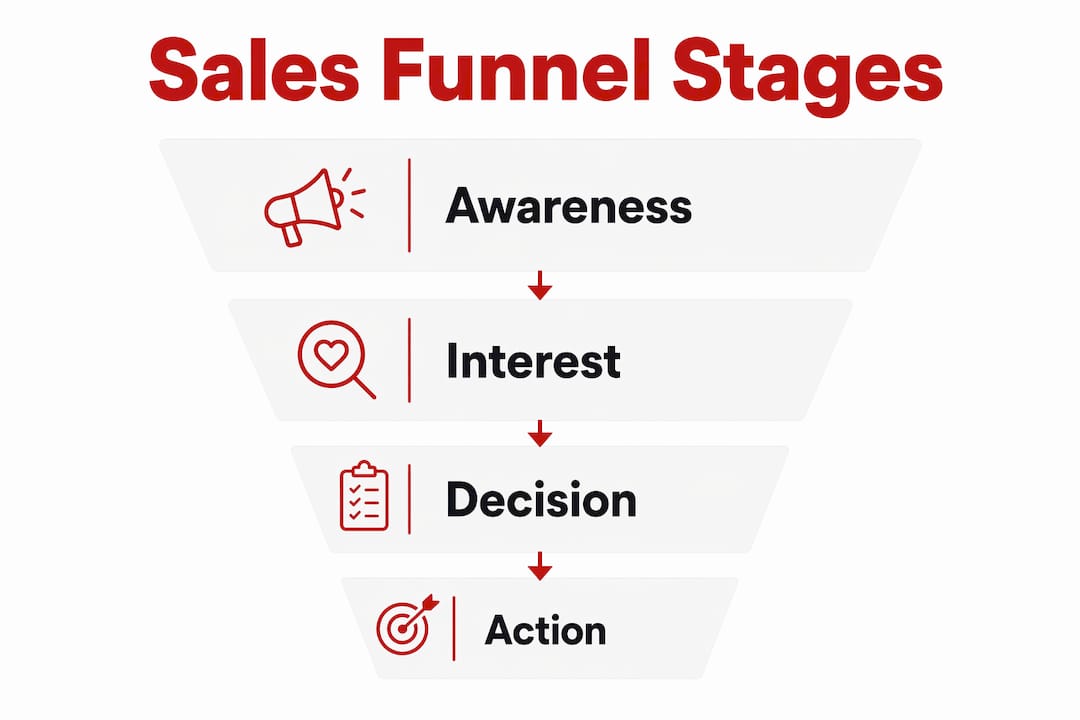
The AIDA model is the most widely used funnel structure in 2026. It stands for Awareness, Interest, Decision, and Action. Each stage requires a different type of content and a different goal.
Awareness is where people first find you, typically through SEO, social media, or paid ads. Interest is where they engage with your content, download a lead magnet, or join your email list. Decision is where they evaluate your offer, read testimonials, or watch a demo. Action is the conversion: a purchase, a sign-up, or a booked call.
It is worth knowing the difference between a sales funnel and a marketing funnel before you build. Marketing funnels focus on brand awareness and acquisition, while sales funnels focus specifically on the evaluation and purchase stages. Beginners often confuse the two, which leads to building the wrong type of content for the wrong stage.
Here is a quick comparison of the three most common funnel models:
| Model | Stages | Best For |
|---|---|---|
| AIDA | Awareness, Interest, Decision, Action | Most online businesses |
| Traditional 3-Stage | Top, Middle, Bottom of Funnel | Content marketing teams |
| Flywheel | Attract, Engage, Delight | Subscription and community businesses |
The Flywheel model, popularized by HubSpot, treats satisfied customers as promoters who fuel new growth. It supplements the linear funnel rather than replacing it, and it is worth understanding as your business matures.
For a deeper breakdown of each stage, the sales funnel stages guide at Moneyfunnel walks through each one with entrepreneur-specific examples.
What tools do you need to build your first funnel?
Three core components make up a beginner funnel: a landing page builder, an email marketing tool, and a lead magnet. You do not need a full website, a developer, or a large budget to get started.
Systeme.io is the most beginner-friendly all-in-one platform for building funnels. It includes a landing page builder, email automation, and a free plan that covers everything you need for your first funnel. ChatGPT cuts lead magnet creation time dramatically. Creating a focused lead magnet takes about 30–60 minutes when you use AI to draft the content. That is the critical entry point for capturing prospect interest.
Here is a practical overview of the tools, their functions, and realistic time investments:
| Tool | Function | Time to Set Up |
|---|---|---|
| Systeme.io | Landing page and email automation | 30–45 minutes |
| ChatGPT | Lead magnet content creation | 30–60 minutes |
| Google Docs | Formatting and finalizing lead magnet | 15–20 minutes |
| Canva | Designing opt-in page graphics | 20–30 minutes |
Every funnel page must have a single goal. An opt-in page asks for an email address. A sales page asks for a purchase. Mixing those goals on one page kills conversions. Keep each page focused on one action and one action only.
Pro Tip: Before you build anything, write one sentence describing exactly what your visitor should do on each page. If you cannot write that sentence clearly, the page is not ready to build.
For a full breakdown of the fast funnel setup process, Moneyfunnel covers why speed matters for beginners who want to learn by doing.
How do you create a sales funnel step by step?
Building your first funnel follows a clear sequence. Each step has a defined output and a realistic time estimate so you know exactly where you stand.
-
Create your lead magnet (30–60 minutes). This is a free resource you offer in exchange for an email address. Use ChatGPT to draft a short PDF guide, checklist, or mini-course on a problem your audience faces. Keep it focused and immediately useful.
-
Build your opt-in page (30–45 minutes). Use Systeme.io to create a single-page site with a headline, a brief description of your lead magnet, and an email capture form. Remove all navigation links. The only exit should be the opt-in form.
-
Write your welcome email sequence (30 minutes). Write three to five emails that deliver the lead magnet, introduce yourself, and point toward your paid offer. The first email goes out immediately. The rest follow over three to five days.
-
Add your opt-in link everywhere (15 minutes). Place the link in your social media bio, your content, and any ads you run. Traffic without a destination is wasted.
-
Test and measure (ongoing). Check your opt-in rate and email open rates after the first 50 visitors. These two metrics are the primary indicators of whether your funnel is working at the top and middle stages.
A healthy opt-in rate for a cold audience sits between 20% and 40%. If yours is below 15%, the problem is usually the headline on your opt-in page or the perceived value of your lead magnet. Fix one variable at a time so you know what actually moved the number.
Pro Tip: Run your first funnel for at least two weeks before making major changes. Small sample sizes produce misleading data. Patience here saves you from fixing things that are not broken.
The steps to create funnels guide at Moneyfunnel gives you a fast-track walkthrough if you want a visual reference alongside these steps.
What are the most common beginner funnel mistakes?
The biggest mistake beginners make is overcomplicating their first funnel. A funnel with an opt-in page, lead magnet, and welcome sequence is sufficient for an initial launch. Adding upsells, downsells, webinars, and retargeting before you have proven the core offer wastes time and creates confusion.
The second most common mistake is treating a funnel like a website. A website is designed for exploration. A funnel is designed for conversion. When you add a navigation menu, a blog link, and a contact page to your opt-in page, you give visitors a reason to leave without opting in.
Watch for these signs that your funnel is underperforming:
- Opt-in rate below 15% after 100 visitors: rewrite the headline and test a stronger value proposition.
- Email open rate below 20%: test a more specific subject line or send at a different time of day.
- High opt-in rate but zero sales: the gap between your free offer and your paid offer is too large. Add a bridge email that explains the next step.
- No traffic at all: the funnel itself is not the problem. Focus on your traffic source first.
A sales funnel visually maps drop-off points so you can fix them with data rather than guesswork. That is the real power of building one. Without a funnel, you cannot see where people leave. With one, every problem has a location.
"The funnel is not the destination. It is the diagnostic tool that tells you where your business needs work."
Why simple funnels win more than complex ones
I have seen hundreds of beginners spend three weeks building a funnel with seven steps, two upsells, a webinar, and a retargeting sequence. Almost none of them launched. The ones who launched a simple opt-in page and a three-email welcome sequence in a single afternoon? They had data, leads, and confidence within 48 hours.
The conventional wisdom in online marketing pushes complexity. More steps, more automation, more touchpoints. My experience says the opposite is true for anyone starting out. A simple funnel teaches you more in two weeks than a complex one teaches you in six months, because simple funnels actually get launched.
Evolving models like the Flywheel show that the best long-term growth comes from happy customers who refer others. You cannot get there without first converting your first customer. That first conversion almost always comes from the simplest possible funnel.
The other thing I have learned is that understanding your customer's behavior matters more than any tool or template. Watch where people drop off. Read the replies to your welcome emails. Talk to the people who did not buy. That feedback loop is worth more than any advanced automation you could build.
Start with one funnel. Get it working. Then build the next one with everything you learned from the first.
— Mike
Ready to build your first funnel with expert guidance?
Understanding the theory behind sales funnels is one thing. Building one that actually converts is another. Moneyfunnel's 6-Day Money Funnel Mentorship is designed specifically for beginners who want to move from concept to a live, working funnel in less than a week.
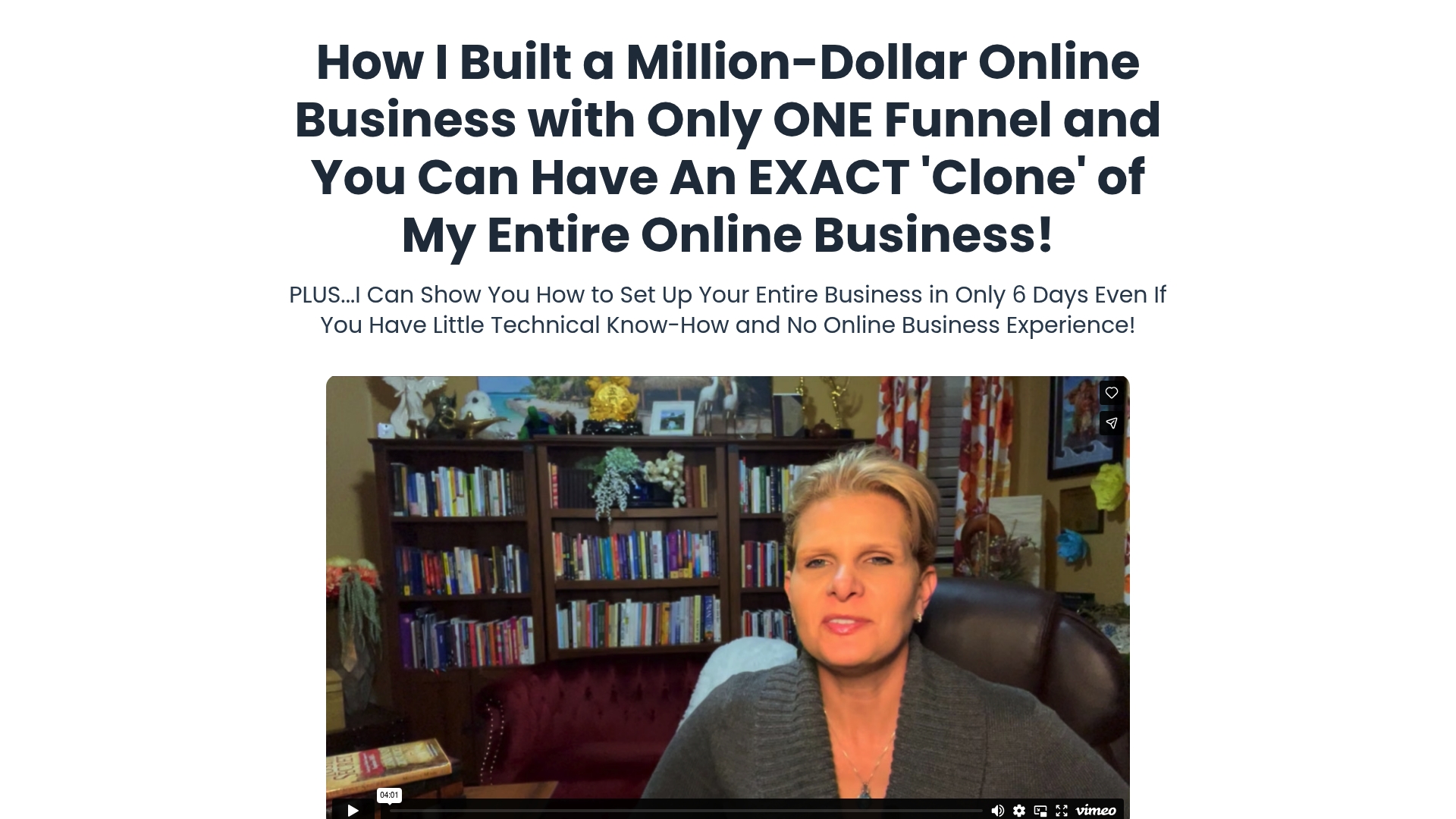
The program walks you through hands-on funnel creation with group mentorship, so you are never stuck trying to figure things out alone. It is built for people with minimal technical skills who want faster results without the trial-and-error that slows most beginners down. If you are serious about building an online business, this is the most direct path from zero to a functioning funnel. Spots are limited, so check availability at Moneyfunnel today.
Key takeaways
A sales funnel works because it replaces guesswork with a structured, measurable path that guides visitors from first contact to conversion.
| Point | Details |
|---|---|
| Start with AIDA | Use the four-stage Awareness, Interest, Decision, Action model as your funnel blueprint. |
| One goal per page | Every funnel page must ask for one action only to reduce friction and lift conversions. |
| Build in 2–3 hours | A lead magnet, opt-in page, and welcome email sequence is all you need to launch. |
| Measure opt-in and open rates | Track these two metrics first before adding any advanced conversion tracking. |
| Keep it simple | Overcomplicating your first funnel is the leading reason beginners never launch. |
FAQ
What is a sales funnel in simple terms?
A sales funnel is a step-by-step process that guides a potential customer from first hearing about your business to taking a specific action, like buying a product or joining your email list.
How long does it take to build a beginner sales funnel?
A basic funnel with a landing page and welcome email sequence takes 2–3 hours to build. Tools like Systeme.io and ChatGPT reduce that time significantly for beginners.
What is the difference between a sales funnel and a marketing funnel?
Marketing funnels focus on awareness and acquisition, while sales funnels focus on the evaluation and purchase stages. Both work together but serve different parts of the customer journey.
What metrics should beginners track in a sales funnel?
Start with opt-in rate and email open rate. These two numbers tell you whether your funnel is capturing interest and building enough trust to keep people engaged.
Do i need a website to build a sales funnel?
No. A sales funnel is not a website. You only need a single opt-in page and an email tool like Systeme.io to launch your first funnel without any additional web presence.