
Income diversification is the practice of building multiple, uncorrelated revenue sources so that no single failure can derail your financial life. Most people rely entirely on one paycheck, which means one layoff, one health crisis, or one economic downturn can erase their financial stability overnight. The question of why diversify income streams is not academic. It is a practical survival strategy that also accelerates wealth building. A household earning $65,000 can create a 20% financial buffer with just $13,000 in secondary income. That buffer is the difference between a setback and a catastrophe.
Why diversify income streams: the core case
The strongest argument for multiple income sources is risk reduction. When your only income disappears, you have no runway to make good decisions. You take the first job offered, sell assets at the wrong time, or go into debt. A second income stream buys you time and choices.

Multiple income streams provide what financial planners call "optionality." That means the freedom to negotiate a better salary, walk away from a toxic job, or pivot careers without financial panic. Optionality is not a luxury. It is a structural advantage that changes how you make every major life decision.
The wealth-building case is equally strong. A second or third income stream compounds over time. Reinvested dividends, growing freelance client bases, and digital products that sell while you sleep all add to your net worth faster than a single salary ever could.
"Income diversification is not about having more jobs. It is about building independent revenue sources that do not all fail at the same time." — Katharine Gallagher, income strategy framework
What the data says about stream counts
The average millionaire has about three solid income streams, typically including investment income. This fact dismantles the popular myth that wealthy people manage seven or more streams simultaneously. Three well-managed, uncorrelated streams outperform seven poorly managed ones every time.
Financial educators consistently recommend 3 to 5 well-managed streams as the target for meaningful stability. The emphasis is on quality and sustainability, not raw numbers.
What are the main benefits of income diversification?
The benefits of income diversification go beyond a safety net. They reshape your entire financial position.
- Risk reduction. Losing one income source hurts but does not destroy you. Your other streams cover essentials while you recover.
- Negotiating power. When you do not desperately need a job, you negotiate from strength. Employers sense financial desperation and use it against you.
- Faster wealth accumulation. Each additional income stream adds to your investable surplus. That surplus compounds through dividend investing, index funds, or real estate.
- Career flexibility. A stable secondary income gives you the runway to retrain, launch a business, or take a lower-paying role that builds toward something bigger.
- Psychological resilience. Financial stress is one of the leading causes of anxiety and relationship breakdown. Multiple income sources reduce that stress measurably.
The financial optionality that comes from diversified income is not just about money. It is about confidence. People with multiple income sources make bolder career moves, invest more aggressively, and recover from setbacks faster than those locked into a single paycheck.
How do you diversify income streams effectively?
True income diversification requires more than just adding revenue sources. It requires that those sources fail independently of each other.
The hidden trap: correlated income streams
Diversifying within the same dependency is the most common and most dangerous mistake. Five income streams that all depend on one employer, one platform, or one industry are not diversified. They are a concentrated risk wearing a disguise. A freelance writer who earns from five different clients, all in the same tech sector, faces the same wipeout risk when that sector contracts.
True diversification maps each income source against its failure triggers. A salaried job fails when your employer cuts headcount. Dividend income fails when companies cut payouts during recessions. Rental income fails when tenants default or vacancy rises. These are different triggers. That independence is what makes the combination genuinely protective.
Quality vs. quantity: the right number of streams
| Approach | Stream count | Risk level | Sustainability |
|---|---|---|---|
| Single income | 1 | Very high | Fragile |
| Correlated multiples | 3–5 (same sector) | High | False security |
| True diversification | 3–5 (independent) | Low to moderate | Strong |
| Overextended | 7+ (poorly managed) | Moderate to high | Burnout risk |
The table above shows why the goal is not more streams. It is better streams. Three independent, well-managed sources beat seven overlapping ones every time.
Pro Tip: Build one stable secondary stream to consistent income before adding a third. Spreading effort across too many streams too early is the fastest path to earning nothing from any of them.
What are the practical ways to build multiple income streams?
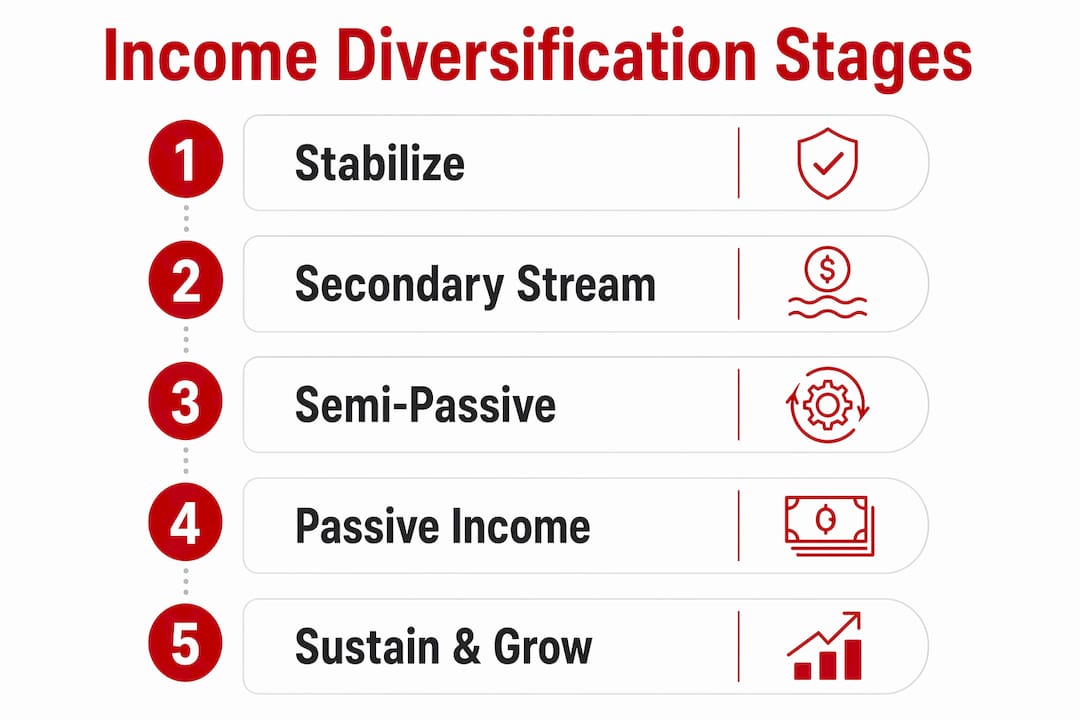
Building a diversified income portfolio follows a clear sequence. Skipping steps is the most common reason people fail.
Stage 1: Stabilize your primary income
Your day job or primary business is the foundation. Before adding anything else, make sure it is stable and not consuming every hour you have. A shaky primary income makes everything else harder to build.
Stage 2: Build one active secondary stream
Beginners should focus on one marketable skill that generates $500 to $1,000 per month before adding more streams. This milestone proves you can earn outside your primary job and builds the discipline needed for everything that follows. Freelancing, consulting, tutoring, and service-based side work are the fastest paths to this milestone because they require skill, not capital.
Practical options at this stage include:
- Freelance writing, design, or coding on platforms like Upwork or Fiverr
- Consulting in your professional field on a project basis
- Teaching a skill through platforms like Teachable or Udemy
- Selling a digital product such as templates, guides, or courses
Stage 3: Transition toward semi-passive income
Early-stage diversification requires active work. Later stages involve having your money or systems work for you. This transition is not instant. It takes months or years of reinvestment and system building.
Semi-passive options include affiliate marketing, where you earn commissions from content you create once and publish permanently. Dividend investing through index funds or individual stocks also fits here. Rental income from a single property is another proven path, though it requires upfront capital and ongoing management.
Pro Tip: Affiliate marketing is one of the most accessible semi-passive streams for beginners. Learn affiliate income strategies before assuming it is easy. The learning curve is real, but the ceiling is high.
Stage 4: Add passive income streams
Passive income streams require significant upfront capital or labor before they generate returns. A rental property requires a down payment. A digital course requires weeks of creation. An index fund portfolio requires years of contributions. Anyone promising overnight passive income is selling a fantasy.
The honest path is this: active work now funds passive income later. Treat passive income as the destination, not the starting point.
How to sustain and grow income streams long-term
Sustaining multiple income streams is harder than building them. Most people who fail at income diversification do not fail at the start. They fail at month six or year two, when the novelty wears off and the grind sets in.
Consistency compounds. A freelance client base built over three years is worth far more than one built in three months and abandoned. Dividend portfolios that are fed monthly for a decade generate returns that dwarf those funded sporadically.
Managing burnout is the real challenge. The solution is not to push harder. It is to stabilize one stream before adding another. People who launch three streams simultaneously almost always end up with three struggling streams instead of one solid one.
Reinvesting early income is what separates people who build lasting wealth from those who earn a little extra and spend it. Every dollar from a secondary stream that goes back into building that stream or funding a new one accelerates the compounding effect.
Realistic expectations matter. Most income streams take 6 to 18 months to become consistent. The people who succeed are not the ones with the best ideas. They are the ones who stay consistent long enough for the compounding to kick in.
Pro Tip: Ignore income hype that promises results in days or weeks. The real metric is whether your secondary income is growing month over month, even slowly. Slow, consistent growth beats fast, erratic growth every time.
Key Takeaways
Income diversification works because independent, uncorrelated streams protect your finances when any single source fails, while compounding your wealth over time.
| Point | Details |
|---|---|
| Start with one secondary stream | Build one source to $500–$1,000/month before adding others to avoid burnout. |
| Prioritize independence | Choose streams with different failure triggers so one crisis does not wipe out all income. |
| Target 3 to 5 streams | The average millionaire holds about three solid streams; quality beats quantity every time. |
| Sequence active to passive | Begin with active income, then reinvest to build semi-passive and passive streams over time. |
| Expect a long runway | Most income streams take 6 to 18 months to become consistent; patience is the real strategy. |
What I have learned about building income streams that actually last
Most people approach income diversification the wrong way. They read about seven streams of income and immediately try to build all seven at once. I have watched this pattern play out repeatedly. The result is always the same: six months of scattered effort, nothing meaningful to show for it, and a return to total reliance on one paycheck.
The insight that changed my thinking came from mapping income streams against their failure triggers. I realized that two of my income sources were both dependent on the same platform's algorithm. One algorithm update could have cut both simultaneously. That is not diversification. That is a single point of failure with extra steps.
The discipline that actually works is boring. Stabilize your primary income. Build one secondary stream to something consistent. Then, and only then, add another. The compounding effect of doing this patiently over three to five years is genuinely life-changing. Not because any single stream is spectacular, but because the combination becomes resilient in a way that no single income source ever can be.
The biggest mindset shift is accepting that income optionality is the goal, not income maximization. When you have three independent streams, you make every career and financial decision from a position of strength. That freedom is worth more than any single high-paying job.
— Mike
Moneyfunnel's structured path to building diversified income
Building multiple income streams is straightforward in theory and genuinely hard in practice. The sequencing, the skill-building, and the patience required are things most people figure out through expensive trial and error.

Moneyfunnel's 6-Day Money Funnel Mentorship gives you a structured, step-by-step framework to build your first serious online income stream without needing technical expertise or a large upfront investment. The program is built around a proven sales funnel system and includes group mentorship so you are not figuring it out alone. If you are ready to move from theory to a working income stream, this is a practical place to start building.
FAQ
Why should you diversify your income streams?
Diversifying income streams protects you from total financial loss if your primary income disappears. It also builds wealth faster by compounding multiple revenue sources simultaneously.
How many income streams should you have?
Financial educators recommend 3 to 5 well-managed, uncorrelated streams. The average millionaire holds about three solid income streams, typically including investment income.
What is the biggest mistake in income diversification?
The biggest mistake is diversifying within the same dependency, such as five freelance clients all in one industry. Real diversification requires streams with independent failure triggers.
Is passive income really passive?
Passive income streams almost always require significant upfront labor or capital before they generate returns. Realistic expectations are critical. Treat passive income as a long-term outcome, not a starting point.
How long does it take to build a reliable secondary income stream?
Most secondary income streams take 6 to 18 months to become consistent. Beginners should target $500 to $1,000 per month from one stream before adding others.