
Business scalability is the capacity of a company to grow revenue and handle increasing demand without a proportional rise in costs or drop in quality. The business scalability definition, as recognized by Investopedia, centers on growing revenue while keeping overhead relatively flat, unlike standard linear growth where costs climb in step with sales. For aspiring entrepreneurs and small business owners, understanding this distinction is the foundation of every smart growth decision. A business that scales well earns more without spending proportionally more. That is the core promise of a scalable business model.
What is business scalability and why does it matter?
Business scalability means your revenue can multiply while your operational costs stay stable or grow only slightly. A software company that sells 10,000 subscriptions uses nearly the same infrastructure as one selling 100. A freelance consultant who doubles clients must also double hours. The first model scales. The second does not.
The difference matters enormously for long-term profitability. The top 5% of highly scalable companies achieve returns to scale roughly 10 points higher than smaller peers, generating 7% more output for the same increase in input. That gap compounds over years into a massive competitive advantage.

Scalability is not just a tech industry concept. Any business, from an online course creator to a regional logistics firm, can build scalable systems. The key is designing your operations so that growth does not require you to hire, spend, or build in direct proportion to every new dollar earned.
How can you determine if your business is ready to scale?
Scaling before your business is ready is one of the most common and costly mistakes entrepreneurs make. Businesses that scale too early often face cash flow problems and degrade customer service quality. Readiness is not about ambition. It is about evidence.
The clearest readiness signals include:
- Consistent revenue growth for 6–12 months. One strong quarter is not enough. You need a predictable pattern that shows your model works repeatedly.
- Leads outpacing your capacity. When you are turning away customers or fulfilling orders late, demand has outgrown your current structure.
- Stable, documented processes. If your team relies on tribal knowledge rather than written procedures, scaling will multiply the chaos.
- Healthy unit economics. Your customer acquisition cost (CAC) must be significantly lower than your customer lifetime value (LTV). If CAC is rising while revenue grows, you are not scaling effectively.
- Positive cash flow or secured funding. Scaling requires capital. Attempting it while cash-strapped accelerates failure.
Operational warning signs matter just as much as financial ones. Overwhelmed employees, rising error rates, and inconsistent customer experiences all signal that your current systems cannot handle more volume. Fixing those problems before scaling is not optional.
Pro Tip: Build a simple one-page dashboard tracking CAC, LTV, monthly recurring revenue, and customer churn before you make any scaling decision. Numbers tell you what gut feelings cannot.
What distinguishes scaling from ordinary business growth?
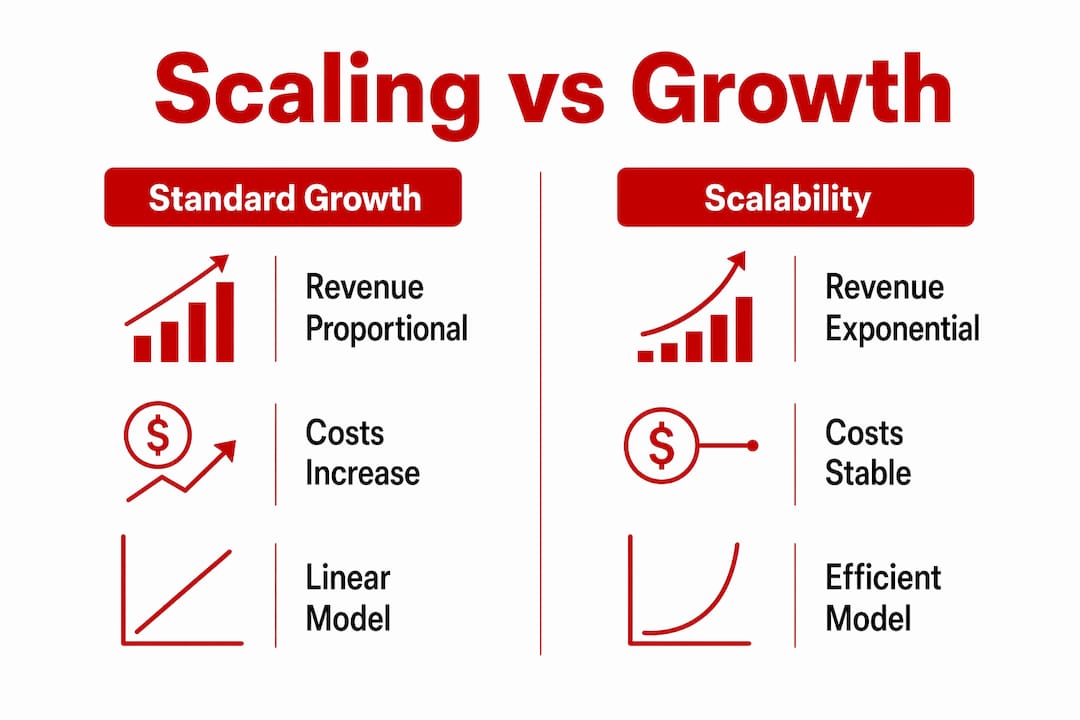
Growth and scaling are not the same thing. Confusing the two traps entrepreneurs in resource-intensive models that never become truly profitable.
| Factor | Standard growth | Scaling |
|---|---|---|
| Revenue increase | Proportional to cost increase | Exponential relative to cost |
| Hiring pattern | Adds headcount with every revenue jump | Adds headcount selectively |
| Cost structure | Costs rise in step with output | Costs stay relatively flat |
| Technology role | Supports existing work | Replaces or multiplies human effort |
| Profit margin over time | Stays flat or compresses | Expands as volume grows |
Standard growth is linear. You earn more, but you also spend more on staff, supplies, and overhead. Scaling is exponential. Automation, standard operating procedures (SOPs), and technology keep costs stable while revenue climbs.
A brick-and-mortar restaurant is a classic non-scalable model. Serving 200 customers instead of 100 requires more cooks, more tables, more servers, and more space. An online cooking course, by contrast, sells to 200 or 20,000 students from the same recorded content. The cost of delivery barely changes.
The practical implication is clear. Before you plan how to scale a business, audit your model. Ask whether each new customer requires proportionally more of your time, money, or staff. If the answer is yes, you have a growth model, not a scaling model. Redesigning the delivery mechanism, through automation, digital products, or licensed systems, is what converts growth into scaling.
Pro Tip: Map your top three revenue streams and ask: "If demand doubled tomorrow, what would break?" The answer tells you exactly where to build before you scale.
What strategies and structures support effective business scalability?
Building a business that scales requires deliberate infrastructure decisions made before demand spikes, not after.
Technology and systems
Cloud-based technology and integrated CRM and accounting systems prevent the capacity bottlenecks that kill scaling attempts. Tools like cloud-based CRM platforms, automated email sequences, and digital payment processors handle volume increases without adding headcount. Choosing flexible, integrated software early prevents expensive migrations later.
SOPs and automated workflows
SOPs and automated workflows must be in place before accelerated growth begins. Trying to document processes after demand surges is like changing tires while driving at 70 mph. Write your procedures when things are calm. Automate repetitive tasks like invoicing, onboarding, and customer follow-up before you need to. You can learn more about building efficient workflows that support this kind of growth.
Financial planning
A scalable business model requires financial discipline from day one. The steps below form a practical financial foundation:
- Calculate your CAC and LTV monthly. A rising CAC signals your growth engine is losing efficiency.
- Identify your break-even point at 2x and 5x current volume. Know what scaling actually costs before committing.
- Align funding sources with your timeline. Bootstrapping suits slow, deep scaling. Venture capital suits blitzscaling, but demands rapid growth in return.
- Build a cash reserve before scaling. Three to six months of operating expenses provides a buffer against the inevitable surprises.
- Review unit economics quarterly. The CAC to LTV ratio is the real-time barometer of whether your scaling is working.
Staffing and supply chain
Hire for flexibility, not just current need. Fractional executives, contractors, and outsourced specialists let you add capacity without permanent overhead. On the supply side, negotiate volume-based pricing agreements before you need them. Waiting until demand spikes gives you no negotiating power.
Pro Tip: Automating your business before scaling is not a luxury. It is the single highest-return investment you can make before growth accelerates.
What are the key benefits and challenges of building a scalable business?
The benefits of scalability are concrete and measurable. The challenges are equally real and often underestimated.
Benefits
- Higher profit margins over time. Economies of scale reduce unit production costs as volume grows, meaning each additional sale becomes more profitable than the last.
- Competitive advantage. Scalable firms outpace competitors who are stuck in linear cost structures. They can price more aggressively, invest more in marketing, and absorb market shocks more easily.
- Market adaptability. A business built on flexible systems can pivot faster. When demand shifts, scalable operations adjust without rebuilding from scratch.
- Investor attractiveness. Scalable models attract funding because investors see a clear path to exponential returns without proportional cost growth.
Challenges
Scaling is not without serious risk. Cash flow instability is the most common failure point. Revenue may grow faster than collections, leaving you short on operating capital at exactly the wrong moment.
Operational quality often suffers during rapid expansion. Customer service response times slow, error rates climb, and the brand reputation built during the early phase erodes. Scaling too fast without solid systems causes long-term damage that is far harder to repair than the short-term revenue gain is worth.
"Successful scaling prioritizes 'scaling slow and deep' to build customer loyalty and stable operations rather than rapid blitzscaling."
Complexity also increases. More customers, more staff, more systems, and more data all require better management. Entrepreneurs who thrive in the scrappy startup phase sometimes struggle with the discipline required to manage a scaled operation. Recognizing that gap early and hiring for it is a sign of maturity, not weakness.
Key Takeaways
A scalable business model grows revenue exponentially while keeping operational costs relatively stable, and the foundation must be built before demand arrives, not after.
| Point | Details |
|---|---|
| Core definition | Scalability means revenue grows faster than costs, unlike standard linear growth. |
| Readiness signals | Look for 6–12 months of consistent revenue, healthy CAC/LTV, and documented processes. |
| Growth vs. scaling | Growth adds costs proportionally; scaling uses automation and SOPs to keep costs flat. |
| Build systems first | SOPs, automated workflows, and technology must be in place before demand spikes. |
| Monitor unit economics | Track CAC and LTV monthly; a rising CAC signals your scaling strategy is failing. |
Why most entrepreneurs scale in the wrong order
The most common mistake I see is entrepreneurs treating scaling as a reward for early success. They hit a good quarter, feel the momentum, and immediately hire more people, spend more on ads, and push for faster growth. Then six months later they are drowning in complexity, cash is tight, and the quality that earned them those early customers has slipped.
Scaling is not a reward. It is a preparation. The businesses that scale well spend months, sometimes years, building the systems, workflows, and financial discipline that make growth sustainable. They are boring in the best possible way. Their operations are documented. Their unit economics are tracked weekly. Their technology handles volume without breaking.
The entrepreneurs I respect most are the ones who resist the urge to scale fast and instead ask: "Can my systems handle 10x volume without me personally holding everything together?" If the answer is no, they fix that first. That patience is not timidity. It is the most aggressive long-term growth strategy available. You can find practical growth tips for entrepreneurs that reinforce this exact approach.
Scalability is not a one-time achievement. It is an ongoing upgrade of your infrastructure, your thinking, and your team. The entrepreneurs who treat it that way are the ones still standing, and thriving, five years later.
— Mike
Moneyfunnel's mentorship for building scalable businesses
Building a scalable business requires more than good intentions. It requires a proven system, clear metrics, and someone who has already done it showing you the path.

The 6-Day Moneyfunnel Mentorship is a hands-on program built specifically for entrepreneurs who want to build scalable online business models from the ground up. The program covers system building, workflow efficiency, and the growth techniques that support real, sustainable expansion. It is designed for people who want a structured, step-by-step approach without needing advanced technical skills. Spots are limited, and the program is built around group mentorship for direct, practical guidance.
FAQ
What is the business scalability definition?
Business scalability is the ability of a company to increase revenue and output without a proportional increase in costs or resources. A scalable business model grows more profitable as volume increases, not less.
How do I know when my business is ready to scale?
The clearest signal is 6–12 months of consistent, predictable revenue growth where demand already outpaces your current capacity. Stable processes, healthy unit economics, and positive cash flow must also be in place before scaling begins.
What does scalability mean for a small business owner?
For a small business owner, scalability means designing operations so that serving more customers does not require proportionally more time, money, or staff. It is the difference between a business that grows and one that multiplies.
What is the biggest risk of scaling too fast?
Scaling too fast without solid systems causes cash flow instability and degrades customer experience. The short-term revenue gain rarely offsets the long-term brand and operational damage.
How does automation support a scalable business model?
Automation handles repetitive tasks like invoicing, customer onboarding, and follow-up without adding headcount. It keeps operational costs flat as volume grows, which is the defining characteristic of true scalability.